No single part of a cat answers the question by itself. What the tail, ears, and eyes mean is a sentence, not three separate words, so the working method is to read the whole silhouette first, then the ears, then the eyes, and take the tail last as punctuation. A tail held high with the ears rotated back and the pupils wide describes a different animal from the same tail with soft ears and half-closed eyes. Pick one signal and you will call a scared cat aggressive and a playing cat furious.
The lamp is on your left. Past the edge of the rug the room goes dim, the refrigerator clicks off somewhere behind you, and the cat has stopped maybe two feet from your knee, close enough that you can hear it swallow. Your hand is flat on the floor. You want to reach out.
Wait three seconds instead. That is the whole technique, and it is harder than it sounds, because everything in you wants to answer the tail.
Start with the shape
Before you look at any one part, look at what the cat is doing with its weight. Is it tall and square over its feet, or low and long, like it is trying to take up less room than it actually does? Is the chest pointed at you, or is the body angled away while the head stays turned in your direction? That last one matters more than most people realize. A cat that wants interaction usually commits its body to it. A cat that is interested but not committed keeps an exit open, and an exit kept open is information.
I also watch the breathing, because it is the easiest thing to fake and the hardest thing to hide. Ribs you can see moving from across the rug means the cat is more activated than its face is letting on. A cat at rest breathes in a way you have to look for.
Then the small stuff, in this order.
Ears, eyes, whiskers: three fast dials
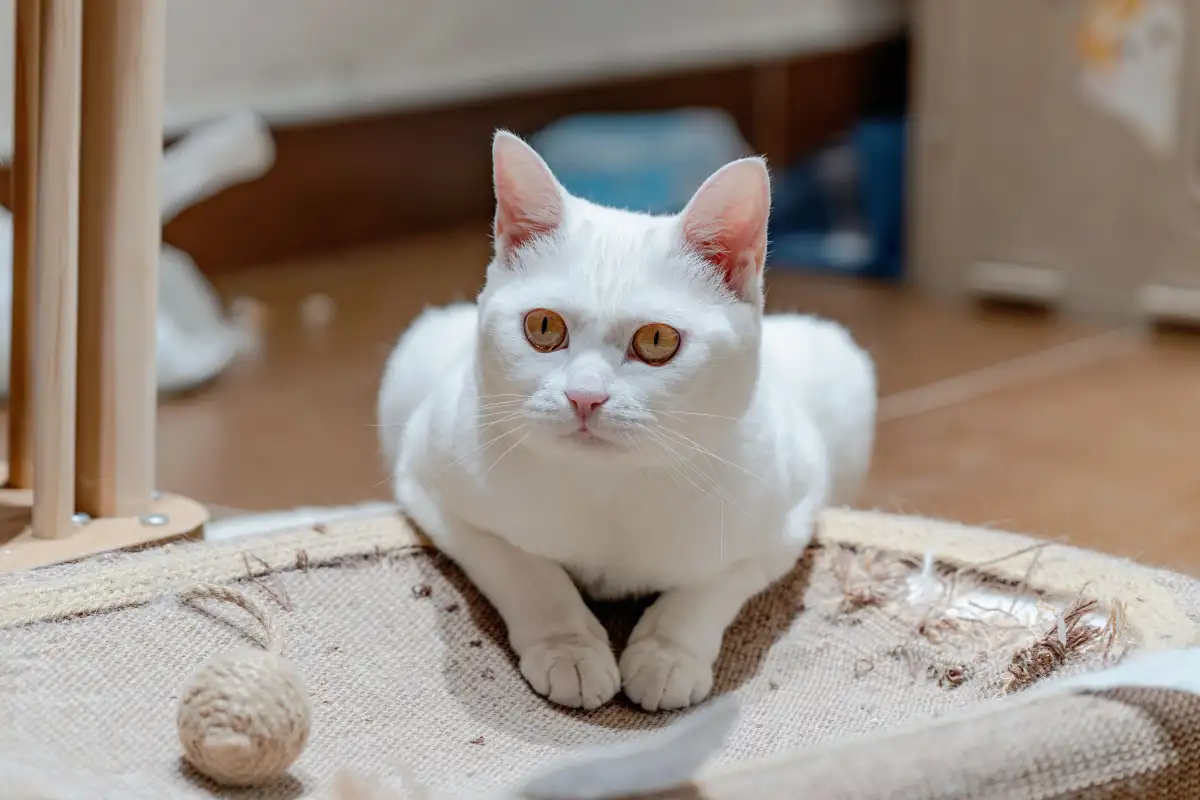
Ears move first and move fastest, which makes them the earliest warning system on the animal. Forward and slightly out is a cat taking in the room. Forward and pinched together is a cat locked onto something. Rotated out to the sides, the position people call airplane ears, is usually a cat in a decision it does not like, weighing a retreat against a swat. Flat back against the skull reads as fear more often than aggression, and I would push back on anyone who tells you flattened ears mean an attack is coming, because a cat that is cornered and terrified flattens its ears for the same reason a boxer covers up.
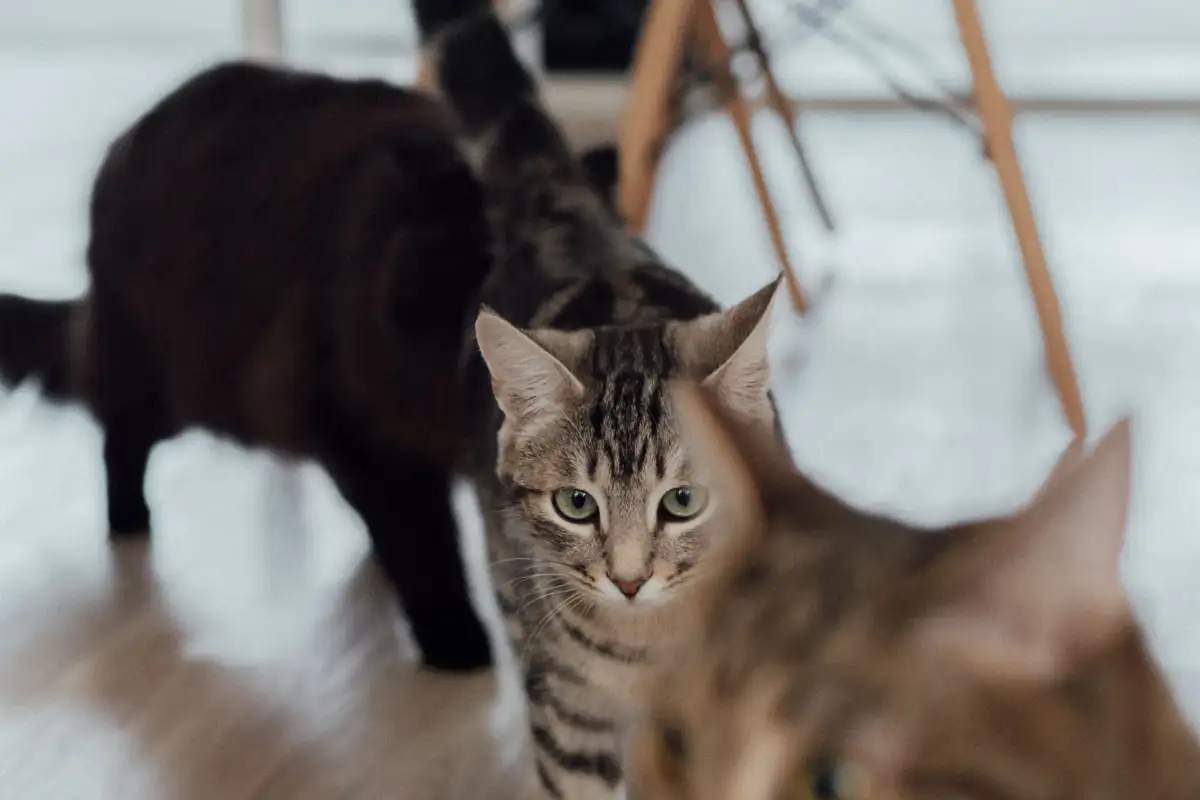
The flick is separate from the position. A single ear flicking while the rest of the head stays still usually means a sound, a draft, a fly, an itch. One ear tracking the hallway while the face stays on you is a cat splitting its attention, and that is a good thing to know before you put your hand on it.
Eyes come next, but check the light first. Pupils are a light meter before they are a mood ring. A wide pupil in a dim room with a lamp behind you is doing exactly what it should be doing. The same pupil in a bright kitchen is a much bigger statement. Once the light is accounted for, look at the quality of the stare: a hard, fixed gaze with the head lowered is pressure, and soft eyes with the lids relaxed are an invitation. Half-closed eyes are only contentment when the ears agree. Half-closed eyes on a cat with ears pinned is a cat shutting down, not a cat relaxing, and that misread is one of the most common ones I see.
Whiskers are the dial people forget. Fanned forward and slightly up, they belong to a cat leaning into its own curiosity. Pulled back tight against the cheeks, they belong to a cat that has withdrawn, even if the rest of the body has not moved yet. Whiskers also tell you about the face around them. A muzzle that looks tighter than you remember it, cheeks flat, a certain fixed quality to the expression, is the thing I notice when a cat is not feeling right, and it is the reason I look at the whole animal over several days rather than one moment. That face is not a diagnosis. It is a reason to make a vet call.
The tail is punctuation, not the sentence
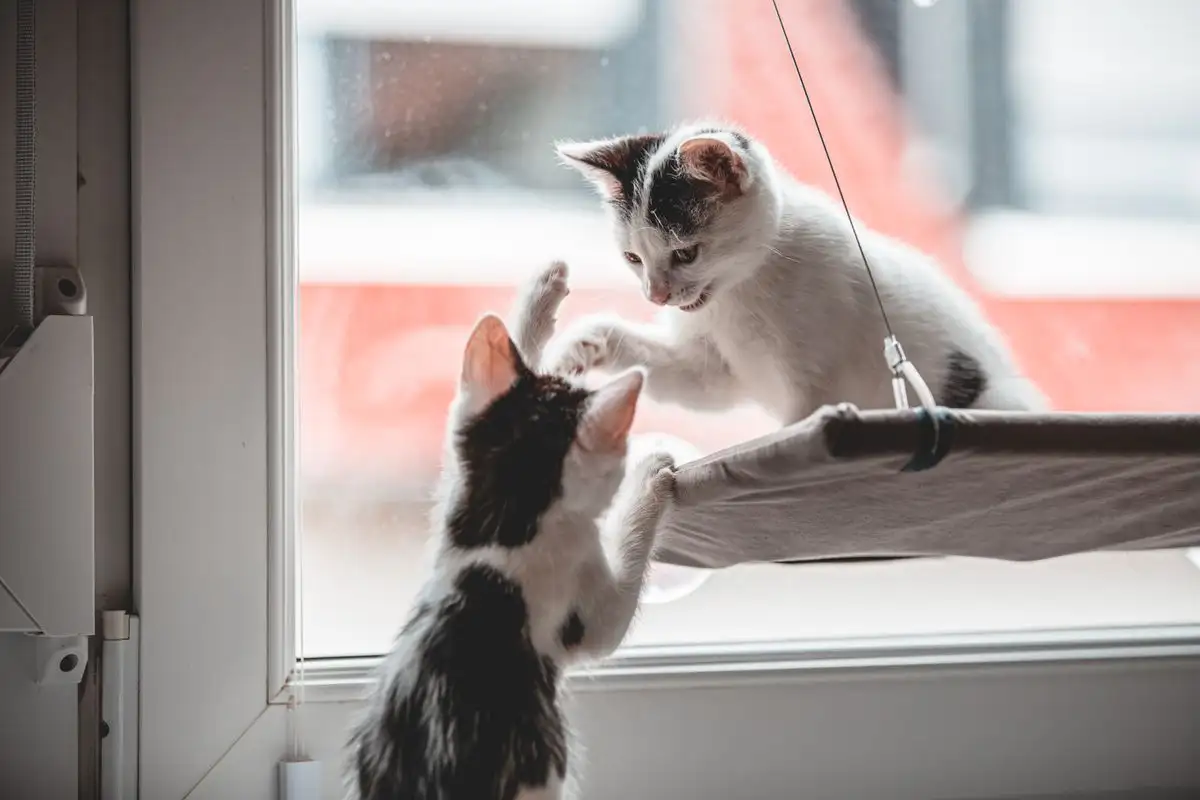
Now the tail, and only now. Upright with a small forward curl is the friendly walk. Upright and quivering is a greeting, provided the rest of the body is loose. Wrapped around the flank or over the nose is a cat that has settled and is probably keeping warm. Tucked is a cat that would like the situation to change. Puffed is startle, and startle is not the same as threat, which is why a puffed tail belongs to two completely different animals: the one hopping sideways with its ears forward and its weight light on its feet is playing, and the one crouched low with its ears flat is not.
The tip is where the useful information lives. A low-amplitude rhythmic flick, back and forth over an inch or two, is a cat building irritation, and it is the politest warning you will get. A slow wide sweep is a cat working something out. A tail carried low with a hooked tip belongs to a cat on a relaxed patrol of its own house.
When the parts disagree, believe the tense one
Most of the value in this is in the contradictions, and in the timing. If the ears have gone from forward to sideways while the tail tip started its flick, you are watching a cat change its mind, and the change is more informative than either position was. This is why I watch for transitions rather than poses. A still cat with no transitions at all is not necessarily calm, either. Freezing is a response, and it looks a lot like relaxation from across the room until you notice nothing on the animal is moving.
When the dials conflict, the tense signal wins, because a cat that is unsure of you is not going to be talked out of it by a friendly tail. In practice: relaxed tail plus pinned ears is a cat to leave alone. Wide pupils plus soft ears plus a loose body is a cat that is excited, not threatened, and play is a reasonable guess. Puffed tail plus forward ears plus a bouncy, weight-forward posture is a chase waiting to happen.
What this read cannot do
It cannot see through the light. It cannot account for a cat that has spent nine years being handled roughly and now reads as wary at rest. Flat-faced cats and folded-ear cats give you less ear travel to work with, tailless breeds take the tail out of the equation entirely, and a senior cat with sore joints will hold itself in ways that look defensive because it is, in fact, defending something. Deaf cats lose the ear-swivel vocabulary. Blind cats read the room with their whiskers in a way that looks odd until you know.
And it cannot tell you why. Body language tells you whether to keep your hand where it is. If the whole animal reads wrong for days at a stretch, that belongs in a vet conversation, not a behavior verdict.
The three seconds are up. Look at your cat again, the whole thing at once: the weight, the ears, the eyes in that light, the tail last. You will usually find that the hand on the floor should stay there a moment longer, or that it should have moved already. Either way, you will have answered the cat's sentence instead of one of its words.