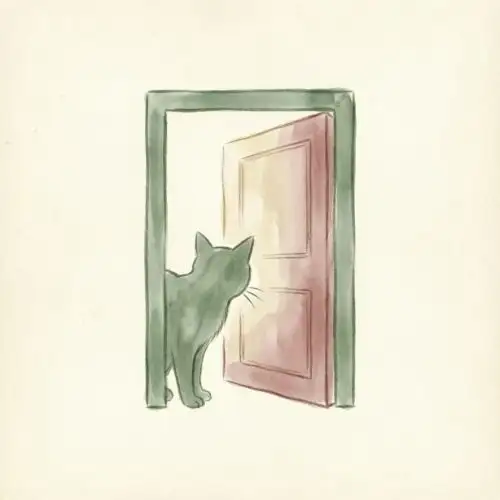
The traits that decide whether a cat can live comfortably with young children are tolerance, low reactivity, and predictability, and the only reliable way to judge them is to watch a specific cat under the specific pressures of your home — noise, motion, grabbing, and a routine that changes without warning — rather than trusting a breed profile. Breed can narrow a search. It cannot make the decision.
I want you to sit on the floor of a shelter meet-and-greet room with me. Linoleum, cold straight through your jeans. A fluorescent hum you stop hearing after a minute. One bench with a towel folded on it, a door that doesn't latch quietly, and a wire carrier against the far wall with its door propped open by a folded wedge of paper. The volunteer has already told us the cat is good with kids, which is a sentence I've learned to treat as a starting point and nothing else. Now we wait. Ten minutes of nothing is the most useful thing that can happen in this room, because a cat that comes out on its own schedule has told us something a cat that gets pulled out and planted in a lap never will.
The three traits, and what they look like from the floor
Tolerance is a budget, not a personality. Every cat has some amount of handling, noise, and interruption it can absorb before its behavior changes. The question isn't whether the cat tolerates a child — it's how much it takes to spend that budget and what the cat does when it runs low.
Reactivity is how big and how fast the reaction is. Watch the cat when a ring of keys hits the linoleum. Ears rotate, head turns, then what? Does the cat come back to baseline in a few seconds, or does it stay flattened under the bench for twenty minutes? The gap between the startle and the recovery is the number I care about most.
Predictability is the one families underestimate. A cat that reliably leaves the room when a toddler arrives is far easier to build a life around than a cat that tolerates a hug on Monday and swats on Wednesday. You can plan around a cat whose signals are consistent. You cannot plan around a coin flip, and the child is the one who gets confused by it.
Put together, those three tell you more than any breed label. A cat with a modest tolerance budget, small reactions, and total consistency is a better family cat than a mellow-seeming cat whose moods move around.
What the breed name actually buys you
I'll be blunt about this because I've watched too many families get it wrong: the breed gets you a starting hypothesis and nothing else. Certain breeds are described as patient and sturdy, and some of those descriptions have real roots in body type and general temperament. But within a single litter you can get a cat that sleeps through a birthday party and a littermate that hides under the bed for two days. The breed description was never describing either of them.
Where individual history shows up most is early socialization. A kitten handled by different people in the first couple of months, exposed to a vacuum, a dropped pan, a door slamming, a shrieking child, and then fed afterward, builds a nervous system that files those sounds under normal. A kitten raised in one quiet room by one quiet adult files them under threat. Same species, same breed, two different animals when a four-year-old runs through the kitchen.
So the question I actually ask is not what breed this is. It's who handled this cat as a kitten, and what happened afterward. A cat surrendered at three years old from a home with two loud boys is carrying a documented record. A cat from a quiet apartment is carrying a question mark.
The signals a child can learn in one afternoon
Flattened ears. Not just back, but rotated outward and down, like a plane tipping. That's an early warning, and it's quiet, which is why kids miss it.
The tail tells a longer story. A tip that flicks is interest or mild irritation. A full lash, back and forth like a metronome, means stop. The ripple that runs down the spine under the fur, quick as a shiver, that one means the cat is done being touched and hasn't decided what to do about it yet.
Then there's the freeze. A cat that goes completely still while being held is not a tolerant cat. It's a cat that has learned that struggling doesn't work. Freezing is the signal families overlook most, and it's the one that tends to end with somebody surprised.
I teach children the same three things I watch for: flat ears means finished, twitchy tail means finished, and walking away means finished and you let her go. Short sentences, one rule underneath all of them. When a cat says finished, we stop. Not because the cat is fragile, but because a cat whose early signals get respected rarely has a reason to escalate.
Leaving is not the same as lunging
This distinction gets lost constantly. A cat that removes itself from the room is doing exactly what a well-adjusted cat should do with an overexcited toddler. It's self-regulating. It doesn't need correcting, and it doesn't mean the placement failed.
A cat that has learned leaving doesn't work — because the door was closed, because someone followed it, because it got picked up out of its hiding spot — is the cat that eventually stops leaving. That cat may stay put and swat. Not because it's aggressive, but because avoidance stopped paying.
The cat sitting perfectly still in the middle of chaos, unbothered, is not automatically the tolerant one either. Sometimes that's an exceptionally steady cat. Sometimes it's a cat with nowhere to retreat that has gone flat. Watch what happens when a door opens. A cat with a real exit takes it. A cat with no exit stays and endures.
Build the room with the closed door
Before any cat meets any child, there needs to be a place in the house that belongs to the cat only. A bedroom with a gate a toddler can't climb. A closet with the litter box and a shelf above the reach line. The top of a tall cat tree placed so the route up it doesn't pass through the play area.
This isn't about protecting the child from the cat. It's about giving the cat a way to end an interaction without a fight. Tolerance in a house is mostly a function of whether the cat has options. Take the options away and you'll find the ceiling of any cat's patience fairly quickly.
The practical test is simple: can the cat get from where it sleeps to where it eats without crossing the room where the kids play? If the answer is no, the layout will cause more problems than the cat's temperament ever will.
What I ask the foster, word for word
I want names and ages, not adjectives. Has this cat lived with children, how old were they, and what did the cat do when one of them cried? Where did the cat sleep? What happens at the vet when someone lifts a paw? Has the cat ever been returned, and why?
The answers I trust most are the boring ones. A cat that slept at the foot of a bed in a house with a two-year-old, and that walks away when the noise gets to be too much, has already told you everything you need. A cat described as loving kids with no history to back it up is a hope, not a fact.
One real limitation worth saying out loud: a kitten is a guess. It's a wonderful guess and it's how most families do it, but it's a guess. A calm adult cat with a documented history around young children is the known quantity, and it feels backwards to most people who walk in wanting a kitten. The behavior is not backwards at all.
The honest answer for some houses
Some cats should not live with toddlers, and some toddlers, right now, at this age, are too loud and too fast for any cat. That's not a failure on anyone's part. It's a timing problem, and the answer is often to wait a year, or to take on an adult cat whose record already reflects the noise level of your actual house rather than the house you're imagining.
What I'd rather you carry out of that meet-and-greet room is this: the cat's breed told you almost nothing. The way it came out of the carrier, the speed it recovered from a dropped key ring, the tail that flicked twice before it walked away, and the closed bedroom door you already have planned, those told you everything.