No — hairless cats do not produce fewer allergens. Removing the coat removes the material the allergen rides on, not the allergen itself. Fel d 1, the protein behind the majority of cat allergies, is produced in sebaceous glands and saliva, so a Sphynx still makes it, and with no fur to wick it away from the body, that protein sits on warm skin and in skin oil. The exposure route changes rather than disappearing: instead of pulling allergen out of the air you breathe, you pick it up with your hands and your lap. For plenty of allergic people that is a worse trade, not a better one.
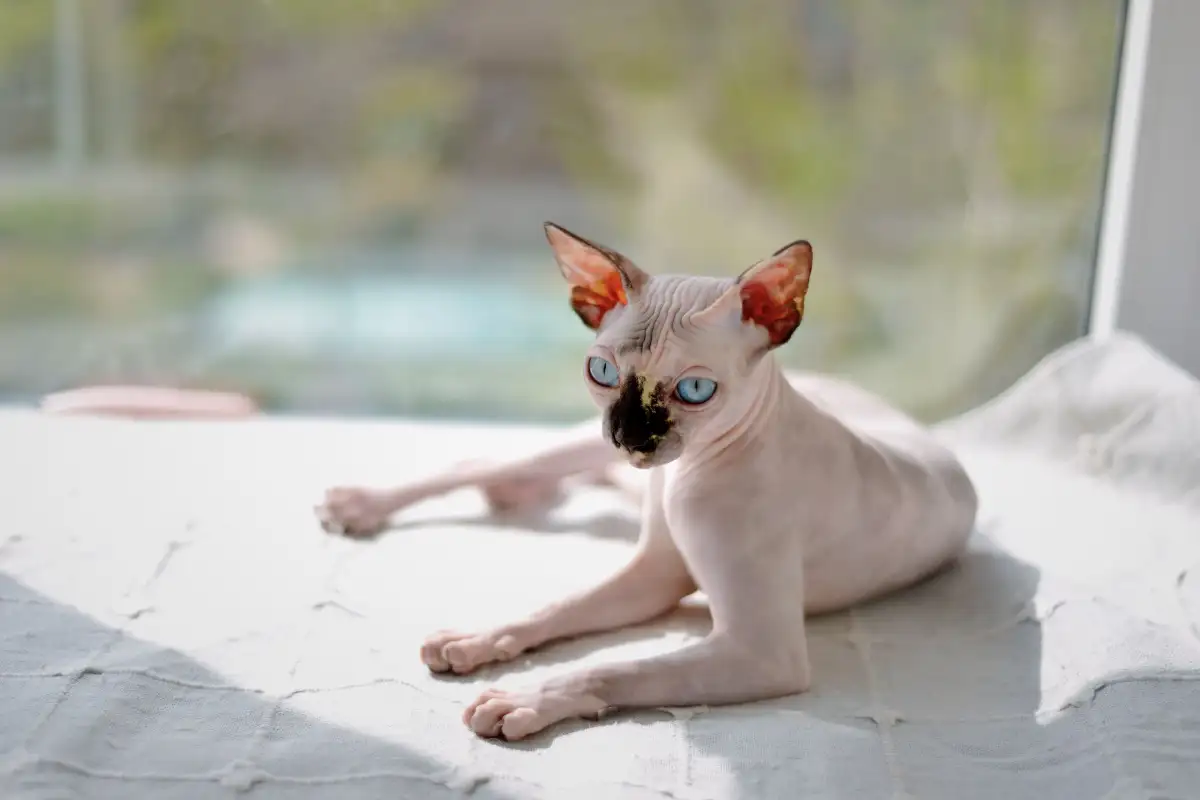
I have lived with coated cats for most of my adult life with what I'd call a negotiable allergy — the kind that makes my eyes itch for a week after a new cat comes home and then mostly settles down. So when a Sphynx came through our house as a foster, I assumed I already knew what to expect. I sat down on the kitchen floor to let him out of the carrier, and he was in my lap before I finished unzipping it.
He was warm in a way that's hard to describe if you've only ever petted a cat through fur — like holding a covered mug of coffee. The skin felt like suede that had been handled a lot, faintly tacky in the creases behind the front legs. I ran my palm from his shoulders down his back and my hand came away with a shine on it. I didn't think anything of it. I wiped my hand on my jeans, and about ten minutes later I rubbed my eye.
That is the whole article, really. Nothing was in the air. Everything was on my hand.
The protein doesn't care whether there's fur
Fel d 1 is made mainly in sebaceous glands and in saliva, and it ends up on the cat's skin and coat as the cat grooms. On a coated cat, much of it gets distributed along the hair shaft and then rides out into the room on shed hair and skin flakes. That's the version most allergic people know: an airborne load that builds up in a carpeted room, a bedroom, a couch.
Take the fur away and the manufacturing doesn't stop. The Sphynx still produces sebum, and the breed is known for how much of it you can see — that oil carries allergen. A hairless cat still grooms itself, so saliva goes onto skin that you are going to touch with your bare hands. There's no coat holding any of it out at arm's length. What you have is a cat whose allergen output is concentrated on a surface that is warm, oil-rich, and attached to a body that wants to be on top of you.
Rex coats are not a loophole
Devon Rex and Cornish Rex get pulled into the same conversation with the same wishful thinking. Their coats are thin and wavy. The Cornish Rex has no guard hairs — just the soft undercoat layer — and the Devon Rex coat is fragile and sheds very little.
Shedding less is not the same as releasing less. Dander is not hair; it's shed skin cells, and every cat produces them whether it has fur or not. A Rex still produces Fel d 1, still sheds dander into the room, still leaves saliva on itself. Some people find they react less to a Rex because there's less hair on the sofa and less of the larger allergen-carrying particles in the air. Others react worse, because a Rex coat is oily in its own right and they are still petting a cat.
Airborne reactions and contact reactions are two different problems
This is the part I wish more people understood before they rehome a cat.
If your reaction is sneezing, a runny nose, and itchy eyes that start within twenty minutes of walking into a house, you're reacting to something you inhaled. If your reaction is a raised, itchy welt on the forearm where the cat's tail rested, or a patch of eczema at your neck, you're reacting to contact.
Hairless cats mostly shift the problem out of the first category and into the second. That is not automatically an improvement. Someone whose reactions are contact-driven can find a Sphynx harder to live with than the coated cat they already own. Someone who reacts mainly to airborne dander may genuinely do better. It depends on which arm of your immune system is doing the yelling, and you cannot learn that from a breed description.
Test the cat, not the breed
I've stopped giving breed-level answers, because the variation inside a breed is bigger than the variation between breeds. Two cats from the same litter can put out very different amounts of Fel d 1. Nobody selling, registering, or writing about cats can tell you how your body will respond to the specific animal in front of you.
What works is a visit that mimics living with the cat. Spend half an hour in the room where the cat actually lives, not a lobby. Let it sit on you. Don't wash your hands right away. Notice when symptoms start and where they start. Then wash up, leave, and keep paying attention for the rest of the day and into the next — delayed reactions are real. If you're signing up for fifteen years, one afternoon is a cheap test.
The skin-care routine spreads it around
This is the part nobody mentions. Sphynx and Rex cats need regular wiping or bathing because the oil builds up and the ears and nail beds get grimy. Whatever you use — a damp cloth, a basin of warm water — the water goes oily fast, and that water is full of the same protein that just made your eyes itch.
Now trace the path. The cloth goes into the sink. The sink is where you brush your teeth. The towel goes into the hamper with your shirts. The cat walks off the towel, across the counter, onto the bed. You wipe the cat, then you pick up your phone, then you scratch your nose. The grooming routine that keeps the cat comfortable is also, mechanically, an allergen distribution system.
The workable version is boring. Dedicated towels that don't mix with the rest of the laundry. Hot water and a separate load. Rinse the sink afterward. Wash your hands when you're done and keep them off your face until you have. None of that removes the allergen, but it changes how much of it you're carrying around on your skin for the next three hours.
The part with no workaround
Hairless cats run warm and they look for heat. Which means they will be under your covers, on your chest, against your neck — and you'll spend eight hours a night breathing what's on their skin from a few inches away, in a room with the door shut.
For people with airborne reactions, that's usually the deciding factor. A coated cat sleeping at the foot of the bed is a different exposure from a Sphynx sleeping under the duvet. If that's your situation, the bedroom door is the only lever that reliably works — and a hairless cat that can't sleep with you is a hairless cat that will spend the night outside the door making sure you know about it. That's a genuine trade-off. You're rationing contact with an animal that was bred, more or less, to want it.
What I tell people now
No cat is allergy-free and no breed is hypoallergenic — not the Sphynx, not the Rexes, not the Siberians and Balinese that get sold with the same word. Anyone offering a cat as the solution to an allergy is promising something the cat cannot deliver.
If you have cat allergies and you want a hairless cat, the honest order of operations is this. Talk to an allergist first, because there are real medical options and they're better than guessing. Then spend actual time with the specific cat, not the breed. Then decide with your eyes open about the bathing routine, the towels, the bed, the heat-seeking, and the fifteen years. Some allergic households do fine. Some end up rehoming a cat they love, which is hard to watch and worse to do.
The fur was never the allergen. It was just where the allergen was parked.