Yes, and the difference is bigger than the brushing-versus-no-brushing version of the question suggests. Longhaired and hairless cats fail in opposite directions. A longhaired cat's shed undercoat gets trapped inside the outer coat and packs into felt flat against the skin. A hairless cat's skin oil has no hair to travel down, so it stays on the surface and gathers in every crease. It is the same underlying job, moving what is stuck, done with different procedures, on different weekly rhythms, with different risks. Coat is the one thing a breed label actually predicts with any reliability, which makes it the only part of the label worth planning your week around.
I got to that model the slow way, by trusting the label first.
Here is the moment that broke it. It is early March. The heat has been running since October and the air in the house is dry enough that my knuckles crack when I make a fist. There is a longhaired cat on the kitchen counter in a square of gray window light, and my hands are flat on his ribs, thumbs parting the fur along his spine. From across the room he looks fine, glossy and smooth and well kept. From eight inches away he does not. The topcoat lies in flat, slightly separated strips, and when I press down, my fingertips stop short of skin on something with a little give to it, like the underside of a rug.
That gap, between the coat you can see and the layer underneath it, is the whole story of longhaired care.
Run your hand back from the shoulder toward the hip. Most of the way it glides. Behind the shoulder blade, and again low on the flank, your fingers stop, the coat goes dense and slightly warm, and if you push, the cat's skin moves along with your hand instead of sliding under it. That resistance is the signal. Nothing looks wrong yet, there is no mat you can point at, but the undercoat has stopped being loose hair and started being a pad. Pads are what mats are made of.
A daily feel, and a weekly pass
Once you know that, the routine stops being a chore with a schedule attached and turns into something you do with your hands while the cat is on you. A thirty-second pass any time he settles in your lap: down the spine, behind each ear, under the front legs, along the belly line, around the base of the tail. Those are the places that go first, because they are hidden, or moving constantly, or out of the cat's own reach.
Then a real session, all the way down to skin, not skimming the surface. Skimming is worse than nothing, because it makes the topcoat look cared for while the layer underneath keeps packing. Once a week is the floor in a settled coat. Every couple of days when the coat is in transition.
Shorthaired cats in the same house need something too, just less of it. They shed. A shorthaired cat on a dark shirt leaves a shadow of hair that a longhaired cat never would, because the hairs are finer and shorter and they travel. A routine going-over mostly means moving loose hair off the cat before it lands on everything else. The surprise, for people who assume short equals easy, is that a dense double coat packed into short hair can mat just as hard as a long coat, in tighter knots that are harder to find. I once worked a felted pad the size of my palm out of a short-haired cat's armpit, and the owner had never seen it, because there was no length of fur waving at her to catch her eye. You find those with your hands.
The mat that is not a combing problem
There is a test, and it takes one finger. Slide a fingertip under the edge of the mat. If your finger passes between mat and skin and the mat lifts away, it is loose. Loose mats come apart with patience, a few fibers at a time, spread over more than one sitting, with the cat free to walk away.
If it does not lift, if the skin comes up with it, that is a different category of problem. That mat is anchored to skin, and the skin has been drawn up into it. Which is exactly why scissors are the wrong answer. The skin is inside the mat. You cannot see where the fur ends and the cat begins, and cutting into what you are certain is only fur is one of the most common ways people seriously injure a cat at home. Tight mats against skin are a professional groomer's job or a veterinarian's job, depending on how the skin underneath looks.
And there is a threshold where it is not grooming at all. If the skin around a mat is red, weeping, warm, or broken, or if the cat flinches when you get near the area, stop and get it looked at. Matted cats are often uncomfortable cats. A cat that suddenly hates being picked up, or swats when you touch its side, may be telling you about a mat pulling at an armpit rather than about a change in personality.
Hairless is not less work, it is different work
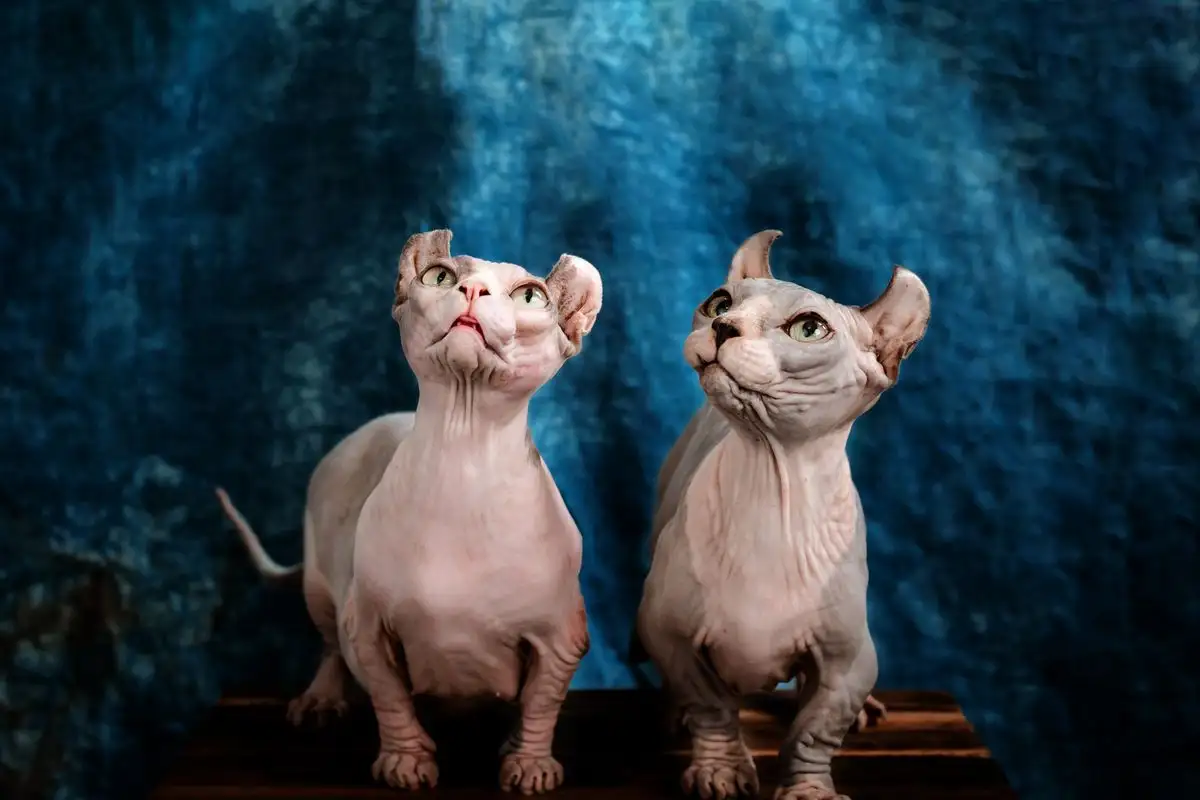
The other end of the range is not the easy end either. In January, the hairless cat in my house spends the day following one square of sunlight across the living room floor. Put a palm flat on her back and it comes away faintly tacky. Lift the blanket off her bed and there is a soft orange-brown ring where she sleeps, and that ring is oil, not dirt. Run a finger along the inside of an ear and it comes back waxy. The nail beds collect a dark line of debris that returns within days of being cleaned out.
Hairless cats still make skin oil, at roughly the rate a coated cat does. The difference is that there is no hair for it to travel down, so it sits. That means routine wiping is not optional maintenance, it is the baseline. The places that need attention are the ones where skin folds on itself or where oil pools: the base of the tail, the creases behind the legs, the armpits, the ear flaps, the nail beds, the chin. A warm-water wipe with something soft, following the direction the coat would run if there were one, covers most of it. Some cats need it daily. Most need it every few days. Almost none need it never. Oil left in place irritates skin, irritated skin gets scratched, and scratched skin gets infected, which is the point where wiping stops being the answer and a veterinarian starts being one.
Sun, cold, and heat
The other half of hairless care has nothing to do with oil. These cats have no coat between their skin and the weather, which cuts three ways. Sunburn is real and easy to miss, because it happens in the spot the cat loves most, the brightest and warmest patch in the house. Cold is the mirror of it: a hairless cat loses heat quickly, seeks heat constantly, and will press itself against a radiator or lie in full sun far past the point where it should have moved. And in a carrier or a parked car on a summer day, a cat with no coat has nothing to buffer the heat. Blankets, warm sleeping spots, shade, and a way out of the sun do more for these cats than for any coated one.
The calendar is half the job
Here is the part that catches people who have been doing everything right, and it is not about breed at all. Shedding runs on light. As the days stretch in late winter, cats blow the coat they have been carrying since fall, and it comes out in clumps. A coat that was perfectly manageable through January can turn into a mat factory in ten days. Fall is the mirror image. The new coat grows in while the old one is still coming out, and you get a transitional layer that is thicker, denser, and harder to get through than anything you will see in midsummer.
Those two windows, roughly March into April and September into October, want far more attention than the rest of the year. The trap is that a quiet January teaches you a habit that does not survive contact with spring. Two skipped sessions in a coat that is blowing can turn into a pad low on the flank, and by then you are back at the finger test instead of in a routine.
Indoor cats are not exempt. They do not see the sun the way an outdoor cat does, but they still respond to day length, and heated winter air pulls moisture out of coat and skin, which makes everything tangle a little faster.
The hairless routine barely moves with the calendar. Its seasons are just different ones: summer sun and heat are the risk, and dry indoor winter air can leave skin tight and flaky.
Read the coat, not the card
If you are in a shelter reading a card that says domestic longhair, that phrase is not a breed, it is a coat description, and it is the most useful line on the page. It tells you more about your next five years of Sundays than the cat's coloring or its ear shape or the breed guess someone wrote in the margin.
What I would do is drop the phrase low maintenance and ask what the coat is actually made of.
Two coats, long: the undercoat has to be moved out and down to skin, on a schedule, hardest in spring and fall.
One coat, short: sheds steadily, mostly manages itself, still benefits from routine upkeep, and a dense one can hide mats in places you would not think to look.
No coat: oil has to be moved off the skin, and the skin has to be protected from sun, cold, and heat, all year.
The instrument in all of it is your hands. You learn what a coat feels like when it is right, cool and loose, fingers reaching skin without resistance, and what it feels like when it is starting to go, warmer and denser, fingers stopping short. That feel beats any chart. The breed name tells you roughly what you are bringing home. The coat tells you what you are doing on Sunday morning.