What gets risked by waiting is time, not drama. A cat is a predator and a prey animal at once, and both halves of that inheritance push it toward hiding discomfort rather than announcing it, so the first honest signal of pain is usually a small adjustment — a changed posture, a hesitated jump, a patch of coat that stops getting maintained — that reads to a human as ordinary calm or ordinary crankiness. Waiting for the cat to look sick means waiting for a stage it is built to conceal. The workable alternative is to know which quiet cues are actually loud, and to call the vet on a specific list instead of on a feeling.
The loaf that isn't a loaf
I want you on my kitchen floor with me at 6:40 in the morning, coffee going cold on the counter, one lamp on over the sink, a cat on the rug by the dishwasher. She's loafing. If you were walking past on your way to the fridge, you'd read it as settled.
Stay with her one second longer than that. The paws are tucked, yes. But the spine is rounded high through the middle instead of flat and heavy. The head hangs level with the shoulders instead of riding above them. The weight is tipped forward onto the front legs, as if she's holding herself up rather than settling down into the floor. A comfortable loaf sinks. This one is braced.
That is the posture I check first, because it's the one owners walk past most reliably. It looks like patience. It looks like a cat waiting for breakfast. In my experience it's the shape a cat takes when it has decided the smallest possible footprint is the most comfortable position available to it — head low, body compressed over the front paws, everything pulled in tight.
Then comes the part that costs people weeks. She ate. She drank. She used the box. She washed her face and her chest. When I sat down on the floor beside her, she purred.
Purring is not a report
I've had a cat purr steadily in her carrier on the way to a vet appointment, and I've had one purr in my lap through a house full of people and noise. Purring is a self-soothing behavior. Cats do it when they're stressed and when they're uncomfortable just as readily as when they're content. The motor running tells you nothing about how the cat feels. It tells you the cat has a motor.
So if you're using the purr as your all-clear, you've handed the cat the job of reporting on itself — and that's a job cats don't do.
What the face is saying while you're reading it as mood
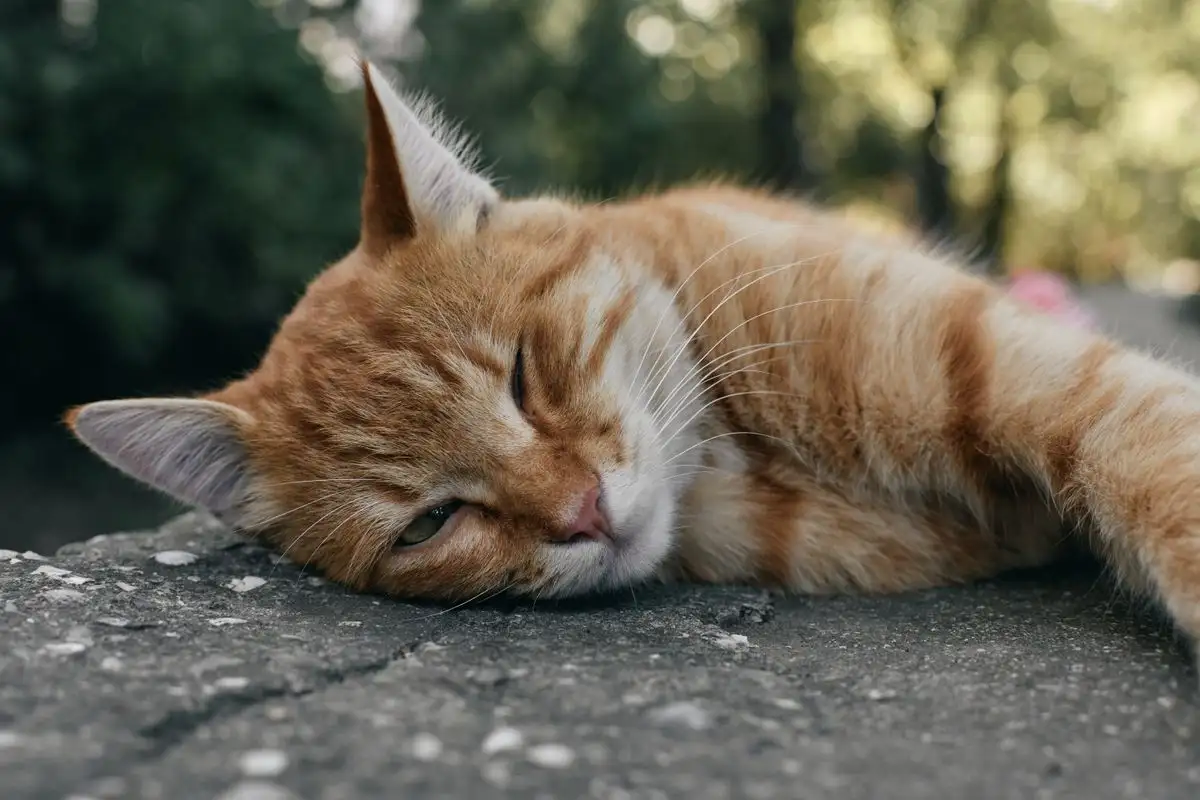
The ears. A relaxed cat's ears stand up and swivel toward sound; you can watch them track your voice across a room. A cat in discomfort rotates them outward, so the openings point sideways or down and the crisp triangle flattens into something rounder. It looks like the cat is annoyed with you. Sometimes it is. When the ears go out and stay out while the cat is alone and nothing in the room has changed, mood is the less likely explanation.
The whiskers. On a comfortable cat they fan forward and slightly up, mobile, moving with attention. Pulled back against the cheeks, or drooping, is a change worth noting.
The squint. This one trips people up, because we've all been told a slow blink means contentment. It does. But a contented squint is loose — the brow stays soft, the lid comes down gently, the whole face relaxes with it. The other squint is tight. The brow draws, the whisker pads pull in, the eye narrows from both directions at once, and the cat does it while staring at nothing in particular in a normally lit room. Soft squint, happy cat. Tight squint on a cat looking at the wall, note it.
Grooming goes in both directions
Everyone knows a sick cat stops grooming. Fewer people know the other half. A cat that suddenly over-grooms one area — working a single spot on a flank or a front leg until the hair thins — is also saying something, and it's pointing at a place. I've found bare patches on cats that looked completely normal from across the room. Both patterns get a call.
The middle version is the one I catch most: the coat stops being even. Not matted, not filthy. The back half goes a little dull, the fur behind the ears looks slightly unkempt. It reads as a cat getting older, or a lazy cat. Sometimes it is. But when a fastidious cat's grooming standard quietly drops, that's a change in what the cat can comfortably reach and hold, and it deserves a question to the vet.
Movement is where it shows up first
Watch the jump. A comfortable cat gathers, springs, lands, one motion. A cat working around low-grade discomfort does the gather, hesitates at the top of the crouch, then either commits to a shorter hop or takes the long way — up the side of the couch, via the arm, via the back. Cats are excellent at engineering workarounds, and the workaround is the signal. If the direct route to the windowsill has quietly become a three-step route, something changed.
The litter box is the other place I watch. What I'm looking at:
- sitting instead of squatting to urinate, or hovering with the rear end high
- front paws braced on the rim of the box, or planted on the floor outside it
- going in and out repeatedly without settling
- eliminating just outside the box, especially right next to it
None of that is a diagnosis. It's the cat reporting that the position it needs to get into is not a position it wants to get into. That's a call.
Hiding, and the spot on the back
Two behavioral cues that get misread as personality.
New hiding places. A cat that always slept on the bed is now spending afternoons behind the water heater. A cat that was always underfoot is suddenly on top of the kitchen cabinets. Cats in discomfort go where they won't be bumped, handled, or watched. It's easy to narrate as her finding a new nap spot. Ask instead whether the new spot is a place a cat would choose to relax, or a place a cat would choose to be left alone. Those are different places, and cats know the difference.
Irritability that has a location. Run your hand slowly down a cat's back. If all is well, the fur stays flat and the tail stays quiet. If your hand crosses one spot and the skin ripples, the tail flicks, the ears rotate, and you get a warning look or a nip, that isn't the cat being moody. That's a location report. A cat that has suddenly become touchy needs that touchiness mapped, not scolded.
The list I actually call over
Here's the short version. I've stopped waiting on any of these:
- Hiding, especially somewhere new, or hiding more than usual.
- Refusing food, or eating noticeably less for more than a day.
- Any change in litter box habits — frequency, posture, location, or noise.
- A posture change that arrived suddenly, or one that's still there the next morning. The hunched, head-low, compressed-over-the-front-paws stance is the one I move on fastest.
- Ears rotated out, whiskers pulled back, a tight squint — together or on their own, if they're new.
- Grooming that has stopped, or grooming that has landed on one spot.
- Jumping, stepping, or climbing that has changed route.
- Flinching, nipping, or pulling away when one specific area is touched.
Anything on that list gets a phone call. Not a wait-and-see. A call. The vet can tell me whether it warrants a visit, and that's the one judgment I can't make from my kitchen floor.
How to call so the vet can use it
If you take one thing from this, take the next paragraph.
The vet sees your cat for fifteen minutes in a strange room where the cat is doing its level best to look normal. You are the only witness to the other 1,439 minutes. So bring data.
Photograph the posture while the cat is holding it. Video the walk across the room, because gait is hard to describe and easy to see. When the cat goes to the box, note the time and what you saw. When your hand crosses the spot that makes the cat flinch, note where — left shoulder, mid-back, right hip. Write down when the change started, even if the answer is that you think it was Tuesday.
Then say the thing that matters most: that this is different for her. Not that she seems off. Different from her baseline, starting when, in what way. A dozen small ordinary observations said plainly are worth more than one dramatic one said vaguely.
The trade you're actually making
I want to be honest about the calculation, because the calculation is the whole point.
If I call and I'm wrong, I've spent twenty minutes on the phone and possibly an afternoon in a waiting room. If I wait and I'm wrong, the cat has spent that same time coping with something, quietly, in the shape of a loaf, in a room where nobody was looking at her. Those costs aren't close.
That isn't a reason to panic at every ear twitch. Cats are individuals. Some are stoic to the point of being unnerving; some will carry on about a hangnail. Which is exactly why the only useful reference point is that particular cat on its ordinary days. I'm not comparing my cat to your cat or to a textbook. I'm comparing her to her.
And I can't tell you what any of these cues mean for your cat, because I genuinely can't. I can only tell you which ones I've stopped waiting on. Waiting doesn't buy information. It spends time the cat doesn't get back, on the bet that the signal will get louder on its own. It usually doesn't get louder. It just gets older.