At ten, senior cat care stops being maintenance and becomes monitoring. The tasks themselves don't change much — feeding, scooping, brushing, the yearly exam — but the reason behind them does. Instead of keeping a stable routine running, you start building a baseline you can measure against, because almost nothing that matters in an older cat arrives as a single bad day. It arrives as a direction. The practical shift at ten is a weekly habit: weigh her, watch her, write it down. Anything that moves — weight, appetite, how she takes the stairs, what the litter box looks like — goes to a veterinarian, not to your own patience.
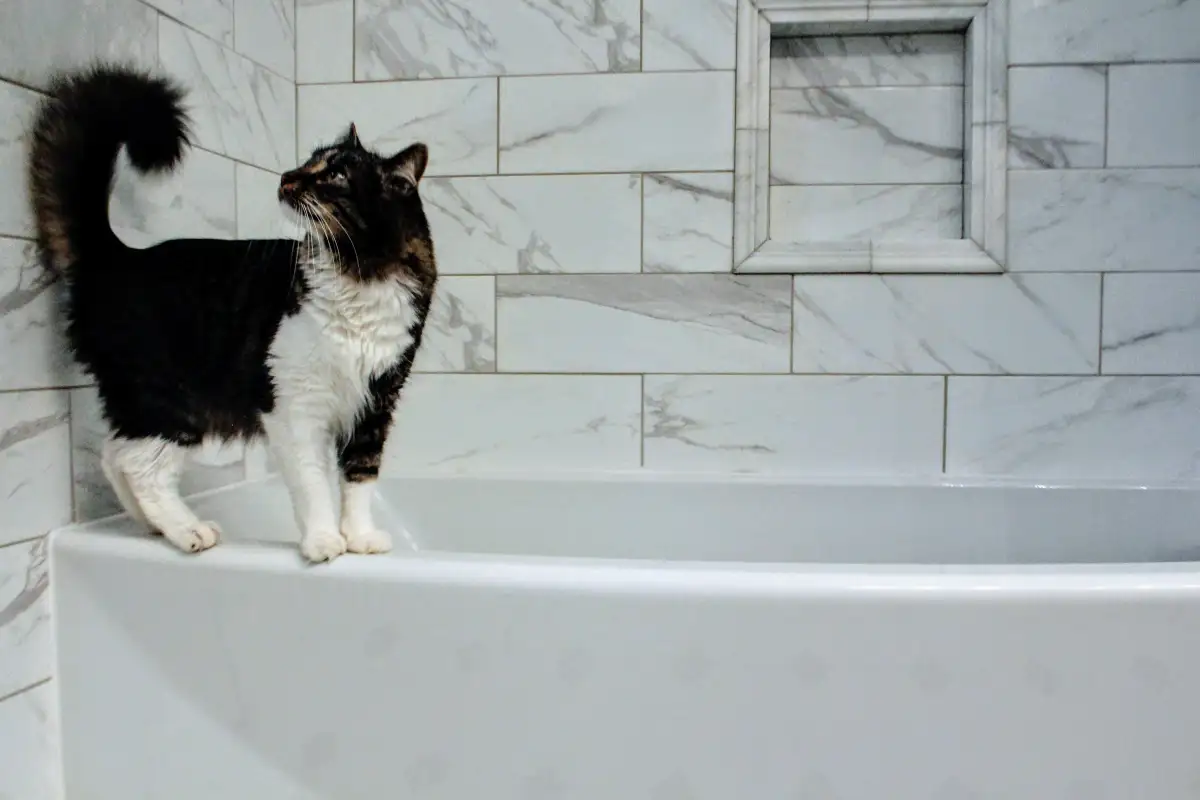
The counter taught me that. For most of a decade, my old girl was up on the kitchen counter every morning, walking the edge of it like a plank while I made coffee. Then for a stretch of weeks she was up there, but only after she'd gone chair first. Then she was just on the chair. Then she was on the floor, sitting in the warm rectangle of sun where the counter's shadow used to fall, and I remember standing there with the kettle in my hand thinking she looks fine.
She did look fine. That's the trap. No yelp, no limp, no morning where I said something's wrong. Just a quiet re-routing of her day that I missed for a month because I was watching for an event, and she was delivering a trend.
The first habit I had to rebuild was weighing her
Weighing a cat feels like it should be simple, and for a cat who tolerates handling, it is. I use a flat digital scale — the kind sold for babies works fine, and so does any kitchen scale with a wide, low tray — and I do it the same way every time. Same day of the month, first thing in the morning, before food, and the same towel on the platform so the surface feels like something she's stood on before.
For the cat who won't stand still, I put her in the carrier and hang the carrier from a luggage scale by the handle, then subtract the carrier's weight, which I wrote on the side of it in marker the day I bought it. It's less precise than a flat scale, and I'm honest with myself about that. What I care about is the line, not the dot.
That's the part people get wrong. A single number is almost useless. Cats fluctuate by a few ounces for reasons that have nothing to do with anything — water, a full bladder, a bad hair week. What a vet wants is a direction and a time frame. "She's down about half a pound since spring" is a sentence a vet can work with. "She looks thinner" is not.
The scale lags behind my hands, though, and that's the other half of this. Once a week I run my palms down her sides while she's eating. Ribs should feel like the back of your hand, not like knuckles. The spine between the shoulder blades should feel like a ridge under a cushion, not like a cord. Hips shouldn't feel like two posts. There's a spot right behind the shoulder blades where older cats stop reaching, and that's usually where I find the first mat, before any scale has moved at all. I note what I find and I call the vet with it. I don't try to solve it in the kitchen.
The house gets edited, not redecorated
The tenth year is when I start thinking of my house as something that has to be re-fitted to a cat who is no longer willing to do things the hard way. Not decorated. Edited.
The litter box is where this shows up first. A box with high sides is a box she has to climb into, and a box she has to climb into is a box she'll eventually skip. I take a plastic storage bin and cut the entry down low on one side and leave the rest of the wall tall so litter still stays in. Bigger box, shallower litter, and one on every floor she spends time on, because the trip to the basement is now a decision instead of an afterthought. Uncovered boxes, always — a lid changes the air in there, and I've never had a cat who preferred it.
And if she's avoiding the box, that's a veterinary call, not a litter call. I learned to stop swapping litters and start making phone calls.
Water is next. I keep bowls in more rooms than I used to, and I keep at least one away from the food, because cats drink less when the water is next to the bowl they eat from. Wide, shallow dishes beat deep narrow ones for a cat with whiskers that seem more sensitive than they used to be.
Feeding changes shape too. In a house with more than one cat, shared bowls stop working the moment you need to know who ate what. I moved to separate stations in separate rooms, and for one cat I used a feeder that only opens for the animal wearing the matching tag on her collar. It's not cheap and it's not for every household. But you cannot track a trend you can't attribute to a cat.
Resting spots are the last piece, and they're the easiest to get wrong by being generous. Low, not high. Warm, but a warmth she can walk away from — a sun patch, a fleece in a cardboard box top, a spot near a radiator with a barrier so she can't press right against it. If I ever use a heated pad, it's on the lowest setting, under a cover, and only in a place where she can step off it any time she wants. A cat who can't move away from heat shouldn't be near it.
Quiet matters as much as warmth. Traffic in a hallway, a dog, a toddler, a stereo — a cat who's losing her edge on the world stops putting herself in the middle of things, and then you stop seeing her, and then you stop noticing what's changing. She needs one place where nothing happens except her.
Grooming, nails, and the jobs she stopped doing herself
Older cats don't stop grooming all at once. They stop in sections. Front first, then the sides, then the back half and the base of the tail. So brushing becomes a job I do, weekly, in short sessions, with a soft slicker or a rubber curry and a treat at the end. She'll tell me when she's done. Two minutes is a real session.
One thing I don't do: cut mats out myself. Cat skin is thin and loose, and it tents up into a pair of scissors in a way that ends in an emergency. Tight mats behind the shoulders or on the hips go to a groomer or to the vet.
Nails change because scratching does. A cat who isn't working a post isn't wearing her nails down, and they grow thicker and start to curl. I check weekly — just press the toe, look, let go. I take the clear hook off the tip and stay well ahead of the pink. If a nail is curling into a pad, I stop and make an appointment. That's not a trim, that's a vet visit.
Dental care at this age, for me, is observation and nothing else. I watch how she chews. Whether she's favoring one side. Whether she's dropping food. Whether the water bowl is suddenly the most interesting thing in the room. I don't poke around in her mouth and I don't try to fix anything I find there. I write the pattern down and hand it over.
What actually goes in the notebook
Mine moved from a paper pad to a note on my phone, because I kept losing the pad. It doesn't matter where it lives. What matters is that it's short enough that I'll actually do it, and that it records the same handful of things every week:
Weight, with the date and which scale. How much food went down and how much was left. Water level — I mark the bowl with a piece of tape in the morning so I can see the drop. Number and size of clumps in the box. Whether she came downstairs today, and whether she used the step or jumped. How long she took to settle after lying down. Where she slept. Whether I heard her at night. Coat, mats, and nails.
That list looks obsessive written out. It takes four minutes. And it means that when something changes, I'm not relying on memory, which is a terrible instrument — I've convinced myself a cat was eating normally for a week when the record said otherwise.
The judgment call is what to do with an off day, and here's my rule: everyone has an off day. Two days in the same direction is not an off day. I call the vet and I bring the list. Slowing down is a description, not a verdict, and it isn't automatically permanent — which is exactly why it belongs in front of someone who can examine her instead of in my own head where it turns into a story about age.
The weirdly specific things I've learned to track: whether she still gets on the bed or waits to be lifted. Whether she's sleeping in a new spot, or facing a wall, or in a corner she never used before. Whether she's grooming the front and skipping the back. Whether she comes to the door when I get home. None of those are diagnoses. All of them are data, and a vet can do something with a month of them that they can't do with "she seems slower lately."
The check-in interval isn't mine to set
Once a year was the pattern for most of her life. After ten, the check-ins get closer together — twice a year is what I've been told to expect, and more often for a cat with something already being managed. That interval is a decision I make with a veterinarian, not one I take from a book, because it depends on what they found last time and what they want to re-check.
What I control is arriving with something useful. I bring one sheet: the weights with dates, the trend notes, the changes over the last month, and two or three questions written down before I walk in. Vets work from timelines. "She's been drinking more since early March and the bowl mark drops about this much a day" gets a very different response than a shrug and a guess.
Ten isn't an event. It's a convenient line, and a small cat and a big cat don't cross it at the same age. A cat who's been managed for something since she was six crossed it earlier. The number isn't the thing. The thing is that the question you're asking has changed — from how do I keep this steady to what is this doing, week to week, and who do I tell.
The counter is still empty most mornings. I look at it anyway. Then I write down what I actually saw.