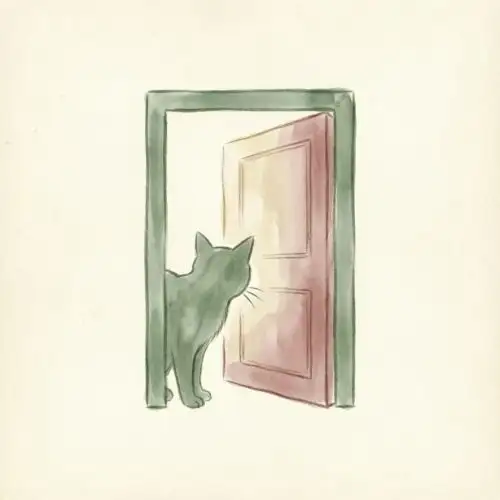
Carrier training works because the carrier isn't really the problem — the prediction is. Leave the carrier out permanently with a worn towel inside, feed the cat a few feet from it, then beside it, then inside it, then close the door for two seconds and open it again, then drive around the block and come home to dinner. Each step has to be small enough that the cat can walk away from it, and none of those steps should end at the vet.
I'm on the floor of the spare room with the closet door open, and the cat is out in the hallway with her ears rotated slightly outward, watching the plastic box I just set on the carpet. She isn't running. That's the part people misread. Her head is low, her tail is pulled in against her flank, and she hasn't looked away from it once.
For years I thought of a carrier as equipment. You get it out when you need it, the way you get out a suitcase. That's correct for a suitcase and wrong for a cat, because a cat learns by frequency and sequence, not by intention. If the only thing that ever follows the carrier is the car and the bright room and the stranger's hands, then the carrier becomes an announcement. And once it's an announcement, the cat doesn't need the rest of the day to happen. The flinch at the closet door is the whole vet visit, compressed into a second.
So the first move isn't training. It's making the announcement stop being true.
The carrier has to become furniture
Put it where the cat already spends time — the corner of the living room, the sunny patch by the window, wherever she naps anyway — and take the door off, or wedge it so it can't swing shut on its own. Fold in a towel that already smells like her. Then do nothing.
That's the hard part for me, honestly. Doing nothing. I want to tap the top, angle it toward her, narrate. The point of the first week is that nothing happens, and the cat gets to walk past it forty times and be right every time. Don't put her in it "just to see." One forced trip inside and you've reset the clock and taught her the box is still a box.
Then the food does the work
The progression after that is almost boring, which is how you know it's working. I run it off meals, not a bowl left down all day, because a cat who isn't hungry has no reason to negotiate.
- Bowl a few feet away for a couple of days. Then a foot closer. Then at the mouth of it.
- Bowl inside, with front feet in and back feet still out. That half-in position is allowed for as long as she wants it.
- All the way in. No door yet.
- Door closed for one second. Open. Treat. Walk away. Next session, three seconds. Then ten. Then quit for the day.
- Lift the carrier two inches off the floor and set it back down. Then carry it into the next room and back.
- Engine off in the driveway. Then engine on. Then to the end of the block and back.
Two things get left out of most descriptions of this. The first is sound. The latch clicking is part of the prediction, and so is the rattle of an empty carrier in the back seat. Practice the click without closing anything, so the sound stops being the last thing she hears before the door shuts. The second is the doorway problem: if she won't put her head in, the step is too big. Move the bowl back a foot and stay there an extra day. You are not the one who sets the pace. The cat sets it and you're the person who keeps showing up.
The ride that goes nowhere
This is the step almost everyone skips, and it's the one that does the most work. A cat who only ever rides to the vet has a car with the same charge as the carrier. Two minutes around the block, back into the driveway, inside, dinner. Do it on a Saturday when you have nothing else scheduled and no reason to be anywhere.
And when the actual appointment is over, the carrier comes back inside and stays out. If it goes back on the closet shelf afterward, everything you built in the living room reads as a decoy, and next time she'll be right about that.
What the vet actually needs from the box
A carrier that unclips at the seam or lifts off the top is worth more than any feature on the label, because it lets your veterinarian work with the cat standing in the bottom half on her own towel instead of being poured out the door. From the cat's side, that's the difference between being examined and being dragged. Practice it at home: top off while she's eating in the bottom, top back on, nothing else. The unclipping becomes one more neutral sound in a week full of them.
If the appointment is already on the calendar
Here's the part I'd want someone to tell me honestly. If the vet visit is in four days, do not start this. A rushed version — carrier out Monday, cat cornered Thursday — doesn't just fail. It adds evidence. It teaches her that the friendly box in the living room was the trap all along, and you'll spend another month undoing it.
Close to an appointment, do the minimum instead. Leave the carrier out. Feed near it if she'll eat near it. Skip anything that requires a chase. Get through the visit the way your vet advises, and start the real work the day you come home. There's no prize for cramming.
Where the vet takes over
If she panics hard enough to hurt herself — torn claws on the door, a split lip, a cat who soils herself or stays hidden for a full day afterward — stop the training and call your veterinarian. That's not a step you shrink; that's information you don't have yet. Same if you can't get her near the carrier without a pursuit, because the pursuit is teaching something too.
Pheromone products come up in these conversations and sometimes they help a cat settle, but they don't build the association. They soften the edges of a step that's still too big. The repetition is the thing.
The goal was never a cat who tolerates the carrier. It's a cat with no strong opinion about it — one who walks past the thing on the rug without breaking stride, who falls asleep in it in July for no reason at all. When you get there, the box stops meaning anything, and vet day goes back to being a day that happens to you instead of something she's seen coming since Tuesday.