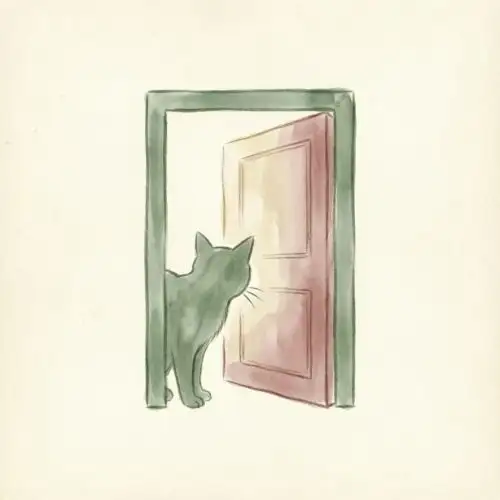
Harness training gives an indoor cat controlled outdoor access on its own terms, and it only works once you stop treating the leash like a steering wheel. The cat sets the pace, the route, and the moment the session ends. Your job is to make the harness boring, make the outdoors something the cat can refuse, and keep the line slack from start to finish.
I'm on the kitchen floor with my back against the cabinet, and the harness is lying on the tile about a foot from the food bowl. Not on the cat. Next to the bowl, where it has been for four days. He sniffs it between bites, ears forward, decides it's not food, and goes back to eating. That's the entire session. That's the point.
Nothing about that looks like training, which is why most people skip it. The harness gets treated as step one when it's really step three. Step one is the object becoming furniture — something that smells like the kitchen and sits near the things the cat already trusts. Food bowl, bed, the spot by the radiator where the sun lands at four in the afternoon. Move it around. Let the cat walk over it, sit on it, bite the strap. If the cat leaves the room when it appears, you moved too fast and you go back to leaving it on the floor.
Two fingers, and one test that actually matters
A harness should let you slide two fingers under the straps without fighting, and it should still be snug enough that the cat can't reverse out of it. Most people get the first half right and the second half wrong, because the two-finger rule is easy to check and the escape test is not.
The test I trust is watching the cat back up. With the harness on and the room closed, wait until the cat reverses into a chair leg or a wall and see what the straps do. If the neck opening slides up over the shoulders, it's too loose, no matter what your fingers told you. Check both adjustment points too — most harnesses adjust at the chest and behind the front legs, and people tend to set one and forget the other.
Here's the thing I learned the hard way: a frightened cat can get out of a harness that felt perfect in the kitchen. Not because it's badly made, but because panic is a different physics. That's why the door stays closed and the hallway gets blocked during early sessions. The harness is one layer, not the whole plan.
The flop is not a failure
The first time I closed a strap, the cat lay down on his side like a felled tree and stayed there, one paw extended, deeply offended. That is not pain and it is not a bad harness. It's an unfamiliar sensation on a body that maps its own edges very precisely, and the standard feline response to unfamiliar is to stop moving until the situation resolves itself.
So I gave it about ten seconds, said something calm, unclipped it, and put a treat on the floor. Next day, fifteen seconds. Then thirty. The number matters less than the ending — every wearing should stop while the cat is still fine, not after the wriggling starts. If the cat is eating, grooming, or walking around with it on, that's your green light to extend.
There's a line between processing and distress, and it's visible. Freezing with normal ears, flopping over, walking stiffly sideways — all processing. Hissing, thrashing, trying to bite the straps, ears pinned flat and rotated out — stop and go back two steps. And a flop doesn't count as success. The gate to the outdoors is the cat walking, jumping onto the couch, and eating a meal while wearing the thing without noticing it.
The doorway is the real border
The kitchen is a controlled environment. The doorstep is not, and this is where a lot of good indoor progress gets thrown away by carrying the cat straight out into an open yard.
I carried mine out the first several times. Carrying, not leading, because dragging a cat through a doorway on a leash teaches the cat that the leash is a thing that pulls. We started on a small closed balcony — maybe eight feet by four — and the first session lasted four minutes, most of which was spent staring at a leaf. Then back inside. Next time, six minutes.
A fenced yard works if the fence is genuinely secure and you're standing right there. A screened porch. A quiet patch of concrete outside a back door. What you're looking for is a space small enough that the cat can't get to a road, a dog, or a gap under a gate before you can react, because you will not outrun a cat.
What the leash is for, and what it isn't
The leash is a safety line. It is not a steering mechanism, and the moment you pull on it you've taught the cat that the harness restricts movement — which is exactly the association you spent three weeks dismantling.
So when the cat heads for a spot you don't want, you don't yank. You stand still and let the line go taut so the cat feels a wall rather than a jerk, or you turn your body and walk the other way so the leash goes slack and the cat follows the slack. If the cat bolts, you go with it. Never reel. Pick the cat up.
Reading the cat instead of the weather
I stopped deciding whether to go out based on how nice the day was and started deciding based on the cat's ears. Flattened or rotated ears, a tail tucked tight against the body, a crouch that stays low to the ground, sudden stillness mid-step, a fast twitching tail tip — those mean the session is over, and you end it on a calm moment rather than waiting for the panic to peak.
Some of it is not stress at all. A cat that goes flat and freezes at the sound of a garbage truck is not traumatized; it's orienting. The difference is what happens after thirty seconds. If the body stays low and the ears stay back, we go in. If the cat lifts its head and sniffs the air, we stay.
And a session where the cat sits under a bush doing nothing for ten minutes is a success. It's not a walk. The cat is collecting data — wind, temperature, the smell of every cat that crossed the yard since Tuesday — and that's the enrichment you came for. Cover and quiet are good. Wide open lawn is not.
Where this honestly falls apart
A harness does not make the outdoors safe. It doesn't stop a loose dog, a car in the driveway, a hawk, or a parasite, and you are still the only thing standing between the cat and all of it. That's a conversation to have with your vet about prevention before the first trip out, not after.
It also builds an expectation. A cat that learns harness means door will sometimes start screaming at the door, or trying to slip out when you come in with groceries. Mine did. The fix was making the harness live in a closed drawer and carrying the cat through the door rather than letting him walk out on his own feet, so the doorway never becomes the cue.
And some cats simply don't want it. If a few weeks of slow steps produce a cat that pancakes at the threshold every single time, put the harness away for a month and try a different season or a different time of day. If it still doesn't take, the honest answer is that a window perch and an open screened window might be the whole of what this particular cat needs. That isn't a training failure. It's the cat answering the question you asked, and the answer is that the indoors is already his territory.