Hairless cats do not shed visible fur, but they are not a low-maintenance cat, and the skin care is not optional. With no coat to carry oil away from the body and no ear hair to keep wax moving outward, a hairless cat needs routine skin wiping or bathing, more frequent ear cleaning than a coated cat, and deliberate management of warmth and sun for its entire life. The missing hair on the couch is real. It is also the only part of the arrangement that gets easier.
I keep a shallow basin of warm water on the bathroom counter on Sunday mornings, with a folded microfiber cloth, a stack of cotton pads, and a dry towel already within reach before the cat comes in. The order matters more than the equipment. A Sphynx that decides the counter is a trap becomes a warm, slippery, remarkably strong animal with twenty claws and no fur to grab, and the rest of that morning is gone.
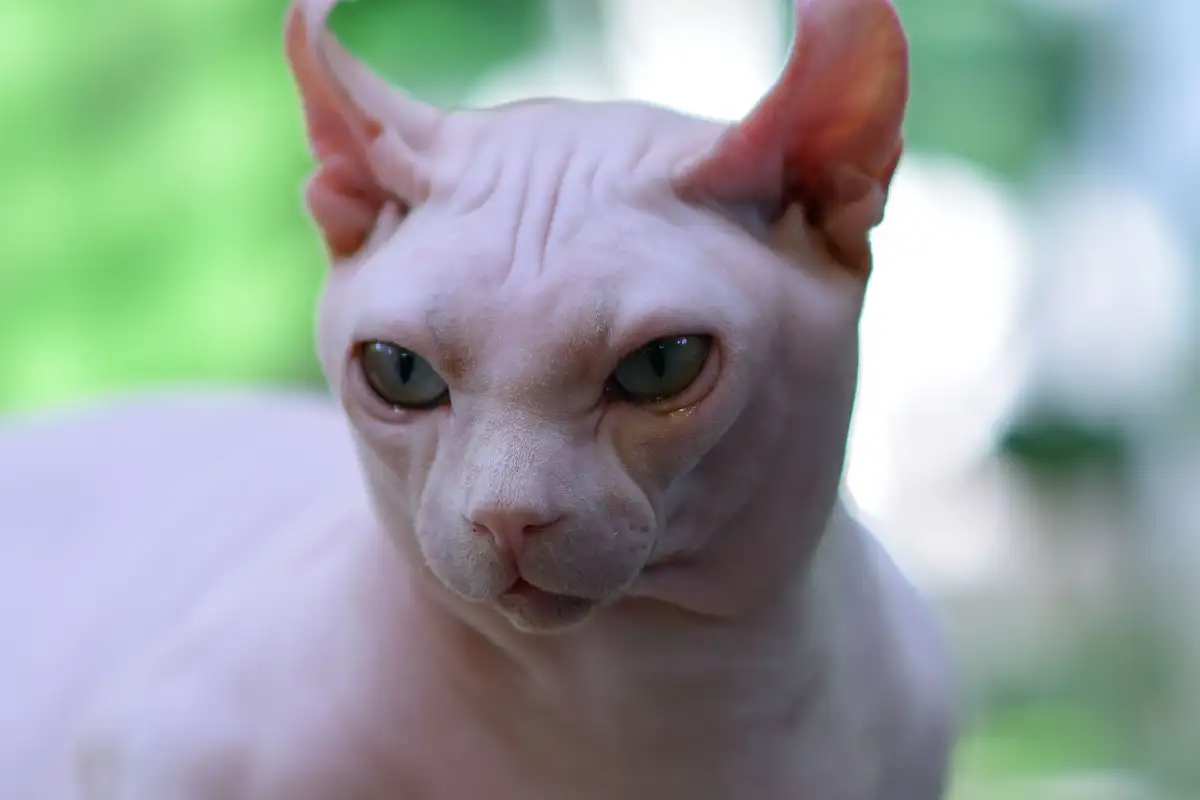
What surprises people who have never held one is the temperature. Not warm. Hot, like a water bottle that has been under the covers for an hour. Run your palm down a Sphynx flank and you feel suede with a grain to it, a fine down that catches the light in the window. That down is the whole point of the confusion.
"Hairless" is a direction, not a fact
Almost none of these cats are actually bare. A Sphynx carries a short, soft down over wrinkled skin, heaviest on the shoulders and the bridge of the nose. A Donskoy tends to feel more rubbery, with deeper wrinkles and a coat that ranges from fuzz to nearly nothing. A Peterbald is the wild card of the group, because the same breed can produce a genuinely bald cat, one with a fine chamois-like covering, and one with a stiff short brush coat that feels like a new paintbrush. A Bambino is built on the same body as a Sphynx with much shorter legs, so the skin and the oil behave the way a Sphynx's do.
That texture changes the job. A cat with a little down wicks some oil into the fuzz and stays tacky rather than slick. A truly bald cat has nowhere for the oil to go, so it sits on the surface and transfers to everything the cat touches.
And they do still shed. Not the way a Maine Coon sheds, but the down and the skin cells turn over and come off, which is worth knowing before you promise someone a house without cat hair in it.
The oil is the whole problem
A coated cat grooms, swallows loose hair, and moves oil down the shaft where it eventually leaves with the shed. Take the coat away and the oil stays on the skin. It builds in the creases behind the front legs, along the belly, around the neck where a collar would sit, and at the base of the tail.
The touch test is what I actually rely on. Run the back of your knuckles from the shoulder blades down to the hip.
If they come away slick, the way your hand feels after you have handled a buttered pan, it is time to wipe or bathe. If the skin feels dry, tacky, or squeaky, back off for a few days. That second part is the one most people miss, and it is the one that matters. Strip a hairless cat's skin too often and too aggressively and you remove the oil layer it needs, the skin responds by producing more, and you end up bathing more often to fix a problem you created by bathing too often.
So the schedule is not a schedule. In a dry winter house I go longer between full baths and use warm water on a cloth most days. In a humid summer, or in a week when the cat has been sleeping on the radiator, it tightens up.
Bathing is not automatically better than wiping. It depends on the cat. I have known Sphynx that stand in the sink like it is a spa and others that scream through the whole thing, and a cat that fights a bath hard enough to scratch its own skin open is worse off than a cat that gets wiped every day with a warm cloth. Match the method to the animal, not to a rule you read somewhere.
Ears, and the coffee-grounds look
Cats with hair in their ears have a wicking system. Hairless cats do not, so wax accumulates in the folds instead of migrating out.
Wet a cotton pad with warm water, fold it around your fingertip, and wipe what you can see: the outer flap, the pockets just inside the rim, the crease where the ear meets the head. What comes off is usually brown and slightly granular, and it looks more alarming than it is. Do not push anything down into the canal. You will pack wax against the eardrum and you will not get it back out.
What should send you to a veterinarian rather than back to the cotton pads: a strong smell, discharge, head shaking, a cat that flinches when the ear is touched, or skin inside the ear that is red and angry. Those are not grooming problems.
Cold, heat, and the sunbeam by the window
With no insulation, everything about temperature is on the surface. These cats find heat compulsively. They will sit on a laptop that is still running, wedge themselves against a dryer, sleep under a duvet with only a nose out, and follow a patch of sun across the floor like it is a job.
Cold is the other half. A drafty floor, a tile kitchen in January, a windowsill with a bad seal. Some cats want a sweater and will tolerate one; some will walk sideways and fall over until you take it off. A heated bed or a folded blanket in a warm corner does more for most of them than clothing does. Test it and watch the cat, because there is no universal answer here.
Sunburn is the one people genuinely do not expect. Window glass blocks most of the shorter ultraviolet light, so a cat baking in a south-facing window does not get the burn that a cat outdoors would. What gets through is the longer wavelength, and over enough afternoons on a pale, thinly furred back and the ear tips, it adds up. If your cat owns a specific sunbeam, closing the shade during the strongest part of the afternoon or putting a UV-blocking film on that pane solves it. On the ears and the nose bridge especially, look before you assume.
No, they are not allergy-free
The protein that drives most cat allergies, Fel d 1, is produced in saliva and skin, not in the hair shaft. A hairless cat makes it, licks it onto itself, and sheds skin cells carrying it into the air, exactly like any other cat.
Some allergic people report that they do better in a house with a hairless cat, and there is a plausible reason for that: less airborne hair means fewer particles riding on it. But "fewer" is not "none," and it is very individual. Anyone choosing one of these breeds specifically to solve an allergy should spend real time in a room with one first, ideally more than once, before making a decision that lasts fifteen years.
What you are actually agreeing to
Fifteen minutes a day, most days, some of it mildly unpleasant, for the life of the cat. Oil prints on the couch and on white bedding until you get the routine calibrated. A trade of hairballs for grease marks. A cat that is genuinely more comfortable at 78 degrees than at 68. Ears that need attention on a schedule the cat did not agree to.
And a hard line: anything on the skin that is red, crusted, oozing, scabbing, or clearly itchy is not a grooming problem and not something to treat with a shampoo you picked, medicated or otherwise. That is a veterinarian's call, and the sooner the better, because skin problems on a cat with no fur to hide behind get worse fast.
What you get back is a cat that lives against you. No fur between you and the warmth. You will know it by feel within a week — you will run your hand along that flank in the evening and know without thinking whether tomorrow is a bath day or a rest day. That instinct is the actual skill. Everything else is a cloth, a basin, and a cat who has decided the counter is a trap.