More shedding on its own is rarely the emergency. What moves this from a grooming annoyance to a veterinary appointment is what is happening on the cat rather than what is happening on your floor: visible thinning or bare patches, broken or stubby hairs, redness, scabs, dandruff that was not there two weeks ago, constant scratching or licking at one spot, or a coat that has gone dull and brittle at the same time the cat is losing weight or acting off. Those get an exam. The rest usually gets a better brush and some patience.
I check the cat before I check the house. That order matters more than anything else here, and I learned it the boring way.
When I started fostering, I measured shedding by volume. How much fur was on the couch, how many hairballs in a week, whether a black shirt survived a lap. That is a bad metric. A cat can dump an enormous amount of undercoat and be perfectly healthy, and a cat can be in real trouble while leaving almost nothing around the house. Volume tells you how much hair left the cat. It does not tell you how much hair stayed.
So what I look at is coverage. Under all that loose fluff, is the skin still covered?
Normal shedding is a cycle, not a malfunction
Old or damaged hair gets pushed out and replaced, on a loop that runs at its own speed in every cat. Breed, coat type, age, and hormones all nudge that speed, and so does plain individual variation. I have had two cats in the same house, same food, same sunny window, on completely different schedules — one drops a full undercoat twice a year like a scheduled event, the other trickles hair out all twelve months and has never once produced a visible blowout.
That is the first thing to internalize: your cat is the baseline, not the breed chart.
Double coats are the ones that startle people. Maine Coons, Norwegian Forest Cats, Siberians, and a huge number of domestic longhair and shorthair mixes carry a dense undercoat beneath longer guard hairs. When light and temperature shift, that undercoat releases in a mass. Spring is the big one; plenty of double-coated cats do a smaller encore in early fall. Single-coated cats — Siamese, Burmese, Tonkinese, Bombay, the Rex breeds — have no undercoat to dump, so their shedding is more even across the year and usually less dramatic.
Indoors, the seasonal calendar goes soft
Artificial light and climate control blur the cues. A cat living under steady overhead light in a 70-degree house does not get a strong signal to shift coats, so instead of two clean blowouts you get a low, constant rain of fur, all year. Owners read that as "she sheds too much." Often it is not too much. It is too evenly.
I stopped trying to fix that with tools, because it does not fix. A deshedding rake, a slicker brush, a rubber mitt — they all do roughly the same job: they take out hair that has already let go. That is worth doing. It cuts down hairballs, it cuts down the tumbleweeds drifting under the sofa, and it buys you ten minutes with your hands on the cat, which is how you notice the stuff that actually matters. But the follicle keeps cycling on its own schedule. No brush changes that, and anything marketed as a way to stop shedding is selling something that is not on the menu.
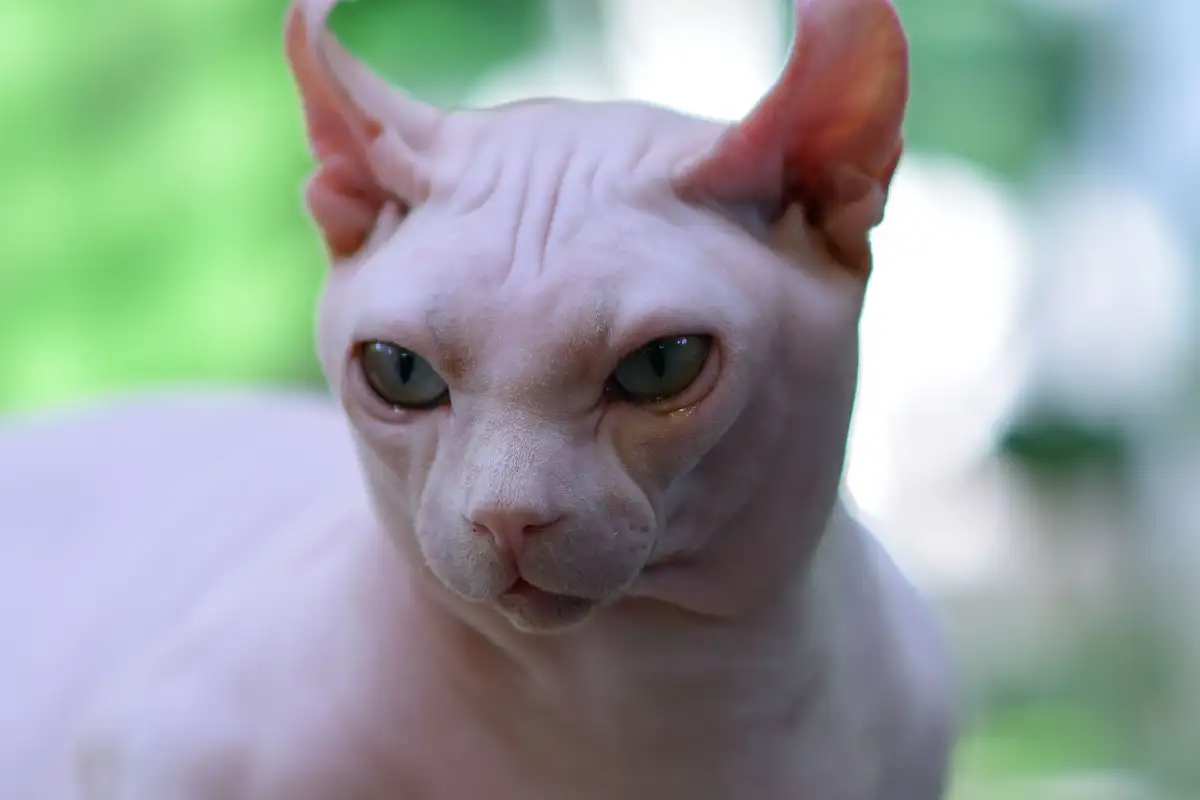
Hairless cats are not exempt from any of this. Sphynx and the other hairless breeds still cycle skin cells and oils. Their skin gets tacky, their ears get waxy, their nail beds get greasy. If a hairless cat suddenly looks different — oilier, duller, irritated — that is a vet conversation the same way a coat change would be.
Is the cat losing more hair, or losing hair?
This is the question I ask before anything else, and it is the one I would put to any owner.
Losing more hair looks like more fur in the brush, more on the floor, more in the litter box, more hairballs, a visible release of undercoat. The cat underneath looks the same. Coat is full. You cannot see skin. That is a cycle doing its job, and in March it can look alarming.
Losing hair looks like thinning. You can see skin through the coat — along the flanks, the back of the hind legs, the belly, around the base of the tail. What is left may look patchy, or the hairs may be broken and stubby instead of full length. That is not ordinary shedding. That is hair failing to be replaced, or being pulled out, or the skin underneath giving the cat a reason to groom it away. Different problems, different causes, and none of them solved by a better brush.
Heavy shedding without bald spots is generally not an emergency. A cat with a full coat, intact skin, normal appetite, and normal behavior does not need a midnight run to the clinic. It is the combination — shedding plus thinning, shedding plus itching, shedding plus flaking, shedding plus a weight change — that pulls it out of the grooming column and into the medical one.
What actually happens in the exam room
When I bring a cat in for a change in coat, this is roughly the sequence. Knowing it made me a much better observer at home.
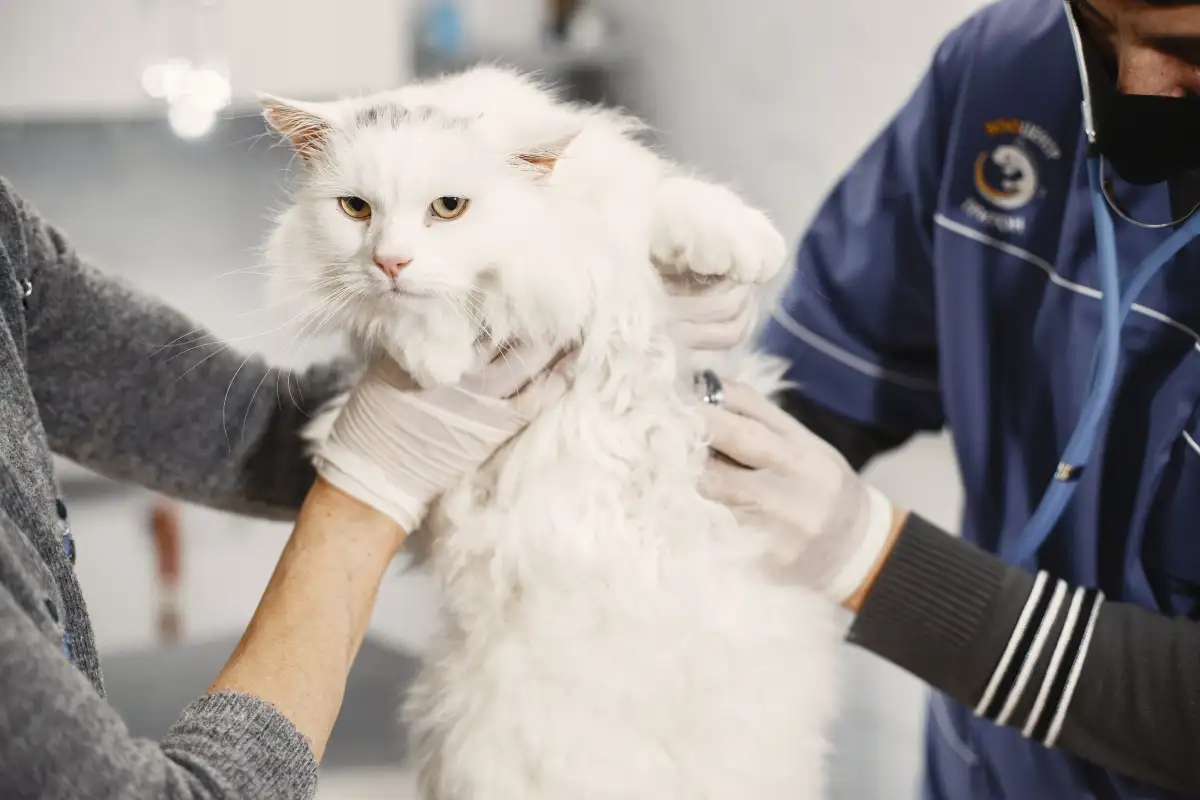
The vet looks at the whole animal first: weight, body condition, coat sheen, how the cat carries itself on the table. Weight matters more than people expect, because a number on a scale is objective in a way that "she seems a little thinner" is not.
Then they comb. Running a fine-tooth comb through the coat over a sheet of white paper tells them how much hair releases, whether it comes out in tufts, and whether crust or scale rides along with it. Then they part the coat and look at the skin itself — redness, bumps, scabs, thickening. Ears, paw pads, nail beds, the strip along the back, the base of the tail. A damp white paper towel or a flea comb pressed into the fur shows what is sitting in the coat. They will ask about diet and any recent change to it, about stress in the house, about other animals, about anything new in the last couple of months. Those questions are not small talk; several of them are the whole workup.
If something is visible on the skin, they may take a sample — a scrape, a tape prep, a few plucked hairs. If the coat looks poor alongside weight loss or appetite change, they may run bloodwork, because skin and coat are often the first place a systemic problem shows up.
Most of that is a fifteen-minute exam and maybe one inexpensive test.
Which changes what you should walk in with. You do not need a diagnosis to bring them. You need a description, and the more comparative it is, the more useful it is. "She has always blown her coat in spring, but this year there is also a bald patch on her left flank that showed up about three weeks ago, and she licks that spot more than she used to" is worth ten times "she is shedding a lot." Timeline. Location. What changed. Whether the skin looks different under the hair.
Where grooming stops helping
Grooming manages the hair that is already loose. It does not manage the reason a cat is losing hair she should be keeping. If you comb and the dead undercoat comes away, the tool is working. If you comb and you are pulling hair out of a coat that is visibly thinning, put the tool down and make the call.
Diet does affect coat quality, and a vet working up a coat problem will want to know what the cat eats, how much, and whether anything changed recently. That is a conversation to have with them. It is not a shopping decision to make alone in the pet aisle.
And the last thing, because it is the thing that gets skipped: a cat pulling out her own hair is not shedding. Over-grooming leaves symmetrical or patchy bare areas, often on the belly, inner thighs, or flanks, and it tends to come with a cat who is at it constantly — not in the ordinary licking-a-few-minutes way, but in a way you notice. Shedding does not do that. When you see it, stop reading about brushes.