A kitten that bites hands is not aggressive and does not need the behavior shut down. It is in the middle of learning a motor skill that littermates would normally teach it between roughly 8 and 14 weeks, and the person whose knuckles are getting chewed is standing in for those siblings. What's being trained is jaw pressure, not the absence of teeth. Teeth on skin should end play instantly and identically from every person in the house, a soft toy should land in the kitten's mouth the moment the mouth opens on a hand, and hands are going to get scratched for several weeks while the pressure dials down. A soft mouth is the goal. A kitten that never uses its teeth at all is not the goal, and isn't really what you want.
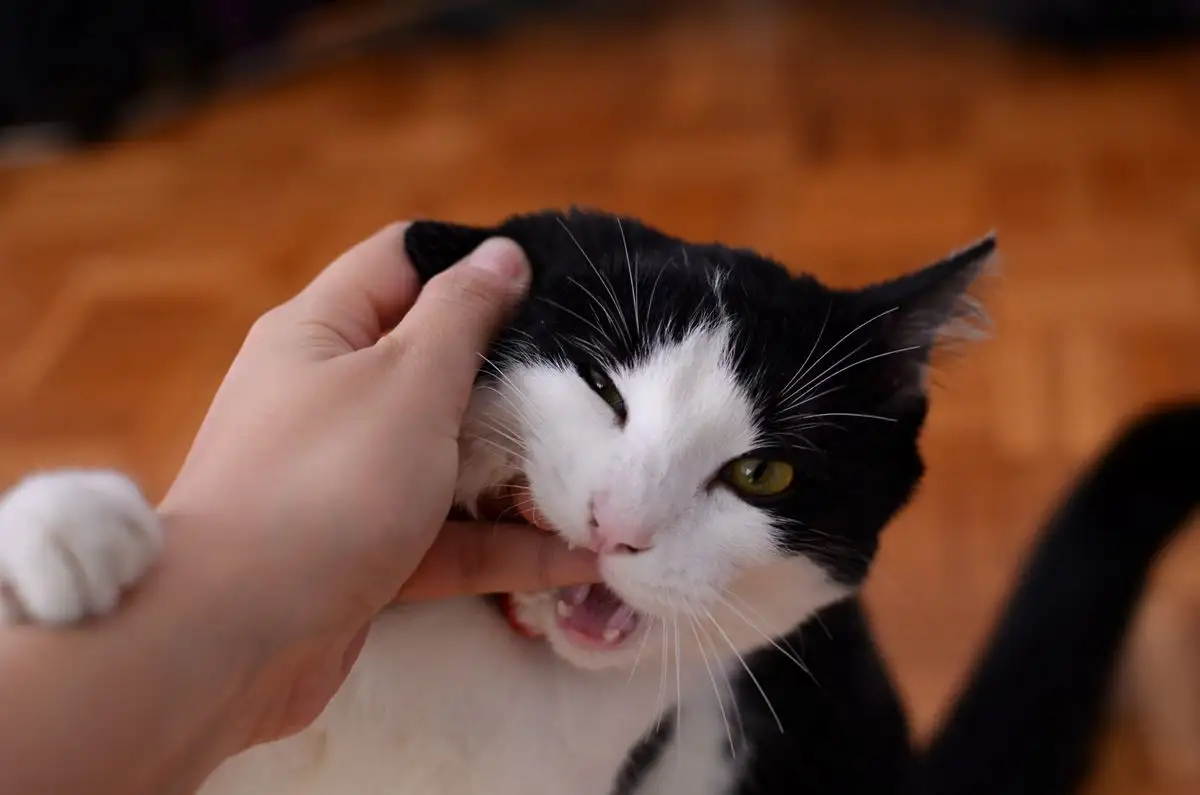
The version of this I keep ending up in doesn't look dramatic. I'm on the floor with my back against the couch, a kitten straddling my forearm, her mouth open around the pad of my thumb. It doesn't hurt. That's the detail that fools everybody. It doesn't hurt, so you keep playing, and that small decision is what the next six weeks get built on. Then she's heavier, the adult teeth are pushing in, there's a red line across your knuckle, and some voice in your head says aggressive. It isn't aggressive. It's confident. Nobody has given her the data that says jaws have a limit.
Bite inhibition is a lesson, and it has a window
Between about 8 and 14 weeks, a litter spends most of its waking hours on top of each other. One kitten clamps down too hard, the sibling yelps and stops playing, and the kitten who bit too hard loses her playmate for the next thirty seconds. That repeats a few hundred times. That's the entire curriculum: teeth that hurt end the fun.
A kitten raised alone, or separated from the litter before 8 weeks, misses most of those repetitions. She isn't mean. She's under-informed, and the household is now the only classroom she has.
The window isn't a trapdoor. Cats can learn jaw pressure later. It's just slower, and the kitten's own teeth get more capable every week you wait.
The yelp is half of it. The pause is the other half.
A short, high-pitched 'ow' — one syllable, closer to the sound a littermate makes than to a human yell — and then nothing. Your hand goes flat and boring mid-motion. You look away. You don't yank it back, because a fast-retreating hand triggers the chase reflex and now you're prey. Count to five, maybe ten, then pick the game back up calmly.
The yelp by itself teaches nothing. If you squeak and then keep wrestling, you've taught her that the noise is part of the game — the yelp becomes a squeaky toy. The lesson lives entirely in what happens afterward: the fun stops the instant teeth press.
If she comes back to skin within the next minute, the session is over. Stand up, walk away, two minutes of nothing. She administers that consequence to herself, which is why it lands harder than anything you could do to her.
Where to set the line
There are two workable versions, and they don't mix well.
One is a hard rule: any tooth contact on skin ends play, every time, no exceptions. It's easy to be consistent about, and it's the version I'd hand to a house with young kids in it.
The other is the one I use with kittens I'm keeping. You react only to pressure that's over the line, accept light mouthing at first, and lower the line every couple of weeks — first teeth that hurt, then teeth that press, then teeth on skin at all. That's how a cat ends up with real jaw calibration instead of a blanket ban, and it's also how you avoid yelping at a mouth that didn't hurt. Yelping at a soft mouth is just noise, and it teaches her that your reactions are random.
Pick one and hold it. Switching back and forth is worse than either.
Every hand in the house has to vote the same way
Kittens don't generalize well. She learns each person's hands separately. If one person in the house thinks it's funny when she latches onto a wrist like a remora, that person's hands are a toy and everyone else's are not, and she'll make that distinction in about a week. When someone says she only does it to me, that isn't random. That's the leak.
Kids are the usual problem, and it isn't their fault — a hand-tussling game is the most natural thing in the world for a nine-year-old. Guests are the second leak. So is the person who says just this once at eleven at night, tired, with a kitten being adorable in their lap.
Fingers under the blanket are a training exercise, just the wrong one
Wiggling your fingers under a duvet, letting her bat at a bare hand, wrestling with a hand instead of a toy — all of it teaches the same lesson: skin is the target. The blanket ambush is the one people refuse to give up, and it's also the one that produces the kitten who pounces on an ankle from under the bed at 5 a.m.
If you love the blanket game, run it with a long fabric toy under there instead of your hand. Nothing about the game has to change except whose body is in the blanket.
Skip the corrections people reach for — the nose tap, the scruff, the spray bottle. None of them teach jaw pressure, which is the actual subject, and some of them produce a cat who bites faster to pre-empt the correction.
What to do in the half-second you have
Redirect. Not stop biting — bite this instead. Keep something soft within arm's reach: a cloth mouse, a crumpled paper ball, a kicker the length of your forearm. When the mouth opens on your hand, you don't pull out of reach, you slide the toy into the gap the way you'd swap a rattle into a baby's hand, and then you keep the game alive on the toy. Chase, wrestle, rabbit-kick, all of it.
The kicker has to be long. If it's short, your knuckles end up back in range and you've solved nothing.
The other half of redirection is boring math. A kitten with two or three real play sessions a day — wand toy, let her catch it, let her carry it off — hits your hands far less often, because hands stop being the only exciting thing in the room.
And if you have a single kitten and you're exhausted, a second kitten in the same age band is often the real answer. It isn't free: double the vet bills, a genuine introduction period. But no human delivers littermate feedback at littermate speed. Not for lack of trying.
What improvement actually looks like
Weeks, not days. Single kittens and kittens separated early mouth harder and go longer, so if that's your situation, expect the timeline to stretch. A quick fix isn't on the menu, and anyone promising one is describing a different kitten.
The first thing that changes isn't the number of bites. It's the pressure. Then it's mouthing that leaves no marks. Then it's a clamp-and-release instead of a grind. Then, at some point, she redirects to the toy herself before you get a chance to intervene — that's the one I wait for.
Around four to five months, when the adult teeth come through, expect a spike: more chewing, a few old incidents back from nowhere. That's teething, not regression. Give her something legitimate to destroy, keep the rule steady, and it flattens out again.
When it isn't a training question anymore
If biting is still going on well past the kitten stage, if it arrives with hissing, flattened ears, or a puffed tail before contact, if it's a grab-and-hold rather than a mouthing, or if it happens when you approach or handle her instead of mid-play — that's a different conversation, and it belongs with a veterinarian. Same if it's escalating rather than fading.
And any bite that breaks your skin: wash it thoroughly and get it looked at. Cat bites infect at a high rate. That's a medical matter, not a behavior one.
What the scratches actually buy
You aren't teaching don't bite. You're teaching how hard. A cat with a calibrated jaw is the cat who, at the vet, or at the end of a tail that got stepped on, does a fraction of the damage a cat without one would do. That's what's on the other side of a few weeks of shredded knuckles — not a cat with no teeth, but a cat who knows exactly what hers are for.