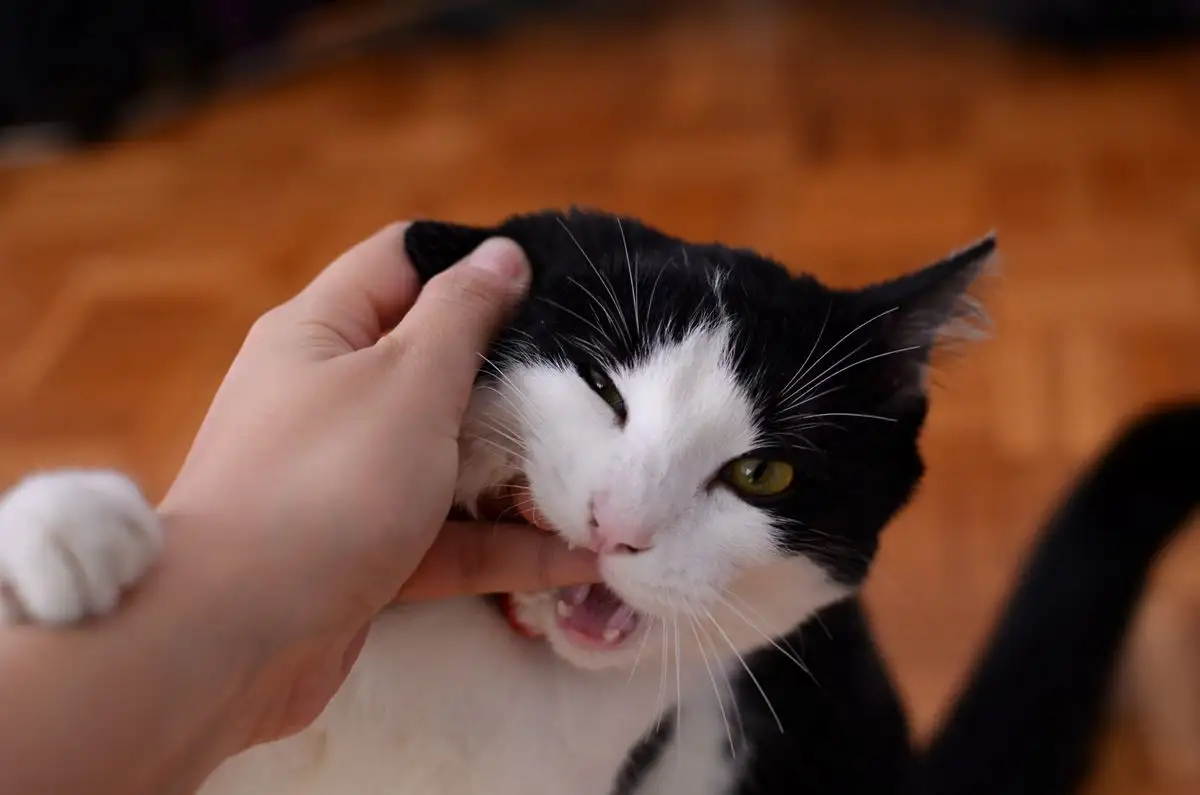
The bite that lands after your cat has been staring out a window is usually redirected aggression, not a sudden change in temperament. The cat locked onto a trigger it could not reach, most often another cat on the far side of the glass, and when the arousal had nowhere to go, it discharged into the closest warm body. The mistake almost every owner makes comes afterward: the cat stays hot for twenty minutes to several hours, and reaching in to comfort, carry, or apologize is the fastest way to collect a second and worse bite.

I was holding a mug when the gray tabby walked the fence line. My cat was already up on the sill, shoulders low, tail ticking against the wood trim. The tabby slipped behind the hedge. My cat turned, and my forearm was in her mouth before I understood she had moved. No hiss. No warning. And the detail I keep circling back to: she never looked at me. Her eyes were still on the window. That is what separated this bite from every other bite I have taken in fifteen years of sharing a house with cats and fosters.
The tell is the eyes, not the mouth
When a cat is in this state, the whole body is aimed outward. Pupils blown wide and black, sometimes so wide the eye looks like a hole. Ears rotated back and out, not pinned flat. Whiskers pushed forward. A ridge of fur standing along the spine. The tail is the loudest part: a slow heavy thump against the sill, or a tip that flicks in tight, fast arcs. Sometimes there is a sound, a low drawn-out moan that is not quite a meow. Sometimes the jaw chatters at the bird feeder. Sometimes there is nothing at all.
What I have learned not to trust is the pause. A cat in redirected aggression can stand still for ten seconds and look almost reasonable, and that stillness is not recovery. It is a held breath. Move into that stillness and you find out what was underneath it.
The other thing I check is where the eyes are pointed. If the cat was watching something outside and never oriented toward me before contact, I know what I am dealing with. If the cat was watching me, that is a different problem entirely, and it is usually overstimulation from petting, play that got too rough, or something physical that hurts. Same teeth, different machinery, different fix.
The trigger is almost always at ground level
This is the part people skip. It is not the birds. Birds are usually fine. The trigger is a cat, a raccoon, a fox, a dog on a leash, moving through the yard at roughly the height of the sill, close enough to feel like an intruder and separated by glass the cat cannot get through. A sliding glass door onto a deck may be even worse than a window, because the cat can press right up against it and pace.
Smell and sound do their share too. A strange cat that sprayed the porch railing the night before. A screen door rattling. Something yowling in the dark two houses over. The cat cannot reach any of it, which is exactly the point. Redirection only happens when the target is unreachable.
I have seen the pattern run by season. Late winter into spring, when the neighborhood cats start patrolling again, is when it spikes. Dusk is when it spikes. If your cat only does this in one window at one time of day, you already know more than most people do: the sightline is the problem, not the cat.
The ninety minutes that decide whether you get bitten twice
The second bite is the one that really costs you, and it is almost always self-inflicted. I have done it. The cat bites, you yank your arm back, and then the guilt hits, and you go after the cat to check on it or carry it to another room or tell it that it is okay. That is when you find out the arousal did not end with the bite.
Hands off, voice down, leave the room
After the initial bite, do not scoop the cat up. Do not corner it in a hallway. Do not kneel down and make soft eye contact from two feet away, because proximity itself reads as a threat when the cat is this keyed up. Lower the lights. Pull whatever covers that window or glass door, and if there is nothing to pull, put something opaque between the cat and the sightline for now. Then leave.
Most cats will solve this themselves if you let them. Mine goes under the bed in the back room, and I do not follow. I close the door to that room so the other cats and the dog stay out of the hallway, and I go deal with my arm. That is it. The room is dim, the trigger is gone, and nothing new is happening. Arousal drops on its own when nothing keeps feeding it.
What you should not do is shut the cat in a bathroom or a carrier. Those have nowhere to hide, and a cat with no escape route and a full head of steam is a cat that will bite again the moment you open the door.
Food tells you when the peak has passed
My gauge is the food bowl. An hour or two after the episode, I put a normal meal in the normal spot and step back. A cat that comes out and eats like nothing happened is usually past the peak. A cat that looks at the bowl, takes two bites, and walks off stiff-legged is not, and I leave it alone for another stretch.
Feeding is not a reward for biting. It is a thermometer. I am not trying to teach anything in that window; I am trying to find out whether the cat is still loaded.
The things that feel kind and make it worse
Yelling stops nothing. Clapping, spraying water, scruffing, or hissing back all add arousal to a cat that is already at the ceiling, and they teach the cat that hands are unpredictable. Punishment after the fact does nothing at all, because the cat connected the arousal to the thing outside, not to you.
Picking the cat up to "let it see there is nothing to be scared of" is the single most common way to earn a repeat. So is dragging a second cat over for company. So is letting the neighbor's cat keep patrolling that one fence line because it seems harmless. It is not harmless. It is the entire engine.
Take care of your arm before you take care of anything else
Wash the wound with running water and soap, cover it, and get a medical opinion. Cat teeth are thin and sharp, and they push bacteria deep under the skin before the surface closes over the top. That is the whole problem with cat bites on hands and wrists, where the tissue is tight and the joints are close to the surface. Do not wait for redness to show up to decide it matters. If the bite is deep, if it is on a hand or over a joint, or if you have any condition that affects your immune response, get seen the same day.
Once that is handled, go back to the cat. Not to comfort it. To check that the window is covered and the room is quiet.
When it keeps happening
One episode with a clear one-time trigger is a housekeeping problem. A cover over that sightline for a few weeks, or permanently if the neighbor's cat is a regular, usually ends it. I have watched cats settle completely once the visual trigger was removed and the household stopped rehearsing the drama around it.
Repeated episodes are different, and that is where I stop guessing. A cat that goes off this way every few days, or that stays agitated for the rest of the evening, or that has started biting without any visible trigger at all, needs a veterinarian and often a veterinary behavior consultation. There are medical reasons a cat's threshold drops this low, and there are patterns that respond far better to a real behavior plan than to an owner moving furniture around and hoping. Trial and error on your own is slow, and the cost is measured in bites.
The cats I have lived with did not do this because they were mean, or dominant, or holding a grudge. Every one of them was a cat that wanted something it could not have, and I happened to be standing between the cat and the glass. Once I stopped taking that personally, the second bites stopped.