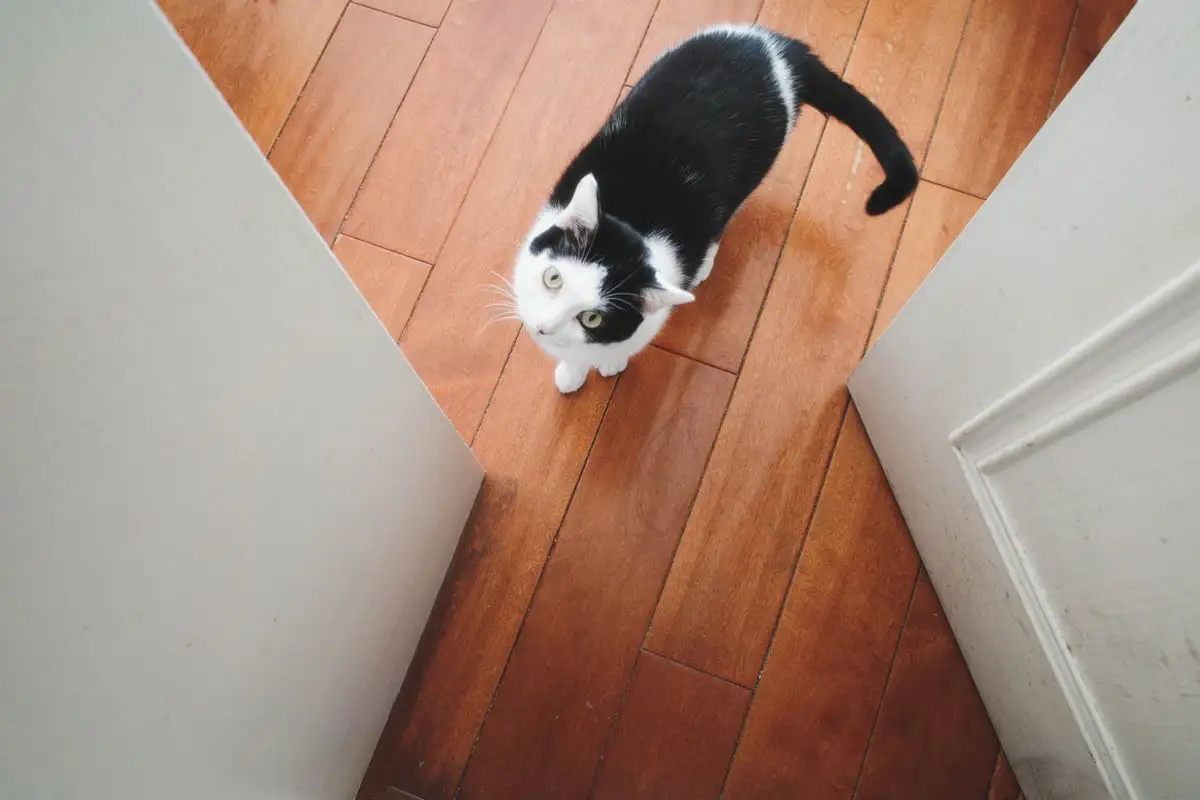
Two cats need three litter boxes, and the boxes only count as three if they sit in separate rooms with different sightlines. The number is not a superstition or a bit of extra kindness — it is arithmetic about exits. Line three boxes up along the same laundry room wall and you have built one bathroom with three toilets, which is exactly the arrangement that fails when there is any tension in the house. In a two-cat home the third box is not spare capacity. It is the box that lets the cat who loses the argument still get to go.
I figured that out in a hallway, not from a book. Six in the morning, coffee going cold, and one of my two cats sitting on the bath mat about four feet from a litter box she had used every day for a year. Not squatting. Not crying. Just sitting, facing the doorway, waiting. Down the hall, the other cat was stretched across the threshold of the room where the box was, half asleep, one eye open, doing absolutely nothing except existing in the only path in and out. Nothing happened that morning. That was the point. Nothing had to happen — the box was simply not available, and both of them knew it before I did.
Stand in that hallway with me and look at what is actually there. Count the exits. The box in the back bedroom sits in a corner with one approach, past a door that swings inward. The cat who wants to use it has to commit before she can see whether the room is empty. Now walk to the bathroom at the other end of the hall, where the second box sits beside the tub with a door that pushes open and a window on the far wall. Different room, different angle, different escape. Same cat, same need, completely different odds.
That is the whole idea. Not fairness. Geometry.
The count is a floor, not a target
The one-box-per-cat-plus-one guideline gets repeated so often it starts to sound like a slogan, so here is what it is actually doing. The extra box is not there because cats are messy. It is there because in any two-cat house there is a cat who yields, and a cat who yields needs a bathroom she can reach without walking past the other one. One box per cat gives every cat a toilet. The plus-one gives the yielding cat a route.
Which is why the extra box matters most in homes that already have friction — the pair who tussle over the sunny windowsill, the older cat who has stopped sleeping on the bed, the two who are fine until one comes around a corner too fast. In a genuinely easy pair, two boxes in two rooms can work for years. I have seen that. But the houses where someone is quietly avoiding something are exactly the houses where the third box earns its square footage.
Why side by side defeats the purpose
Three boxes in a row in the same room is one location with three liners. If a cat is holding the doorway, she is holding all three. If a cat is nervous about the furnace kicking on beside the boxes, all three are compromised. The boxes need to differ in room, in approach, and in what the cat can see while she is in them. One box where she can watch the door. One box in a quiet dead-end where nothing walks past. One box with a view of the room. That spread is what the count is trying to buy you.
What guarding actually looks like
I had been watching for the dramatic version — the swat, the yowl, the chase — and missed it for months, because guarding at a litter box is usually dull. It looks like:
- Hovering. One cat standing near the box, not using it, not leaving.
- Loitering in the doorway or on the threshold, facing in or facing out, apparently napping.
- Sitting in ambush a few feet away, around the corner or behind the door, where the exiting cat cannot see her until she is out.
- Following. One cat trails the other toward the bathroom, stops short, and settles in the hall.
- The queue. One cat waits at a distance while the other uses the box, and the waiting cat is always the same cat.
None of that is aggression you would call aggression. All of it is a tax. And the cat paying the tax does not complain — she just starts going less often, or going somewhere else, or holding it until the house is quiet.
Covered boxes make it worse
A covered box has one entrance. In a single-cat home that is fine, even preferred by some cats. In a two-cat home you have taken a room with one door and put a cat in it. The cat inside cannot see out, cannot hear well, and has exactly one way to leave — through whatever is standing in front of the opening. If there is any guarding in your house at all, swap at least one covered box for an open one and watch what changes. The open box is not prettier. It just has more exits, and exits are the currency here.
When a shared box is fine, and when it isn't
Some pairs genuinely share. Mine did for a while, in the early months, when they were both young and the house was calm and neither had anything to protect. Here is how I tell the difference now. If both cats use the same box and neither one waits, hovers, or checks the hallway first, the box is shared in fact and not just in appearance. If one cat uses it freely and the other only uses it when the first is asleep on another floor, that is not sharing. That is a schedule, and schedules break the week something changes.
Watch for three weeks and count who you actually see going in. Not who you think goes in. Who you see.
Learning which cat is avoiding which box
You cannot fix distribution you have not mapped, and in a multi-cat house the map is usually wrong in your head. What worked for me was boring:
I scooped at the same time every day and wrote down what I found, box by box. Number of clumps, roughly how big, where in the box. Over a couple of weeks a pattern showed up that I had completely missed — the bathroom box was getting steady traffic, the bedroom box was getting almost nothing, and the basement box was getting exactly one large deposit a day, always overnight. That overnight box was the yielding cat's box. She was using it only when the house was dark and everyone was elsewhere.
Clump size and count are a rough proxy, not a diagnosis. Two cats can produce a confusing ledger. But you are not building evidence for a court; you are looking for a box that is suspiciously quiet, and a cat whose output shows up only in the small hours. Then look at where that cat sleeps relative to each box, and how far she has to travel, and what she has to walk past.
When there are more cats than rooms
Eventually the arithmetic runs out. Four cats in a two-bedroom apartment do not get five ideal boxes in five ideal locations, because there are not five locations. When that happens, prioritize in this order: spread first, then size, then privacy. Get boxes into genuinely separate spaces even if some of them are smaller or less pretty than you would like. A mid-sized open box in a hallway alcove beats a large covered one in the same room as two others. Then protect the routes — keep the hallway clear, stop the door from closing, move the box that sits beside the noisy appliance.
And be honest about capacity. If every route to every box passes through one room where one cat likes to hold court, you do not have a box problem, you have a floor plan problem, and no fourth box fixes it. That is worth saying out loud rather than buying more plastic.
One more thing, because it matters more than the count. If a cat is urinating outside the box, especially repeatedly or in new places, that is not a box-arithmetic problem and it is not something to solve with placement alone. Get her to a veterinarian first — urinary issues in cats are common and time-sensitive — and if she checks out clear, bring in a qualified behavior professional. Resource distribution is what you fix in the hallway at six in the morning. It is not a substitute for medical care, and it should not be asked to be one.