Bathing a cat that hates water without injury comes down to treating the bath as a series of stress thresholds, not a wrestling match. Prepare the room and the cat days ahead, use the least handling that keeps the cat supported, keep a second person nearby if you can, and treat flattened ears, dilated pupils, a thrashing tail, growling, or sudden stillness as the signal to stop—not as the moment to grip harder.

I start on the bathroom floor, not at the sink. The door is closed, the room is warm, and I have a shallow plastic tub with two inches of water that I can dump with one hand. A folded towel sits on my left knee, a second towel on the floor, and a plastic pitcher is within reach. The cat is not in the tub yet. The cat is on the bath mat, sniffing the edge, and I am watching the face.
Read the Face Before the Water Touches Fur
The scratch almost never comes out of nowhere. It comes after a conversation you can learn to read. A cat that is merely unsure will hold its ears slightly back, watch the water, and keep its tail low but loose. A cat moving toward a bite will flatten its ears against its skull, widen its pupils until the eyes look black, and start a tail that thrashes in hard, separate strokes. Some cats growl. Some hiss. Some do the thing people miss most: they go completely still.
Stillness is not calm. A cat that freezes has stopped trying to negotiate. If the next thing you do is pour water on its back, you will likely get a bite or a hind-foot rake. I treat still as red. I stop. I put the pitcher down. I let the cat stand on the mat and look around.
I use a simple three-color read. Green is a cat that is curious, ears forward, tail relaxed, stepping toward the tub on its own. Yellow is a tail tip twitching, ears rotating, pupils starting to widen, a cat that is still willing to stay but is no longer comfortable. At yellow, I slow down. I use a washcloth instead of the pitcher. I give the cat a break. Red is flattened ears, hard tail, growl, hiss, or freeze. At red, the bath ends for now. That is the exit plan. You decide it before you need it.
The Bath Starts Days Earlier
The worst bath I ever helped with was not caused by the water. It was caused by the ten minutes before the water, when a cat got grabbed out from under a bed and carried into a bright bathroom with the door shut. By the time the tub was ready, the cat was already past yellow.
So I do the boring work first. Two or three days before a bath, I leave the bathroom door open when the house is quiet and let the cat walk in and out. I put a towel on the floor and leave it there, so the towel is not a new texture on bath day. I run a trickle of water in the sink while the cat is in the room, not to soak the cat, just to make the sound ordinary. If the cat leaves, fine. The point is not to test the cat. The point is to remove the surprise.
If the cat is food-motivated, I might put a few treats on the far end of the bathroom counter while the water runs. If the cat is not, I do not push it. A cat that has learned the bathroom is a place where nothing grabs it is already easier to bathe.
This is also where I stop thinking about restraint. Do not scruff. Do not pin. Do not hold a cat down by the back of the neck. Scruffing and pinning do not calm a cat; they convince it that it is trapped. A trapped cat fights differently. It bites without warning and rakes with both hind feet. The safer bath uses the least handling that keeps the cat supported. I let the cat keep its own feet on a nonslip mat. If I need to steady the cat, I put one hand under the chest and one under the hindquarters, and I keep my grip loose enough that the cat can still shift its weight.
Set the Room So You Do Not Have to Wrestle
Before the cat comes in, I set up everything within arm's reach. A shallow tub or a clean sink with two to three inches of warm water. A nonslip mat on the bottom. A plastic pitcher or a large cup. A washcloth for the face. Cat-specific shampoo, already diluted in a cup of water if the label allows it. Two towels: one for the body, one for the floor. A second person, if I can get one, whose only job is to manage the pitcher and keep a calm hand near the cat's chest.
That second person matters more than most people expect. One person alone has to wet, soap, rinse, and steady. That means reaching over the cat's head, which is exactly what makes a water-shy cat bolt. With two people, one person stays low and steady while the other pours. The bath gets shorter, and a shorter bath is a safer bath.
I also pick the time. A cat that has just had a good play session is more likely to be tired and less likely to be coiled. A cat that is hungry, or that has just heard the doorbell, or that is already hiding from a house full of visitors, is starting the bath at yellow. I wait. I feed a normal small meal earlier, not right before. I close the windows if there is construction noise. I do not invite the neighbor's kids to watch.
The Actual Bath: Water Last, Movement Slow
When the cat steps onto the mat and stays, I start with the washcloth. I wipe the face with plain warm water, no shampoo, moving away from the eyes. I wet the back with the pitcher, pouring behind the shoulders, not over the head. I talk low. I do not make eye contact. I keep my movements in one direction, from shoulders to tail, so the cat can predict what is next.
If the cat stands still, I add a little shampoo to the washcloth or my hand and work it into the fur on the back and sides. I do not scrub. I do not chase the belly if the cat tucks it. I rinse with the pitcher, again behind the shoulders, using the same slow pour. The head stays out of the pour. The face gets the washcloth only.
If the cat starts to climb the side of the tub, I do not push it back down. I support the chest and let it stand against my forearm. I keep the water off. If the cat tries to climb my arm, I stop pouring. If the tail starts thrashing, I stop. If the ears flatten, I stop.
I aim for a bath that is over in a few minutes. A four-minute bath with a cat that is uneasy but still standing is better than a ten-minute bath with a cat that is fighting. The goal is not a perfect show-quality coat. The goal is clean enough, no bites, no scratches, and a cat that will still let you near it tomorrow.
When the Bath Stops Early
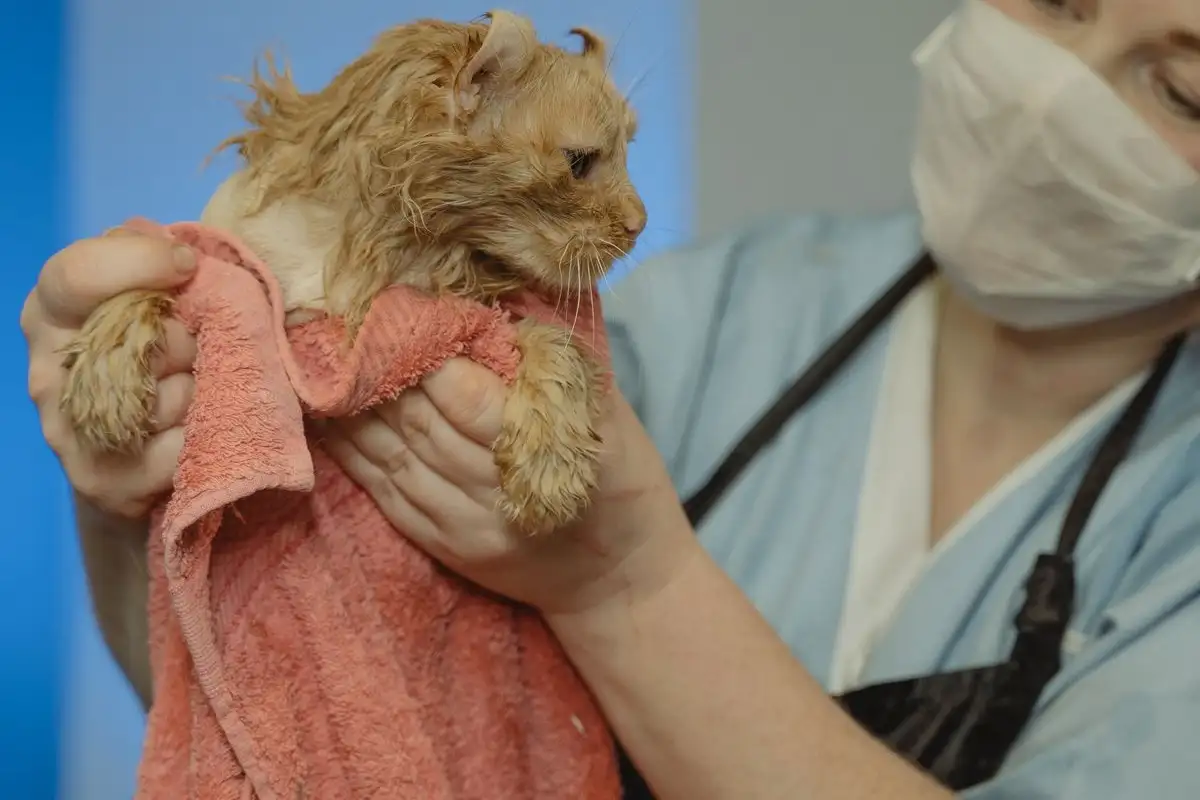
If the cat panics, the bath is over. Not paused while you finish rinsing. Over. I turn off the water, drop the pitcher, and wrap the cat in the towel that is already on my knee. I do not chase it around the bathroom. I do not grab it by the scruff. I carry it, if it will let me, to a quiet, warm room and leave the towel around it. If it will not let me carry it, I open the bathroom door and let it walk out wet. A wet cat will groom itself. A terrified cat that is held down will not.
The remaining shampoo can be rinsed later, or not. A little residue is not an emergency. If the cat is soaked in something toxic, that is a different situation, and I call the vet or a poison control line rather than improvise. For an ordinary bath, stopping is a valid outcome.
If the cat is still too frightened to finish, I switch to a waterless method: a cat-safe foam or mousse, a damp microfiber cloth, or pet wipes made for cats. It does not get the coat as clean as a full bath, but it breaks the cycle of a bath becoming a fight. Next time, I go back to the days-before work.
What a Calmer Bath Actually Looks Like
A calmer bath is not a cat that has given up. It is a cat that has been set up to succeed. That usually means:
- The cat is tired from play, not wired.
- The house is quiet.
- The cat is not hungry.
- The bathroom has been a normal room for days.
- The water is shallow and warm.
- The towel is not a new texture.
- The exit is decided before the first splash.
I cannot promise that every cat will stand still. Some cats never enjoy a bath, and that is normal. The measure is not enjoyment. The measure is whether the cat can be handled without a bite, whether you can stop before the scratch, and whether the cat is willing to come near you afterward.
When to Ask for Help
Some cats are not just water-shy. They are so afraid of handling that nail trims, vet visits, and towel drying all turn into a struggle. That pattern is worth raising with a veterinarian rather than solving with firmer restraint. It might be pain, a skin problem, or something else that makes handling hurt. I am not going to diagnose that from a bathroom floor, and neither should you.
If you have tried gradual familiarization, kept the handling minimal, and still end up injured every time, ask your vet about a professional groomer or a vet tech who works with fearful cats. That is not giving up. That is choosing the path that keeps both of you intact.
The cat does not need to learn who is boss. It needs to learn that the bathroom is not a trap, that the water is not a surprise, and that when it says stop, you listen. That is how you bathe a cat that hates water without injury. You win by not needing to win.