Keeping a cat clean without a bath comes down to matching the method to the soil rather than to the smell. Brushing does most of the work — it lifts loose hair, dust, and surface dander, and it carries the skin's own oils down the hair shaft where they keep the coat smooth instead of dull. A barely damp cloth takes dust, dander, and a small fresh patch of dirt off the top layer. A cat-formulated wipe or foam can lift light surface grease and a mild odor sitting on top of the coat. None of those emulsify heavy grease, none of them reach the skin under an oily or matted coat, and a medicated bath a veterinarian has prescribed is a treatment with a schedule attached, not a grooming preference you can trade for a wipe.
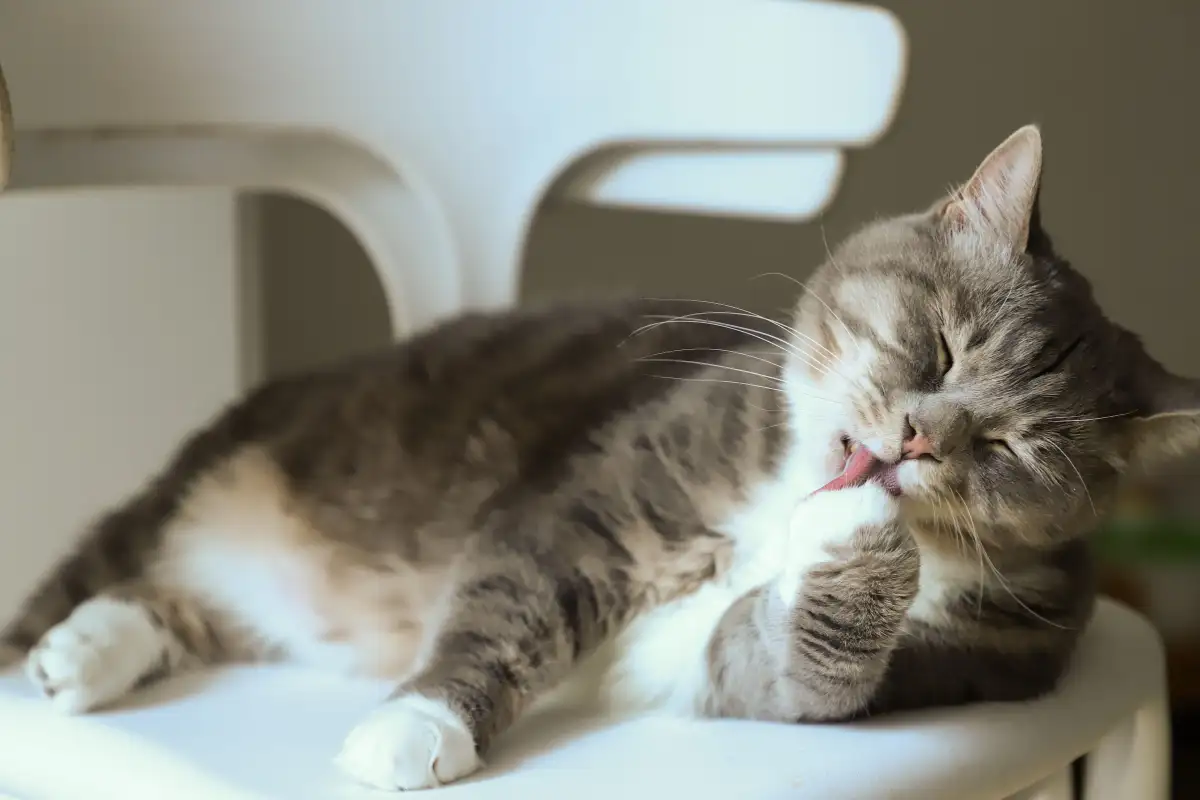
The kit sits on my bathroom counter next to the sink: a slicker brush, a greyhound comb with fine teeth at one end and coarse at the other, a rubber curry, a folded microfiber cloth, and a cereal bowl of warm water. The cat is on the cold countertop because that is where the window light is best, and because the towel back there is hers.
I don't start by cleaning. I start by reading the coat with my hands.
Fingers flat, from the shoulder blades back to the hips, then against the grain near the spine. Then I look at my fingertips. Three things can come off.
A gray film that smears. That's sebum, the cat's own skin oil, and it isn't dirt. A cloth moves it around and takes a little of it along. It does not remove it. Grease has to be emulsified, which means surfactant and enough water to rinse — that's a bath, or a vet-prescribed bath, and there isn't a third option.
Grit, a faint sandiness on the fingertips. Litter dust, dried dirt, dander. Loose material sitting on the coat, and it comes off with almost anything, including a dry brush.
Flakes. Dander, or dry skin. Brushing takes most of it. A damp cloth gets what the brush loosened.
So when someone asks me for the best waterless cat product, I have to reframe the question. There isn't one. The question is what is on the coat, because every item on that list has one method that removes it and several that just move it around.
Brushing is the cleaning, not the warm-up
Most of what people call a dirty cat is a cat holding dead hair. A coat packed with shed undercoat looks dull and feels greasy at the roots even when the skin underneath is fine, because the oil is sitting on hair that should already be gone.
The first pass is always dry. Always before anything wet touches the cat.
For a short coat, a rubber curry in circles gets an astonishing amount off, and most cats lean into it. For medium and long coats, a slicker, working in the direction the hair grows. For long coats, do it in rows — comb up a part, work through that section, move over an inch, and be honest about whether the comb teeth are reaching skin. If the comb stops before it reaches skin, you have a mat, and mats are not a cleaning problem. They're a detangling problem, and hauling at them with a brush just teaches the cat that the counter is a bad place to be.
Here's the part that matters for waterless cleaning: wet friction felts hair. Wipe a coat before you brush it and you're pressing dust and loose undercoat deeper, creating the exact tangles you'll spend next week fighting. Dry first, every time.
The comb tells you when you're done
After the brush, run a metal comb through and check the teeth. No hair, no white scurf, clean. Still picking up undercoat, keep going. A brush can glide over a coat that a comb will catch, which is why I own both and reach for the comb to finish.
What a damp cloth actually does
A folded microfiber cloth, warm water, wrung out until it's barely damp — damp enough that a hard squeeze gives you one drop. Not wet.
What that removes: dust, dander, a fresh smear of wet food, a dusty paw, a spot of drool, a small patch of something that hasn't dried yet. Move in the direction of the coat, one pass per section, fold to a clean side or use a different part of the cloth for each area. Then stop. Going over the same spot four times doesn't clean deeper, it just chills the cat.
What it doesn't remove: grease, dried-in dirt, and odor. Odor especially. That's a separate problem and I'll come back to it.
The instinct, when the cloth comes away dirty, is to use more water or wet the cat more thoroughly. Don't. Water that reaches the undercoat is exactly what you were avoiding by skipping a bath — it sits against the skin, it chills the cat, and it turns the undercoat into a mat the moment the cat lies down and starts grooming.
Foams and dry products live or die by the brushing-out
Any leave-on product has one hard rule: whatever stays in the coat, the cat eats. Cats groom a large share of their body every day, and the coat is upstream of the stomach. That is the whole cost of a leave-on anything.
So application is the easy half. Removal is the job.
Work in sections no bigger than your palm. Brush the product through, then keep brushing until the comb comes away clean and the coat feels dry and soft instead of tacky or stiff. Coat that feels like it has a film on it still has a film on it. If the label suggests a couple of minutes and the truth is twenty with a comb, the truth wins.
Use less than you think you need. You can always add a little. Getting it back out of an undercoat takes three times as long as it took to put in.
Human products are the wrong tool even when they smell nice
Baby wipes, hand wipes, face wipes, human shampoo, dryer sheets, whatever is closest to the sink — every one of them leaves something behind, and every one of those somethings ends up in the cat. Cat skin is thinner than ours, the cat is a fraction of our size, and the dose that lands in the mouth is the dose that counts. A baby wipe isn't a gentler version of a cat wipe. It's a product designed for skin that is never going to be licked.
The tell is behavioral. If the cat goes straight to that spot and works at it for two minutes, you left residue. A clean, well-brushed patch gets a couple of lazy licks and then the cat moves on. An over-scented patch gets serious attention.
Where spot cleaning earns its keep
A few places, and only one of them usually needs a tool other than a cloth.
The rear end. For longhaired cats this is the whole argument. A damp cloth handles fresh mess on a cat who got surprised. It does not fix a coat that keeps collecting it. The honest fix is a sanitary trim — a short strip clipped close around the back end, the inside of the thighs, and under the tail — done calmly over several short sessions, or by a groomer. That isn't cleaning. It's preventing the cleaning problem from coming back. And if a rear end that has always been clean suddenly isn't, that's a conversation about digestion or mobility with your vet, not a grooming one.
The paws. Litter dust and clumping litter packed between the toes. Warm damp cloth on the pads and between the toes, then dry between the toes with the dry corner. Cats with long toe tufts hold litter like a broom; keeping those tufts short solves more of it than wiping does.
The chin. A damp cloth along the jaw and under the lower lip after meals, for cats who leave the bowl with food on their face. Worth also looking at what they're eating out of — some cats do better with a shallow ceramic or stainless dish than a deep plastic one. But if the chin is red, scabby, swollen, or the cat flinches when you touch it, put the cloth down and call the vet. That's past what any wipe is for.
The outer ear. A dry cloth on the flap. Never anything into the canal.
When waterless has to stop
Two situations.
The first is heavy contamination. Grease from an engine, cooking oil, paint, glue, anything sticky. Don't wipe it. Wiping spreads it, drives it into the undercoat, and sets the cat up to lick it off. If the substance could be toxic — and plenty of things in a garage or a kitchen are — that's a call to your vet or to poison control before anything touches the cat, and then you follow what they say.
The second is a prescribed medicated bath. That isn't a bath in the sense this is about. It's a treatment with a contact time and a coverage requirement, and a wipe delivers neither. Wiping the cat down instead of doing the medicated bath isn't a gentler version of the treatment. It's a treatment that didn't happen.
How you know it worked
Fingers, not eyes. The coat should feel dry and separate — push it back and it should fall into place rather than clump into spikes. The comb should come away clean. The cat should not be working at any one spot afterward.
And the nose is the last check, not the first. A cat that smells strongly usually isn't a dirty cat. Odor that comes back within a day or two of any cleaning, or odor you can smell from across the room, tends to come from somewhere a wipe never reaches — the mouth, the ears, the anal glands, or a skin problem under the coat. Scrubbing the coat harder won't touch any of those.
Five minutes of brushing, four days out of seven, keeps a cat in the range where a damp cloth is the only thing you ever need. The rescue hour on a Saturday, after a month of nothing, is where people conclude they need a product. That's usually where it goes wrong, because the coat didn't need a product. It needed the five minutes.