The chores that slip first in a busy household are almost never the ones people don't know how to do. They're the ones nobody owns. Feeding, water, litter scooping, and brushing don't fail from a lack of knowledge; they fail because they live in somebody's short-term memory, and a Tuesday afternoon takes that first. The fix is administrative rather than educational: put a name next to each chore, write the assignments somewhere every person in the house can see them without asking, and rotate them on a schedule so consistency stops depending on any one person's week. Everything below is what that looks like when it's 9:40 on a weeknight and you're standing in the kitchen with your shoes still on.

The night it actually breaks
You come in late. Bag on the counter, keys on top of the bag, jacket over the chair because hanging it up is a decision and you don't have one left in you. The cat is sitting beside the water bowl, which is empty, looking at the bowl, then at you, then back at the bowl. That's the whole conversation.
And here's the part that stings: you know exactly what she needs. You could recite the whole list. Feed, water, scoop, and the brush is somewhere in the drawer. The knowledge isn't missing. What's missing is any way to tell whether the water was already refilled at 6:50 this morning or whether that was yesterday, and whether the person who said they'd scoop actually did.
Three adults in this house knew what the cat needed that day. The job still didn't get done. That's the thing about a chore with three owners: it has zero owners. Ownership gets fuzzy, everyone assumes, and the cat pays for the confusion in an empty bowl.
Where the chart lives matters more than what's on it
Ours is a small magnetic dry-erase week board stuck to the side of the fridge. Not the front — the side, in the path between the coffee maker and the door, so you physically pass it on your way out and you can't pretend you didn't.
Four rows of jobs, seven columns of days, and here's the rule that makes it work: when you do the morning feed, you put your initial in the box. Your initial, not a checkmark. A checkmark tells you the job happened. Initials tell you who to ask when the water bowl is still empty at 8 p.m. and you want to know how that's possible.
The digital version works if everyone in the house actually opens a shared calendar. The tradeoff is straightforward. A reminder that pings one phone is a personal reminder, and personal reminders are only as reliable as that person's worst week. The board is on the wall for everyone. Pick the version that is impossible to miss on the day you're least likely to look.
Anchor the schedule to events, not clock times
Cats don't read clocks. They read the house. The sound of the coffee grinder, the front door opening, the stair that always creaks, the moment the kitchen light goes off for the night. That's how they track the day.
So the two anchors on our board are not 6:30 and 9:00. They're "first person up" and "last person before bed." In a house with shift work, school pickup, practice, and a rotating who-gets-home-first problem, those slots survive where fixed clock times fall apart. The cat gets the same sequence every day even when the times slide, and sequence is a big part of what feeling settled looks like for a cat living with unpredictable humans.
One caution from experience: don't try to fix the timing and the ownership in the same week. Change who does it first, let that hold for a couple of weeks, and only then start nudging things tighter. Do both at once and the whole board collapses by Thursday.
What belongs on the chart, and how little of it
Five lines. Not twelve. A twelve-line chart gets abandoned by Wednesday, and an abandoned chart is worse than no chart because now everyone thinks it's handled.
Morning: feed and rinse-and-refill the water. Evening: feed. Daily: scoop the litter box. Weekly: full litter change, on a standing day. Weekly: brushing, and nails on the alternating week.
The full litter change is the one people get wrong most often. Waiting until the box looks bad or smells bad is a standard you can't apply, because you're not the one using it. If you can smell it from across the room, the cat made its judgment about that box well before you did. Put the full change on a calendar day, not on a reaction. Same logic with scooping: daily is the habit, and the reason it needs to be daily is that it's the chore most likely to be quietly skipped twice and then become a bigger job than anyone wants.
Grooming belongs on the calendar for the same reason. The difference between a cat that tolerates a brush and a cat that treats the brush like a threat usually comes down to whether it shows up on the same two evenings a week or only when someone finally notices mats forming. Nail trims: one person, five minutes, one or two nails if that's all the cat is offering that day. A scheduled five-minute annoyance, not a crisis nobody wants to start.
Rotating jobs, and the swap rule nobody writes down
The person who always gets the litter box starts to resent the cat. I've watched it happen. So rotate weekly, and pair a bad job with an easy one — whoever is on scoops is off water — so the trade feels even instead of feeling like a punishment handed down.
Now the rule that most charts are missing, and the one that quietly kills them: swaps are allowed, but a swap only counts if it's written down. Two people agreeing at the door on the way out — "I'll get the box tonight, you get it tomorrow" — is exactly the failure you started with. You both walk away certain the other one has it. Nobody's lying. And nobody scoops.
Kids, water bowls, and what the rotation is actually buying
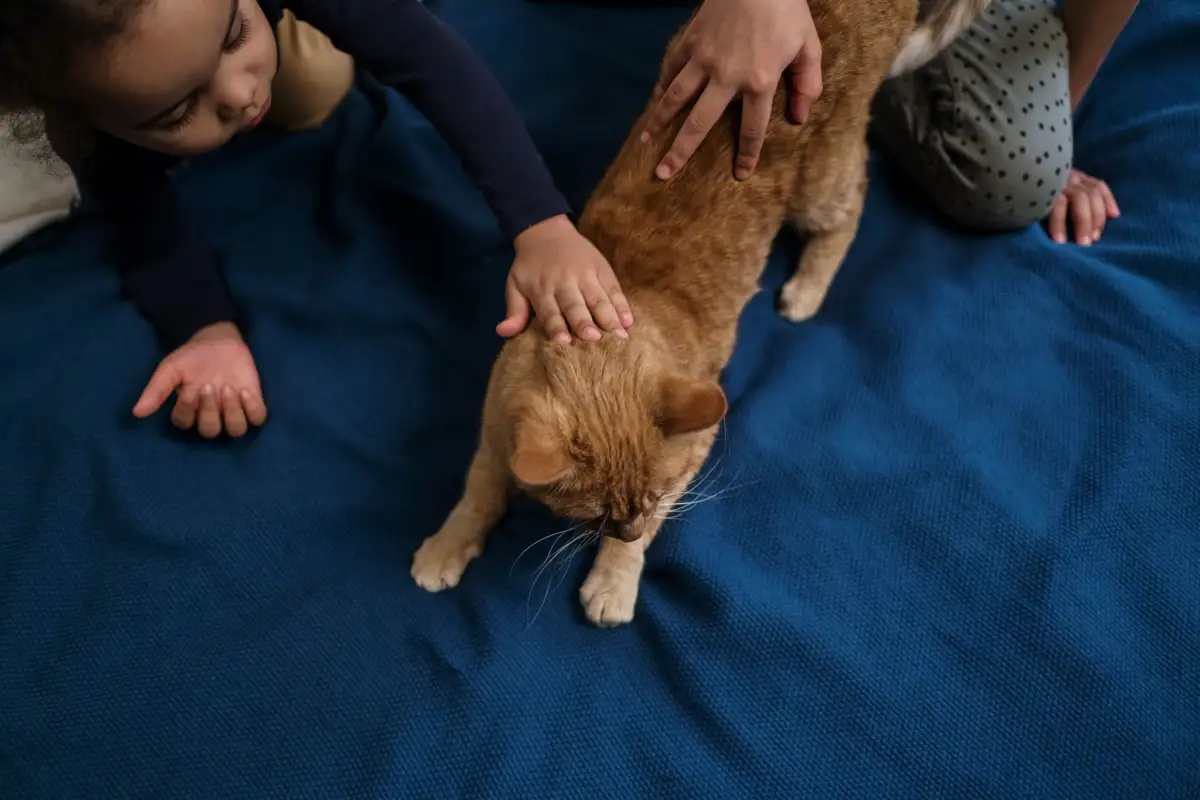
The water bowl is the best first job in the house. Second is the brush, supervised, with someone else holding the cat so the kid only has to do the brushing part. Give children jobs where doing them imperfectly is recoverable — a spilled bowl is a towel, an overloaded food bowl is a different problem entirely.
The labor saved is real, but it isn't the point. The point is that the cat's experience of that child becomes routine: same small human, same time, same predictable thing, no grabbing. Cats build trust out of repetition with the same person. A kid who refills the water bowl every Saturday morning becomes a known quantity to that cat in a way a kid who occasionally picks the cat up never will. That's the trade you're actually making.
When the routine isn't the problem
A household can fix a missed feeding. It can fix a sloppy scoop. It cannot fix a cat.
If appetite changes, if box habits change — avoiding the box, going beside it, going more or less often — or if a cat that always kept itself groomed stops, that goes to a veterinarian. Not to the chart, and not to a change in the household routine. And it cuts the other way too, which is the part organized families miss: the more on top of things you get, the more tempting it is to explain a real change as a scheduling problem that will sort itself out once the rotation settles. Adjust the rotation for logistics. Take the cat to the vet for the cat.
What the board is really for isn't the good weeks. It's the two nights a month when nobody's at their best — the school play, the late meeting, the stomach bug going through the house. Memory fails on exactly those nights, and it fails silently. The chart is what's left standing when it does.