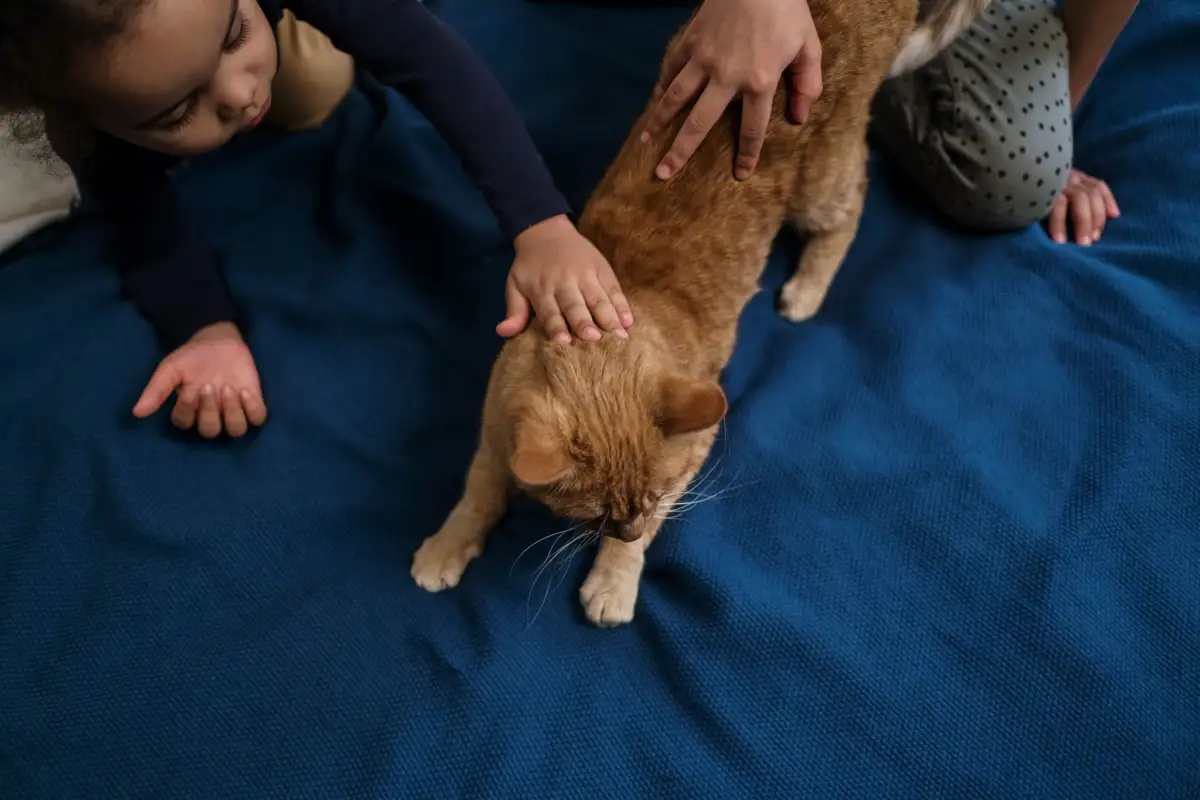
A family home needs three zones in place before the cat arrives: a reachable high perch, a cat-only retreat that children never enter, and a shared middle zone where the litter box, food, water, and scratching post are placed by foot traffic instead of by convenience. Of those three, the perch and the retreat do more for household peace than any single piece of cat furniture, because they give the cat two separate exits from a bad moment — up and away — instead of the one exit most homes accidentally leave open, which is under the couch, where nobody can reach it and nothing gets better.

I figured that out the hard way, standing in my own living room with a carrier on the floor and a three-year-old who had been told, at least four times, not to open it.
What I do now, before any cat comes into the house, is sit on the floor. Not on the couch — on the floor, at cat height, with my back against something solid. Then I look at the room the way the cat is going to look at it about ninety seconds from now. Where is the first thing taller than a toddler? Is there a way to reach it without crossing the open middle of the floor? Can a cat up there see the doorway, the couch, and the kitchen without turning its head? If any of those answers is no, the room isn't finished yet, no matter how much stuff is already in it.
Zone one: the high ground, and the route that leads to it
Height only counts if it's reachable. A perch a cat can't get to in one clean move is decoration, and decoration doesn't help anybody at 6 p.m. when the house is loud.
The mistake I see most often is the tallest, most impressive setup placed in the corner of a room nobody uses. Cats want to be near the action, not near the furniture catalog. A cleared shelf above the couch beats the best perch in the house if the perch is in the spare bedroom. Height near the middle of the household is worth more than height in a quiet corner, because the whole point of going up is to stay in the room while staying out of reach.
Then the route. A kitten, an older cat, or a cat with a little extra weight needs a staircase up, not a single leap that ends in a slip. When I plan this, I look for at least two ways up and two ways down. One route is a dead end. A cat cornered on a shelf by a determined four-year-old is exactly the situation the perch was supposed to prevent, and it happens when there's only one way off.
Sightlines matter just as much. A cat on a perch should be able to see who's coming. That's most of what the perch is for. Things that work in a family home: a shelf above the couch, the top of a bookcase anchored to the wall, a window perch, the top step of a staircase with a landing you can gate off. Clear the surface of anything breakable, and anchor anything that could tip — a cat landing hard on an unanchored bookcase is a real hazard, not a theoretical one.
And the rule that people skip: being up there means being left alone. A high perch that a child is allowed to reach up and grab from isn't a zone. It's a trap with a nice view.
Zone two: the retreat children are not allowed into
The retreat is the zone people resist, usually because it costs floor space.
It doesn't have to be a room. What it has to be is reliably off-limits to kids and reliably available to the cat. A bathroom with a covered bed on the counter. A laundry room with a gap the cat can slip through and a child can't. A closet held open a few inches by a wedge, with a bed inside. A hallway behind a gate. Any of those work.
The requirement is the rule, not the room: when the cat is in there, nobody follows. Not to pet, not to check, not just for a second. Kids can learn this, but it sticks faster when there's a physical signal attached — the gate latched, the door shut, the wedge in place. If the cat is behind it, the cat is off duty.
Here's why this matters more than people expect. The retreat gives the cat a way to disengage before it has to escalate. A cat with nowhere to go works through a sequence: flattened ears, tail flicking, skin twitching along the back, a warning swat, then a bite. Every one of those steps is the cat asking for distance and not getting it. A retreat short-circuits the whole sequence, because the cat leaves at the tail flick instead of at the swat. That's the difference between a cat that avoids the toddler and a cat that gets labeled aggressive.
There's a tradeoff, and I won't pretend otherwise. A closed door can trap a cat on the wrong side, and a cat separated from its litter box or water for hours is a bigger problem than the one you were solving. In a house with young kids, I'd rather set up a gate the cat can clear but a toddler can't, or a door that opens for the cat and not for the child. Whatever the mechanism, test it in both directions before you trust it: cat can get in, cat can get out, child cannot.
Zone three: the middle, where the negotiation actually happens
The first two zones buy the cat somewhere to go. The third is where the cat actually spends its day, and this is the zone where placement matters far more than anything you buy.
Start with the litter box. One box per cat, plus one more, and none of them in a high-traffic path. Not beside the furnace, not next to the washing machine, not in the hallway everyone walks through on the way to the kitchen. A cat using a box needs to feel like it can get out. A box jammed into a dead-end corner with one narrow approach fails that test, and the failure shows up as a cat eliminating somewhere else in the house. It's the same question as the perch: can I see who's coming?
Food and water belong away from the litter box — far enough that they aren't sharing a room, ideally. And food and water separated from each other. Plenty of cats drink less from a bowl sitting right next to their kibble, and you'll notice it as a cat that seems to live at the water bowl in the bathroom sink instead. Some cats genuinely don't care. You find out by offering two water spots in different places and watching which one actually gets used.
Scratching is the one where instinct beats planning. Put the post where the cat already scratches. Not where you'd like it to be, not in a tidy corner out of the way. If the couch arm is getting shredded, the post goes right beside that couch arm, close enough that the cat can pivot from one to the other without walking anywhere. A post in the spare room gives the cat no reason to leave what it's already working on where it stands.
Play follows the same logic — put the hunt where the cat already is. A wand toy worked like prey: across the floor, up over the couch, behind a chair, quick and then still, and let the cat actually catch it. Then a meal. That order — chase, catch, eat, groom, sleep — ends the evening with a cat that settles instead of a cat that's still wired at ten o'clock and looking for something to ambush. If you feed first and play after, you get the opposite, and you'll spend the rest of the night wondering why.
When the house is small
Not every home has three rooms to spare. I've set this up in an apartment where the entire place was under 900 square feet, and it still worked, because the zones don't have to be rooms. They have to be positions.
Vertical zones can stack — a shelf above a shelf, a route that goes up one wall and across a beam. A retreat can be a single gated hallway, or half a closet. The middle zone can be one room if the resources are far enough apart: box at one end, food at the other, water somewhere that isn't on either path. What you can't do is compress the middle zone by clustering everything within arm's reach of everything else. That's the configuration that produces the exact problems you set the zones up to avoid.
The order I do it in
Before the cat comes home, I want all three standing. Perch up and reachable. Retreat established, with the rule explained to the kids and to any adults who think the rule is about them. Litter box in place, food and water separated, scratch post beside the spot the cat will most likely target.
Then I wait. The carrier comes in, and I don't open it. I set it down in the middle zone, near the retreat door if I can, and I let the cat decide. Some cats are out in ninety seconds and walking the perimeter. Some take a day and a half and only move at night. Both are fine, provided the three zones were already standing when they finally came out.
The last thing, and the one I'd keep if I could only keep one: the perch and the retreat aren't really about the cat's comfort. They're about the cat's options. A cat with two exits doesn't have to solve a problem with its teeth. That's the entire reason to set the house up before the cat arrives rather than after the first incident — afterwards, you're rearranging furniture while you're also upset, and the cat has already learned something about your family that you now have to unteach.