Kids can learn to handle a cat gently, and it happens in short supervised sessions of two to five minutes that end while the cat is still willing to stay. The habit that prevents bites is almost never the cat's temperament or the child's self-control; it's an adult's timing. A cat that has scratched a child is not a cat that can't live with kids. It's a cat that ran out of quieter ways to say the visit was over, and those quieter ways are readable long before anything happens.
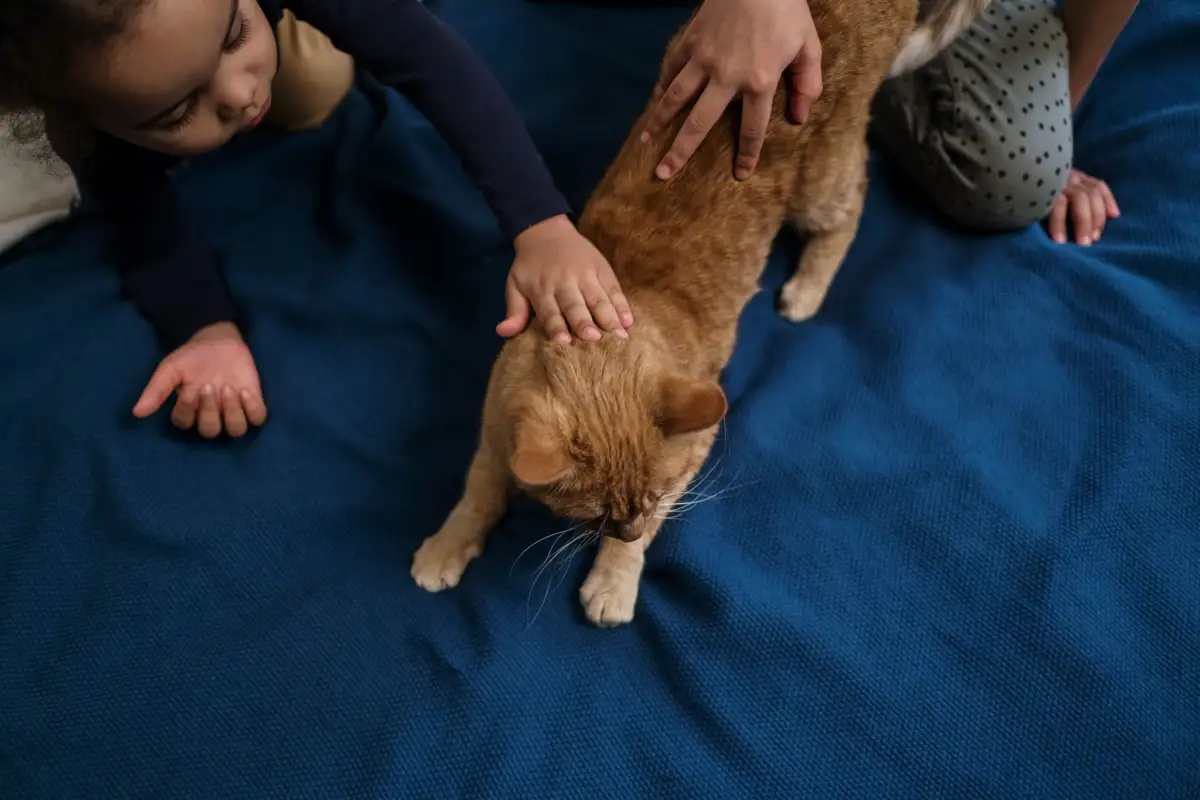
I've spent years sitting on floors with other people's cats — fosters moving through the house, shelter cats I was getting to know, my own two, and whatever kids happened to be around at the time. So here's the room I always picture. Low-pile rug. A kid sitting cross-legged with hands flat on their thighs. A cat parked halfway between the couch and the coffee table, deciding whether this is a good idea.
The tell you're watching for is not the one you think
The tail comes first. A steady thump against the rug is not trouble; that's a cat thinking. What you listen for is the change. The thumps speed up. A hind foot starts drumming. Or the tip of the tail begins to flick while the rest of the tail lies still — that's the one people miss, because it's small and everything else about the cat looks relaxed.
Then the ears. Up and forward with a slow swivel means the cat is still in. When one ear rotates out to the side, not flattened, just turning away like a satellite dish losing the signal, the cat is done and hasn't left yet. That gap, between done and gone, is where scratches live.
I stop a session when the blinking stops, too. A cat that was blinking slowly and then goes still and hard-eyed has stopped having a nice time, whatever the rest of its body is doing.
So the first person I teach isn't the child. It's the adult in the doorway. Your job is not to watch the kid's hands. Your job is to watch the cat and call the end before the cat has to. Out loud: "Okay, that's it. Good cat." The child stands and walks away. That sentence, delivered on time, is most of the method.
The first ten seconds
The child sits. On the floor, at the cat's level, not standing over it and not leaning in from the couch. Sitting changes the geometry. A standing child is a looming shape, and a cat with a coffee table on one side and a wall on the other has fewer exits than one with an open hallway behind it. The cat comes to the kid, or it doesn't, and if it doesn't, that's the session. Zero minutes is a valid session length. I would rather a kid get thirty good seconds than four minutes that include the moment the cat wanted out.
Hands stay flat and open. No reaching over the cat's head, no scooping it up, no cornering it under furniture. If a child wants to touch, one hand on the shoulder or along the back, following the direction the fur grows, and then off. Not a stroke repeated until somebody says stop.
Lifting is the part I'd mostly cut. Most sessions with a young child shouldn't include picking the cat up at all. When it does happen, both hands matter: one under the chest, one supporting the hindquarters, so the back half isn't left hanging. A cat scooped up under the front legs alone is a cat that suddenly feels like it's falling. When I show the shape of that motion to a kid, I do it with a rolled towel first, because what they need to learn is the shape, not how tightly to squeeze.
Ending early is the whole trick
Two to five minutes, then you stop. Not because cats are delicate, but because a short session you can repeat ten times a week beats a long one you can only get away with once. Every time the cat gets to end things on its own terms, the next approach starts from a slightly better place.
Follow it immediately with a treat or quiet praise, and put the food down after the child has stood up and stepped back, not while the cat is being handled. The order matters. Handing a cat food while a kid is holding it rewards the cat for sitting still past its own limit, which is the opposite of what you want it to learn.
And the rule that outweighs everything else: if the cat walks away, the interaction is over for everyone. No following it, no "just one more pet," no calling it back. This is the single most effective bite-prevention habit in a family home, and it's the one adults break most often, usually because the moment looks sweet and the kid is having a good time. I've broken it. Most people have. The cat keeps the receipt.
Hands are not toys
Wand toys, string, whatever dangles from a pole — that's the target. Hands are for petting and for feeding. If a kitten learns that the most fun thing in the room to bite is a hand, that lesson doesn't expire when the kitten becomes a twelve-pound adult. A lot of bites in family homes aren't sudden. They're the back half of a game somebody taught.
And a child under about six should never be alone with a cat, regardless of how calm that cat has always been. That isn't a knock on the cat or the kid. It's that a five-year-old's braking distance is short and a cat's patience is finite. Supervision means close enough to intervene in a second, not watching from the kitchen doorway with your hands full.
After a scratch or a bite
Rinse a scratch under running water with mild soap, and stop there. Bites are a different thing. A cat's tooth makes a small puncture that seals over quickly, which can trap what's inside, so any bite that breaks a child's skin needs to be looked at by a medical professional rather than managed at home. That's a phone call, not an emergency room drama, but it isn't optional.
Then comes the part families usually get wrong. The instinct after a scratch is to separate the child from the cat permanently — kid plays in the living room, cat lives in the bedroom, everybody stays safe. What that actually creates is a house where the only interactions left are the unsupervised ones, and where the cat learns that children are unpredictable and worth avoiding.
The repair work is reassignment. Bring the child back into short, ending-early sessions as soon as the adults are ready to supervise closely again, and let the cat collect a few weeks of evidence that kids are brief and predictable and always leave before the ears turn. Same cat, same kid, different script. The scratch wasn't a verdict on either of them.
There are limits worth naming. A cat that's older, or sore, or has been grabbed before may need months of nothing but distance, and some cats will simply never want to be held by a child. That's fine. The goal was never a cat that tolerates anything; it's a house where a cat can say no with its feet instead of its teeth. Sometimes the honest answer is a baby gate, a closed door, and a schedule that gives each of them a room of their own for part of the day.
The kid isn't really learning "be gentle." That phrase is too abstract to act on. They're learning to notice — that a tail can speed up, that an ear can turn, that a cat that's finished will usually tell you before it does anything about it. That's a skill they'll have for the rest of their life, with every animal they meet.
The scratch isn't the failure. The five seconds before it are, when the cat asked and nobody answered.