A cat fits your home when the worst ten minutes of your day still leave that cat somewhere to go. The decision gets made by your floor plan, your noise, your children's ages and energy, and the animals already living with you, not by a breed chart or an adoption write-up. If a cat needs more quiet or more room than your household can hand over on its loudest, tightest afternoon, that is the wrong cat for you, however sweet she was in the meeting room.
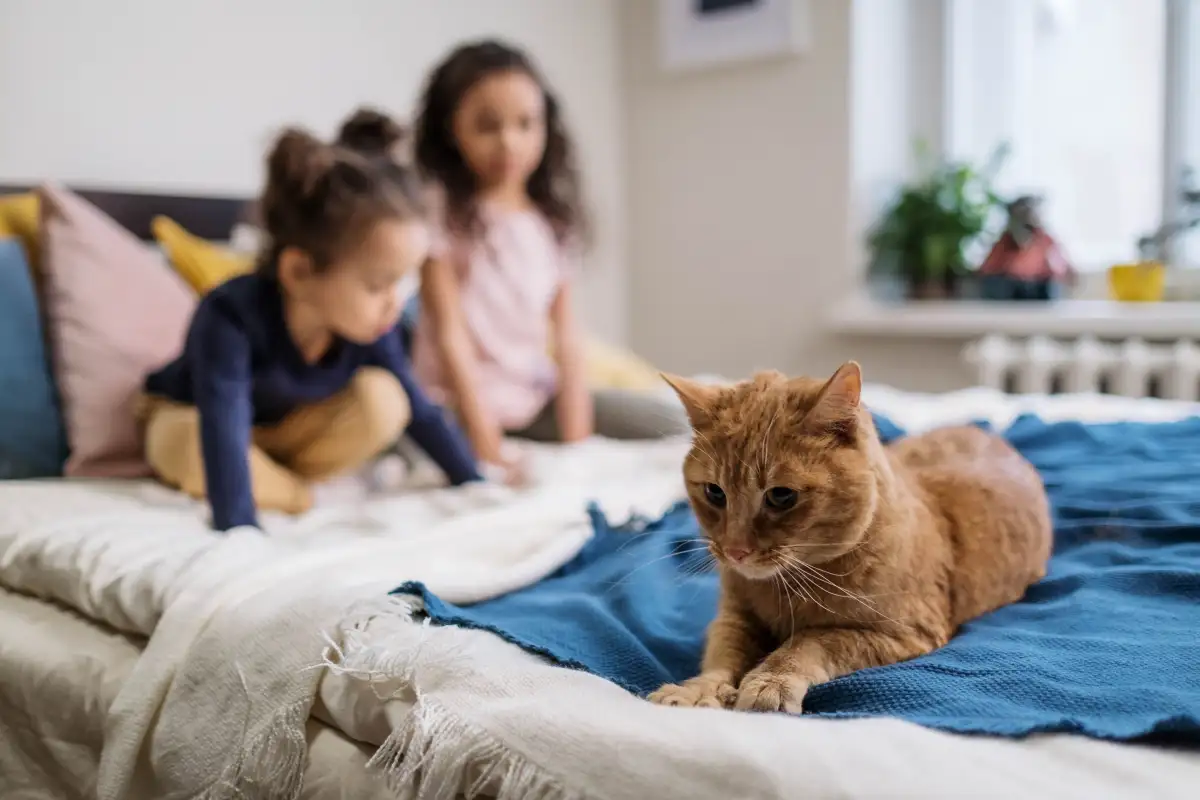
Stand in your front hallway at 6:45 on a weekday morning and do not tidy anything first. Listen. A dishwasher is finishing its cycle somewhere behind you. The dog's nails are ticking across the kitchen floor because he heard the school bus two streets over. Someone upstairs is yelling about a missing shoe. That is not a bad morning, that is a Tuesday. Now put a cat in that hallway. Not the cat at her best, but the cat at hour thirty, tired, still working out where the edges of this place are.
I walk a house like that every time before I look seriously at a cat. Not the staged version. The version where the recycling is stacked on the counter and the back door has already been left open twice this week. What I am listening for is not whether the house is loud, because every house is loud. I am listening for whether there is a route through the noise that belongs to the cat.
Start with the ten worst minutes
Most people audit their home on a quiet Sunday afternoon and then wonder why everything fell apart on a Tuesday night. I audit the other end of the day. Where is the loudest hour here? Usually it is the end of the school day, or the hour before dinner, when people come in and out, the dog gets up every time someone moves, and the volume in the kitchen climbs for no particular reason.
Then I walk the house during that hour and ask one question per room: if the cat is standing right here, where does she go when it gets bad? If the honest answer is "she would have to run past the dog and through the kitchen to get anywhere safe," that room is not usable territory. Enough unusable rooms and you do not have a home for a cat. You have a home with a cat trapped in it.
There is a second thing I count on that walk: doors that open to the outside. Front door, back door, garage, slider. In a house where four of them get opened and closed all day by people who are not watching, the escape math is different from a house with one entrance and a porch where you can see the cat before she gets to the street. An apartment door that opens onto a shared hallway is a different problem again, because a cat who slips out there is loose in a building, not on a lawn.
That count is not a reason to skip adopting. It is a reason to be honest about which cat you can safely live with.
Room by room, with the cat already in mind
The entry is where I start, because it is the room nobody thinks of as a cat room. Where do shoes come off? Where does the door swing? Is there a path from the rest of the house to the litter box that does not cross the threshold where the door opens? A cat who has to walk through a door-swing zone twice a day to use the box is a cat who gets startled there twice a day, and over months that adds up to a cat who starts avoiding the box or holding it.
Living room next. Is there a window she can get to? Is there anything above waist height that she is allowed on? Where does the television sit, and how loud does it get? Where do the kids actually play, on the rug or on the couch? A cat can share a living room with a lot of chaos if she has one surface nobody else uses.
The kitchen is where the feeding station usually lands, and it is almost always the worst placement in the house. Food bowl on the floor by the refrigerator means eating next to the loudest appliance, in the room with the most foot traffic, at the level where the dog's nose lives. I have watched cats go skinny rather than eat with their shoulder blades up. Food does not have to be in a separate room, but it should be somewhere the cat can eat without watching a doorway.
The litter box has the same problem in reverse. If the only spot for it is a windowless bathroom or a laundry closet with a door that stays shut, the cat has to ask permission to use the bathroom for the rest of her life. That is a real cost in a busy house. A box she can reach without passing the dog, with a sightline to the room, in a place that stays dry and gets scooped, beats a box in a fancy spot she cannot get to.
Bedrooms matter more than people expect. If every bedroom door is closed at night, the cat's territory after 11 p.m. is the hallway and the living room, which is exactly where the humans just turned everything off. For some cats that is fine. For a cat who wants company, it means twelve hours alone in the dark, every night, in a house that claims to be full of people.
And the hallway itself. Hallways are chokepoints. They are where a cat gets cornered by a dog, or by a seven-year-old running to the bathroom. I look at whether there is a shelf, a ledge, or a piece of furniture she can get on top of before anything can catch her there.
Vertical space, hiding, and the route above the furniture
Cats solve crowded floors by going up. If your home has nothing above waist height that a cat is allowed on, you have removed her only reliable way to be in the room without being in the way. This does not require buying anything. It requires deciding which surfaces are hers and then defending that decision against the rest of the household. The top of a bookcase. A cleared shelf. A windowsill. The back of a couch nobody sits on.
The question I actually ask is not "do I have a cat tree." It is: if a toddler comes around the corner fast, is there a surface within a couple of strides that the cat can reach and the toddler cannot? If the answer is no in most of the house, you have built a home where the cat's only options are freeze or flee, and both of those get old.
Hiding spots are the floor-level version of the same thing. Under the bed, behind the couch, inside an open closet. One hiding spot in one room is not enough, because it means every startle in the house sends her running past the source of the noise to get to safety. I want at least two, in different parts of the house, and I want the path between them to be clear of the dog's sleeping spot.
The decompression room is the piece people skip. It is one room with a door that closes and stays closed, that the cat controls. Litter box, water, food, something soft, a window if there is one. Not the bathroom everyone uses. Not a punishment room that gets opened the second a guest arrives. The point is that there is one place in this house where the rules do not change and nobody barges in, and the cat needs to be able to find her way back to it from wherever she is.
Kids: what their age actually changes
I care far less about whether your kids like cats than about what time of day they stop moving.
A four-year-old who adores cats will still chase, grab, and shriek, and no amount of loving the animal changes that, because the impulse control is not there yet. A ten- or twelve-year-old can be taught to sit still and let the cat come to them, and can be trusted to notice when she has had enough. Between those two ages, it depends heavily on the individual kid, and you know your kid better than anyone writing about this does.
What I actually map is the quiet window. If the last child is asleep by 8:30, you have a two-hour stretch every night where the house goes still, and that is a real resource. A cat who needs quiet to settle can use two predictable hours a day. A house with a toddler who wakes at 5:30 and a teenager who comes in at midnight has almost no quiet window at all, and a cat who needs one to decompress will spend weeks with nothing to decompress into.
The number of kids matters too, and so does how often other people's kids are in the house. Two children have a different sound profile than one. A house that hosts four kids after school every day is a different house than the one you picture when you imagine adopting a cat. Count the afternoons, not the people.
One more thing, and I mean this without hedging: there is no cat whose label guarantees she will tolerate being picked up, chased, or cornered by a child, and no label that tells you how she will react on the day your kid has a friend over. The only evidence that counts is what the cat actually does when a child moves fast near her. Everything else is marketing.
The residents get a vote before the newcomer does
If you already have a cat or a dog, that animal is the constraint you cannot negotiate with. She did not choose this. She is not getting rehomed if it goes badly. So the questions I ask before anything else are about her, not about the cat I am considering.
For a resident cat: where does she sleep, and who does she follow? Does she eat out in the open or only when the room is empty? Does she use the litter box in the middle of the room or only when nobody is watching? What does she do when the doorbell rings? Where is her territory, and how much of it would a newcomer have to cross to get to food, water, and a box? Has she ever lived with another cat, and if so, what did it actually look like? Stalking, blocking doorways, guarding the box, going quiet at mealtimes. Those are the things that tell you something, not whether she seems lonely.
For a resident dog: what does he do when something small runs? Prey drive usually announces itself before the chase, as a hard stare, a freeze, a low whine, a body that goes very still. Has he lived with a cat before? Where does he eat, where does he sleep, and does he guard either one? A dog who guards his bowl plus a cat who wanders near it is not a personality clash, it is a setup. And can the dog be on the other side of a closed door without losing his mind? A dog who scratches and whines at a closed door makes the decompression room useless, because the noise is on the wrong side of it.
If the answers are shaky, the honest move is usually not "we will manage it." It is to look at a different cat, one with a temperament that suits the house you already have.
Apartments and houses fail in different places
Apartment living concentrates the things a sensitive cat cannot get away from. Noise comes through walls and floors from people you do not control, at hours you do not choose. Trash chutes, elevators, hallway footsteps, the buzzer. There is no acre of distance between the sound and the cat. The upside is that apartments are usually one level and small enough that closing a single door creates a genuinely separate zone, which is harder to do in an open-plan house.
Houses fail differently. More square footage, more doors, more chances for someone to leave one standing open. More likely to have a dog door, a garage, an unfinished basement with a gap under the stairs. And the open-concept house is the worst of both worlds for a shy cat: large, echoing, and with no way to be in the room without being visible. If your main floor is one big room, vertical space and hiding spots stop being nice-to-haves and become the whole plan.
Multi-story houses have one real advantage: a cat can live upstairs while the dog lives downstairs, and that can be a permanent arrangement rather than a temporary one. But only if someone is willing to carry a litter box and a water bowl up there every day, forever. That is the part people agree to in March and resent by July.
Hiding is not a verdict
A cat who hides for the first three days is doing exactly the correct thing. She is cataloguing a new building with new smells, new sounds, and predators she has not identified yet. The signal is not day one. It is day four, and day six, and day ten. Does she start moving when the house goes quiet? Eating after dark? Using the box? Coming out for one specific person? That is decompression working.
What is not working: a cat still flattened in the same spot after a couple of weeks, not eating, only moving when the house is empty. At that point the question stops being about fit and starts being about her health, and that is a veterinarian's call, not mine. I can read behavior and the shape of a household. I do not diagnose what stress is doing inside a cat's body, and I would be careful of anyone who does it from a chair.
What quiet decompression looks like in practice is boring on purpose. A closed door. A low-traffic room. No visitors for a while. Food, water, and a box all within a few feet, so she does not have to cross open ground to survive the day. The rest of the household going about its normal routine at a lower volume for a week, so she learns the sounds instead of being sheltered from them. Not a silent house. A predictable one.
And after that week, when the door opens, the test is whether she has somewhere to go in each room she now has access to. If she does not, the hiding was not a phase. It was an accurate report about your floor plan.
The audit is subtractive
None of this is about fixing your house. Most houses cannot be fixed. The toddler is not going to get quieter this year, the dog is not going to change, the apartment is not growing a second floor, and the hallway is going to stay eight feet long no matter how many times you rearrange the furniture.
So the point of walking your home at its worst hour is not to reshape it. It is to arrive at a short list of cats who can live inside the constraints you already have. If your walkthrough rules out four cats and leaves one who naps through the school-bus chaos and eats with her back to the room, you did the work right. Ruling a cat out is not a failure of compassion. It is the only way the cat you do bring home ends up staying.