The question most cat owners never ask their vet is not "what's the best food?" It's "what does this food actually have to do for this cat, right now?" Reframed that way, feeding stops being a hunt for one perfect product and becomes a check against four requirements that have to line up at the same time: the food has to be nutritionally complete for the cat's life stage, it has to supply enough water in a form the cat will actually take in, it has to match where that cat is in its life, and it has to keep the body in front of you at a healthy condition. Any one of those four can be off while the other three look fine, and figuring out which one is off is a conversation for your veterinarian, not a decision to make by switching bags in the aisle.
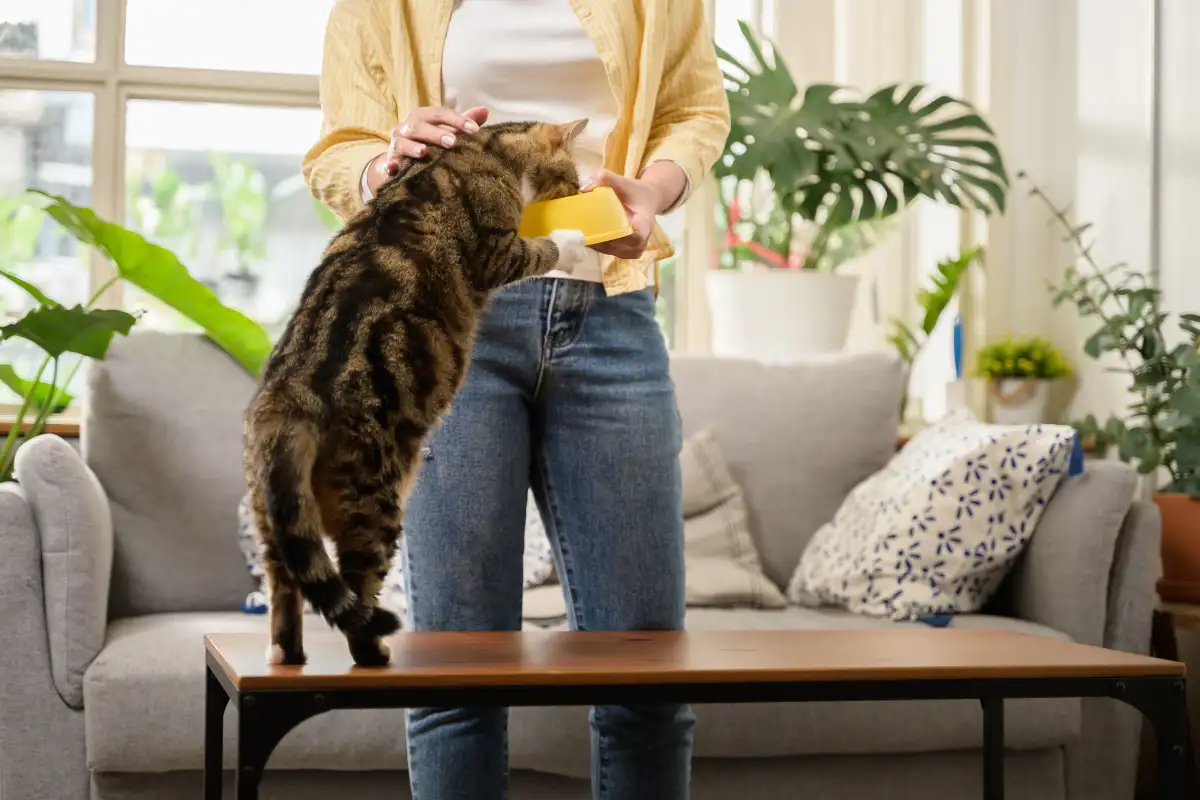
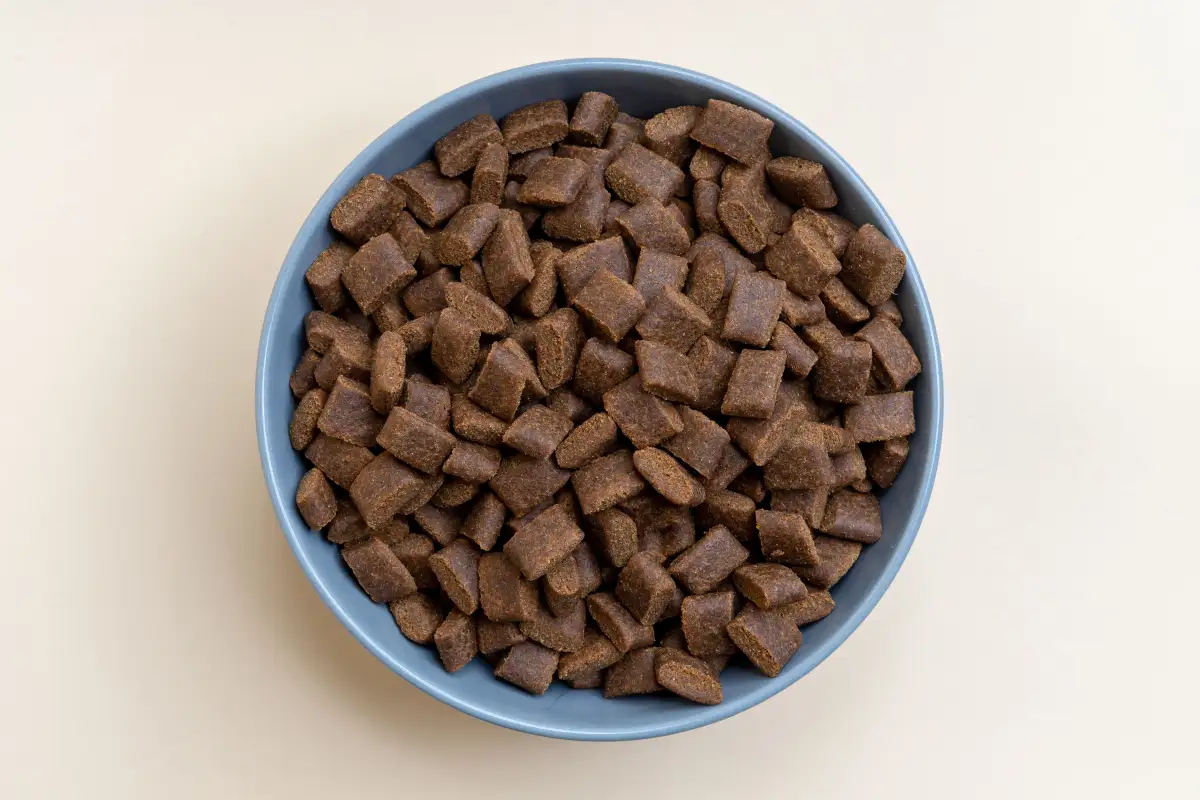
I run that check standing in the kitchen at 6:40 in the morning, one cat wrapping around my ankle and an old kitchen scale on the counter with a cereal bowl sitting on top of it. Bowl on the scale, scale to zero, and the food gets weighed instead of scooped, because a cup of one kibble shape and a cup of another are not the same amount of food, and a scoop is just a guess with a handle. If you're following along, put your hand on your cat's side while the coffee brews. That's where the real information is. Run your palm flat along the ribs. They should feel like the back of your hand, findable but not sharp. Press a little harder and you hit knuckles, that's too thin. Press and feel nothing but a soft pad, that's too much. Then stand and look straight down at the cat. There should be a waist behind the ribs. Then crouch and look from the side. There should be a slight tuck where the belly meets the hind legs, not a straight line, and definitely not a sag.
The scale gives you one number on one day. Your hands tell you what that number is made of. Muscle and fat can trade places on a senior cat while the scale barely moves and the body changes underneath it. That's why I weigh the food and feel the cat.
Here's the part that took me years to unlearn. Most of us shop for a feeling. Grain-free, ancestral, human-grade, wild-caught, whatever word is printed largest on the front. The words that actually matter are the smallest ones on the back.
Complete and balanced is a legal claim, not a compliment
"Complete and balanced" on a cat food label refers to the AAFCO nutrient profiles, and a food has to meet the profile for its stated life stage. Look for the life-stage statement: growth, adult maintenance, or all life stages. A growth food is built for a kitten's demands. An adult maintenance food is built for a grown cat. An all-life-stages food has to satisfy the hardest case, which is why it tends to be nutrient-dense. That statement has to match the cat in front of you. Feeding adult maintenance food to a growing kitten is a mismatch, and so is the reverse when you're trying to manage an adult cat's condition.
Completeness is a floor, not a fit. A food can be perfectly complete and still not suit your particular cat, whether that's the format, the texture, or the energy density for an animal that naps sixteen hours a day. Complete means this food won't create a deficiency on its own. It does not mean this food is the answer.
Why cats can't be fed like small dogs
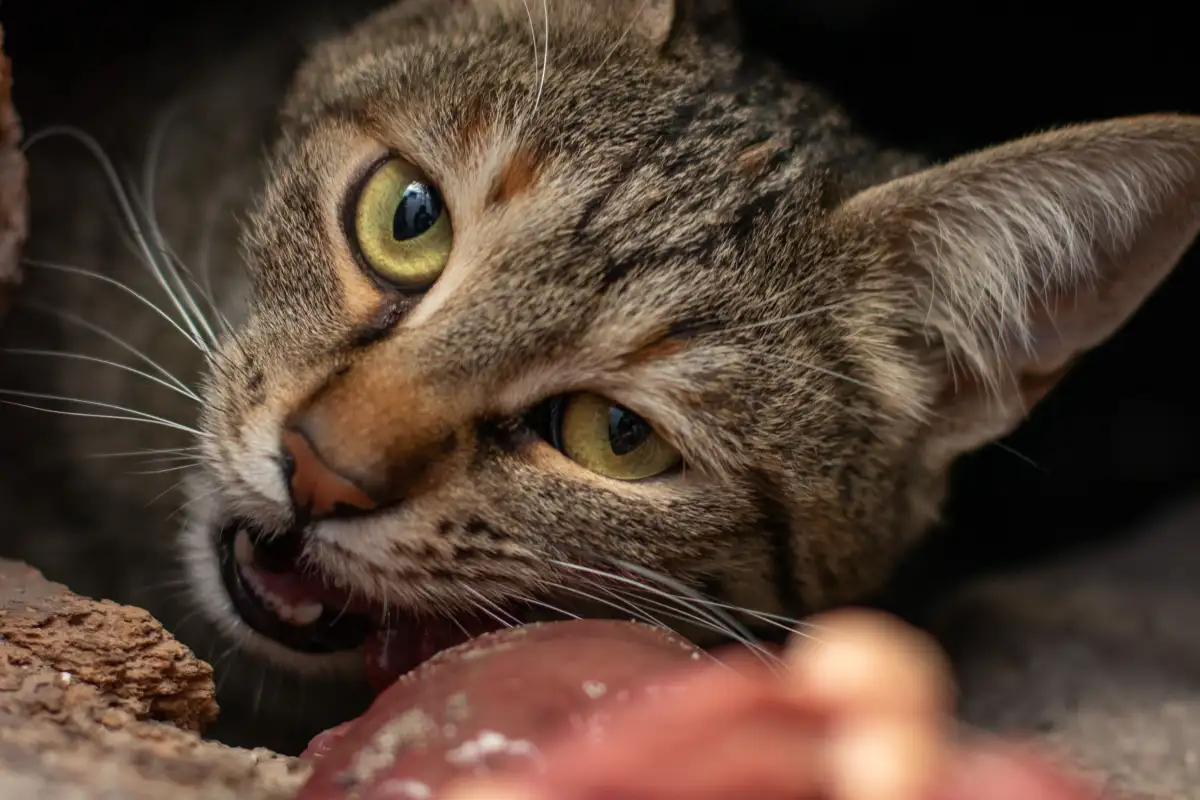
Cats are obligate carnivores, which is a structural fact rather than a marketing angle. They need several nutrients preformed in their food because their bodies don't manufacture enough of them. Taurine, arginine, arachidonic acid, preformed vitamin A, among others. A dog can synthesize some of these from plant precursors. A cat largely can't. Taurine is the famous one, tied to heart and eye problems, and it's the reason a cat food has to be formulated rather than assembled from ingredients that sound nutritious. It's also why improvised homemade diets are riskier for cats than people assume. Cooking for your cat is a legitimate path, but it needs a formulation from a veterinary nutritionist, not a recipe that circulated online.
Water is part of the label too
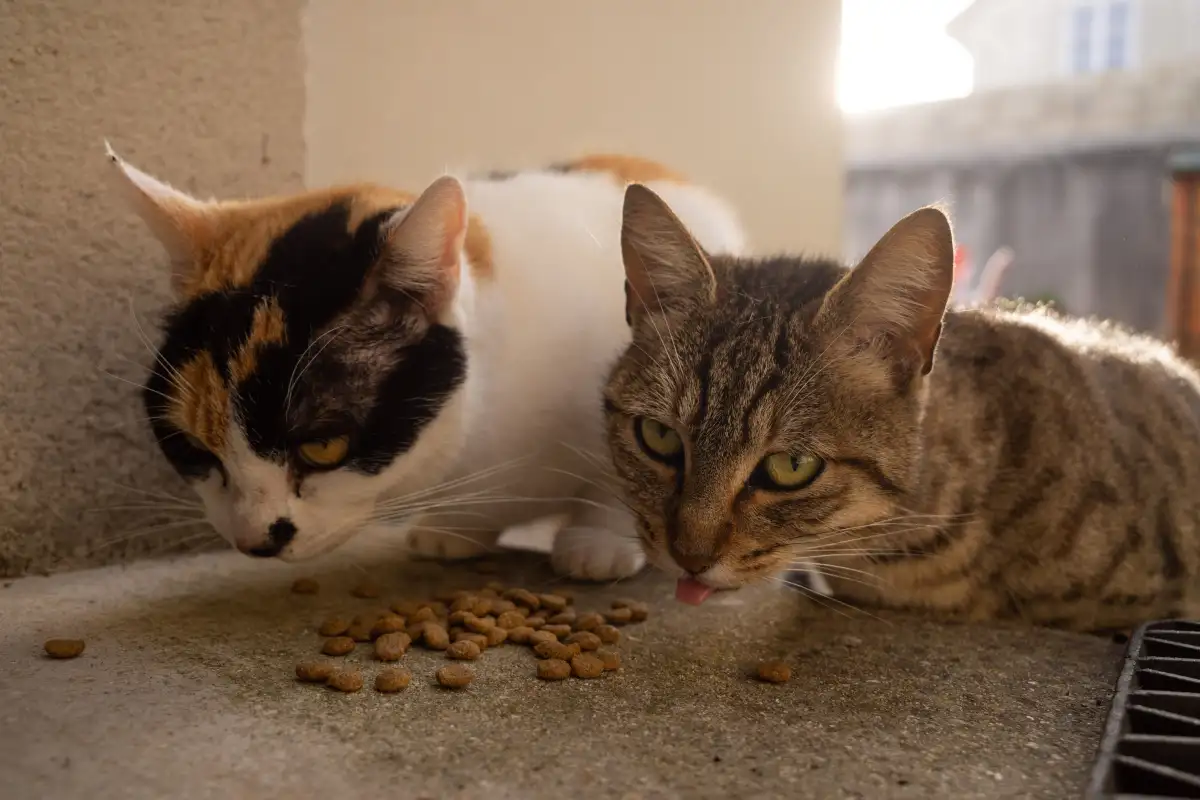
Cats evolved hunting small prey and got most of their water from what they killed. Prey is roughly three-quarters water. A can of food lands in that neighborhood. Dry food sits near a tenth of that, sometimes less. So a cat's total water intake is the moisture riding along in the food plus whatever goes into the bowl, and for a lot of cats the bowl contributes far less than their owners picture. Cats have a comparatively weak thirst drive. They don't reliably make up the difference by drinking more.
That doesn't automatically condemn dry food for every cat. I've known cats who ate it their whole lives, drank plenty, and died old. It depends on the individual, on their kidneys and urinary history, and on what your vet sees in the labs. What I do now is count the whole picture: how much moisture is coming in on the food, how much is going into the water bowl, and how much is leaving the litter box. That last one is a data point owners ignore for years and then suddenly care about very much.
Practically, more than one water source, placed away from the food. Wide and shallow rather than deep and narrow, because cats don't love dunking their whiskers. Some drink more from a fountain. Some won't touch one. Watch your cat, not the product page.
Life stage keeps moving
Energy needs shift with age, activity level, and whether the cat is neutered. A neutered adult generally needs less than an intact one. A kitten needs a great deal more per pound than an adult. A senior cat can drift either direction, and older cats often absorb nutrients less efficiently and lose muscle along the spine. That's why the feeding amount printed on the package is a starting point and nothing more. It was calculated for a generic cat of a certain weight. You have an actual cat.
So I feed to the body, not to the bag. Weigh the food, write it down if you're the kind of person who writes things down, watch the ribs and the waist, adjust. If the printed amount happens to hold your cat at a good body condition, wonderful. If your cat is gaining on it, that number is too high for that cat, full stop.
Switching foods is a week, not a day
Sudden diet changes commonly cause vomiting or diarrhea, so plan on spreading a switch over roughly a week, mixing increasing proportions of the new food into the old. Some cats need longer than a week. And here's the trap nobody warns you about: if a cat gets sick after eating a new food, they can form an aversion that outlasts the illness. I had a cat refuse a food for two years because of one bad night. Slow is faster.
Which brings me to the two things that should stop you from adjusting anything at home. A cat that stops eating for more than about a day needs a veterinary visit, not a different flavor. And a cat losing weight with no change in diet is telling you something a food swap won't fix. Those are the moments to call the clinic, and to bring information with you: photos of the label, the life-stage statement, roughly how much you've been feeding, how the litter box looks, and a timeline. If you've been checking body condition with your hands, you can say exactly where the cat was three months ago and where they are now. That conversation goes somewhere. "What's the best food?" usually doesn't.
Back in my kitchen, the scale is still on the counter and the bowl still reads zero. The question I take into the exam room now isn't which food is best in the world. It's what this food is doing for this cat. Nutrient completeness. Moisture. Life stage. Body condition. Four checks, one cat. You can run the whole thing at your counter tomorrow morning.