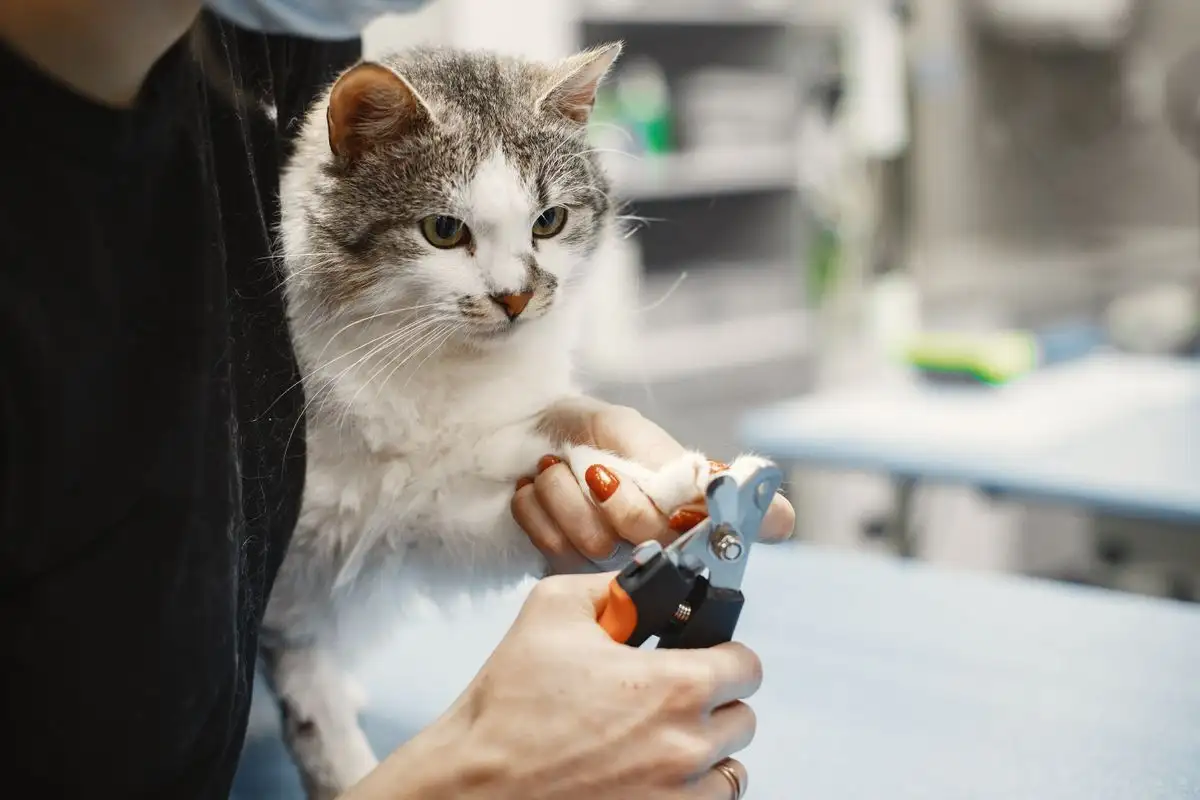
Eighteen claws in one sitting comes down to a route and a grip: front left, front right, rear left, rear right, in that order every time, with each dewclaw counted into the total so no leg gets short-changed. One claw at a time gets pushed forward by a thumb pressed into the pad, and the trim stops the moment the cat stops tolerating it — which is a real finish, not a failure.
I want to walk you through the whole thing as a single session, because that's what the scattered advice out there never gives you. Tips are easy to collect. A sequence you can actually run is something else.
Before the cat is on the table
The surface matters more than the hold. I've done this on counters, on a table pushed flat against a wall, and on the floor with the cat sitting in the triangle of my crossed legs. What those setups have in common is that the cat can't slide. A slick counter is the worst place in the house for this: the cat's feet skate, every muscle goes into staying upright, and now you're trimming a cat that's already working. A folded towel on the table fixes it.
I sit on a stool instead of standing. That puts the cat at chest height and stops me from looming, which is the same message as cornering whether or not that's the intent.
Two things are ready before the cat arrives: light in front of the paw, and clippers already in my dominant hand. Overhead light comes from behind me and drops the paw into its own shadow, which is exactly where the quick hides. A small lamp on the table, angled at the paw, costs nothing and saves skin. And a sharp blade matters — a dull one crushes the claw instead of slicing it, and a crushed claw can split down toward the quick.
I also wait for the window. Most cats have one: twenty minutes after waking from a long nap, before a meal, when the body is warm and loose. I don't go get the cat. I wait for the cat to be in that state and then bring the towel.
The order, and why I never vary it
Front left. Front right. Rear left. Rear right. Five claws on each front leg — four ground toes plus the dewclaw — and four on each rear. Ten and eight. Eighteen.
The order isn't for the cat. It's for me. A fixed route means I never finish and wonder whether I did the right rear paw or double-counted the left one. That's the same reason a surgical tech counts instruments out loud: you aren't trusting memory, you're trusting the route.
If a cat has had enough at claw three, I don't renumber anything. Tomorrow starts at front left again, and I don't care that front left has had two trims and front right has had none. It evens out over the week.
Front paw: thumb on the pad, one toe at a time
The grip does most of the work.
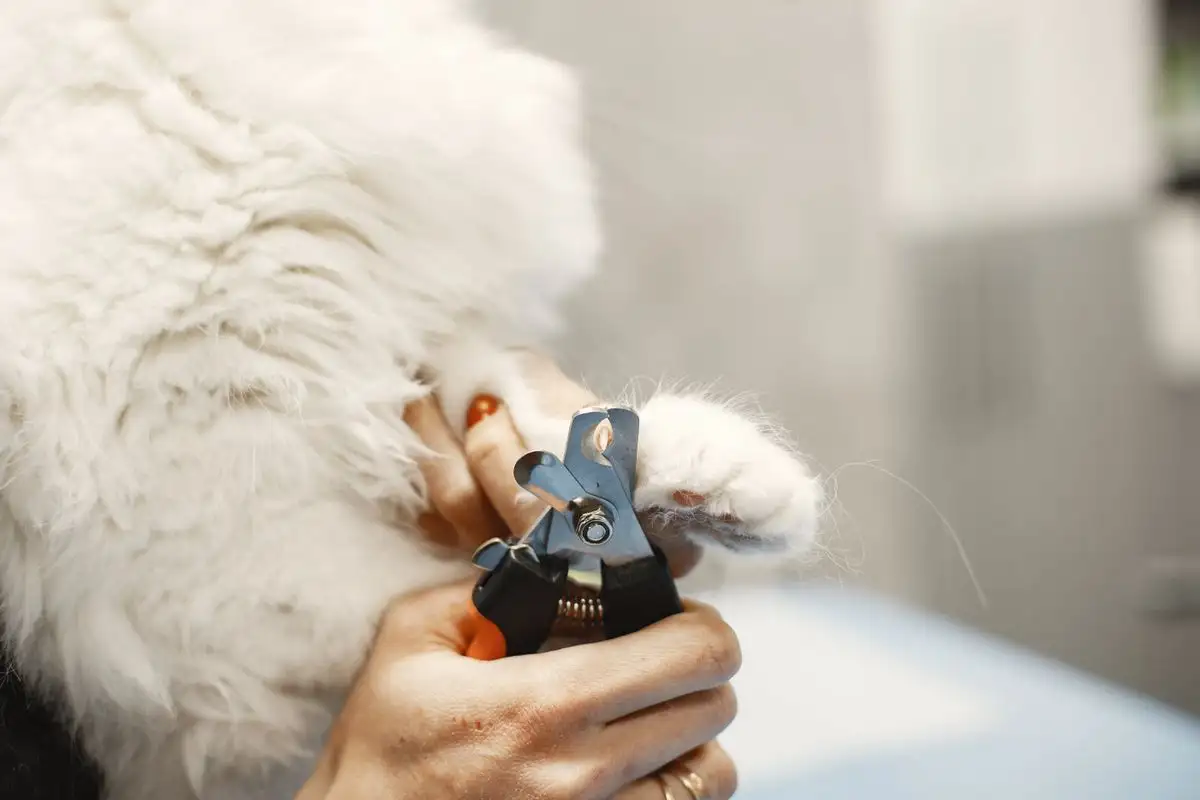
The cat's paw goes in my non-dominant hand with the back of the paw resting in my palm, pads facing up. My thumb sits on the big central pad, the one that looks like a bean. My index finger rests on top of the toe I'm about to do. To extend that claw, I press the thumb gently into the pad and let the index finger meet it from above. The claw slides forward out of its sheath. That's the whole mechanism. If the claw isn't showing, I'm pressing the wrong spot or the toes are curled and I need to wait a beat.
Then the index finger moves to the next toe and presses again. I work in a line — from the toe closest to my wrist to the one furthest away — so my hand barely moves and I don't lose track of which toe I just finished.
The cut itself is small. A claw is a shell with a pink core running down the middle, and that core is the quick: blood supply, nerve, sensitive. On a light claw the quick shows through and you can see it. On a black claw it doesn't, and that's where people panic. What I do on dark claws is take a thin sliver, then look straight at the cut face. If it's all opaque white or grey, I take another sliver. When a faint grey or pink dot appears in the center of that face, I'm close and I stop. That dot is the warning light, and it usually shows up with a millimeter or two to spare.
I cut straight across the curve rather than on a slant. An angled cut leaves a sharp point on the side of the claw, and a sharp point is what snags on carpet and gets caught on a blanket at two in the morning.
The one people forget
Once the four ground toes on that front leg are done, I stay on the same leg and go up. The dewclaw sits higher on the inside of the front leg, above the paw, tucked against the leg at roughly what would be the wrist. It doesn't touch the floor, so it never wears down. It also curls — not slightly, often most of the way around. A dewclaw skipped for a year can grow in a full circle and come back into the leg's skin, and by then it's a vet visit, not a trim.
You find it by feel. It's a loose flap of skin with a claw inside it, and it moves independently of the leg. Same press, same cut. Because it's on the inside of the leg, it's easiest to reach while my hand is still positioned from the ground toes — another argument for finishing a leg before moving to the next one.
Then I set the paw down. On purpose. One breath, then front right.
Rear paws: let the leg fold instead of pulling it out
Rear legs kick. I don't drag one out sideways to get at it. I let the cat keep the foot on the table, then lift the foot backward and up — the leg folds at the hock the way it does when a cat sits, and the paw comes up with no resistance at all, because folding is a direction that joint already goes. The underside turns toward me. Thumb on the pad, index finger on the toe, same motion as the front.
If the foot goes back down, I let it. I don't chase it. I'll get that claw on the next lift, and there's usually a next lift.
Rear claws tend to be thicker and duller from ground wear, but they still hook, and a hook is a hook. Same rule: clear curved tip only, stay above the pink.
The release is the reward, so give it on purpose
Here's the piece most instructions leave out. When a cat yanks its paw back and you hold on, the cat learns that yanking is how to get free — and yanking gets harder every time. The answer isn't a stronger hold. It's making the release not worth fighting for.
So I build it in. Trim one claw, let the paw go, pause for a breath, take it back. Trim the next. The paw returns to me on a rhythm, and a rhythm isn't something a cat has to struggle against. Some cats will give me all five on one leg in a single hold. Some want a release between every nail. Both are fine.
And one or two claws is a real session. I mean that as plainly as I can: if the cat is done after the first claw, the other seventeen are tomorrow's problem. Two or three short sessions across a week do more for the cat's long-term tolerance than one long one that ends with both of us upset, because a bad nail trim is remembered for a long time.
The towel, on the days it's needed
For a cat that won't hold still, a bath towel does most of the containment. The body wrapped, one front leg out past the towel's edge, that paw trimmed, then re-wrap for the other side. Loose enough that the cat can breathe easily and turn its head. The point is to reduce how many things are moving, not to overpower anything. If the towel is tight enough that the cat is straining against it, that's the wrong amount, and I unwrap and start again.
I'd rather say this plainly than imply otherwise: this grip and this route work on most of the cats I've handled. They don't work on all of them. A cat with sore joints, a paw injury, or a memory of a nail cut too short may need a different approach entirely, and for those cats the right move is a slow build-up over weeks or a vet visit, not a firmer hand right now.
Five on the left front. Ten at the right front. Fourteen at the left rear. Eighteen when I finish the right rear.
Then I run a fingertip over each claw once, feeling for a point I missed, and check the cut faces under the lamp. If one bleeds — it happens, most often on a dark claw where I couldn't see the quick — a pinch of styptic powder or plain cornstarch pressed against the tip stops it in a minute or two. That claw doesn't get trimmed at all next time; I work around it and let the quick recede on its own.
The towel comes off, the cat gets the table back for a minute to sniff, and the clippers go in the drawer. Eighteen is the goal, but the number that actually matters is how the cat walks away from the table. A cat that leaves loose and unbothered will be easier in two weeks than one that left fast.