Trim a biting cat's nails in three short sessions by making each one too small to trigger a bite: one paw, or even a single nail, per sitting, a real break in between, and an immediate stop the moment the tail or the ears change. The trim itself is rarely what sets a cat off. The length of the sitting is.
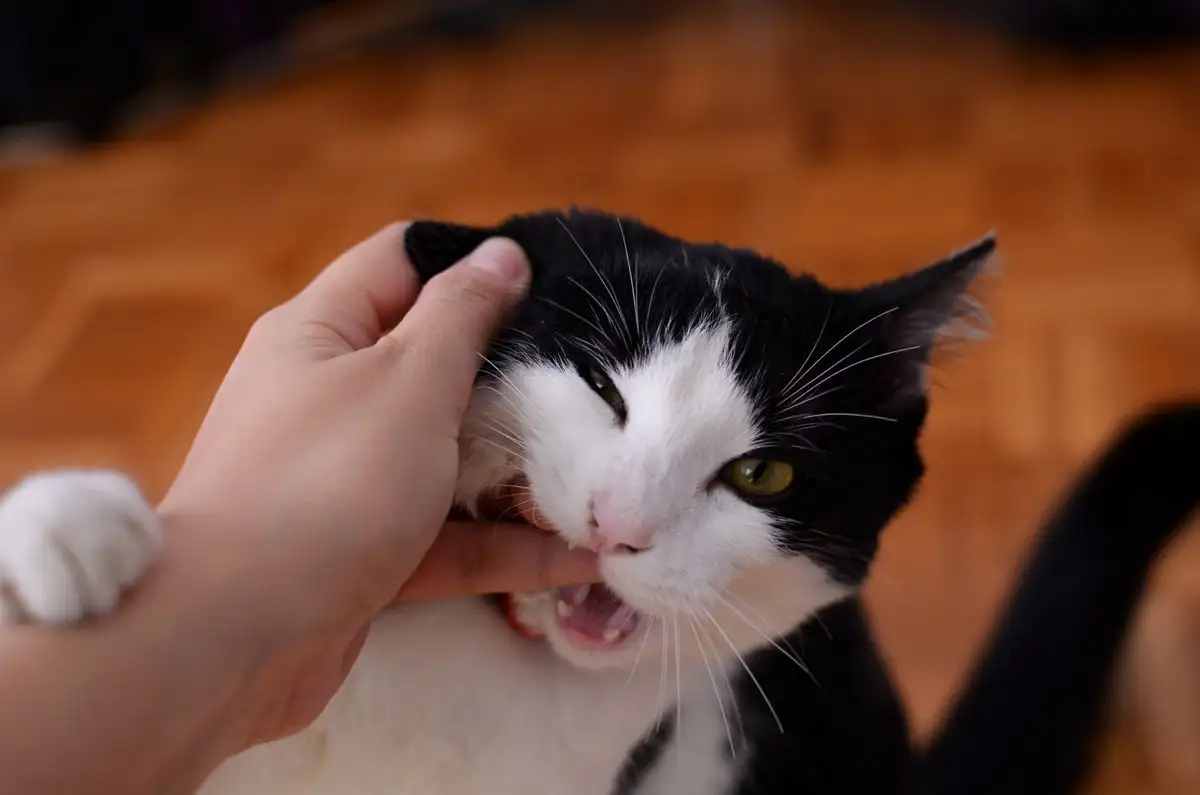
I learned that the slow way, on a bath mat with a cat planted on my knees and a towel I kept re-wrapping because I was sure that if I moved fast enough I could get through all four paws before she decided she'd had enough. Eleven nails. Every time. On the twelfth she would go still — not struggling, still — and then she would have my thumb. It took me an embarrassingly long time to notice she wasn't escalating. She was on a schedule, and I kept walking right into it.
What I trust now is that stillness. Not the growl, not the tail. Those come earlier and I should be gone by then, but the flat silence where the cat stops resisting is the last clear warning, and it's the one most of us read as cooperation. It isn't. It's the moment before.
The bite is a threshold problem, not a handling problem
Every cat has a line. Under it, you can hold a paw, extend a toe, click a clipper, and the cat barely registers it. Over it, you have a different animal entirely, one that is not being difficult and is not being dramatic but is doing what a small predator does when a bigger one won't let go.
Where that line sits moves. A cat that let you do one paw at nine in the morning may refuse a single nail at nine at night. A cat that is fine after dinner is not fine before it. Hormones, pain, noise, whether the dog is in the room, whether the mail carrier just hit the porch — all of it shifts the line, and none of it is under your control. The only thing under your control is how long you stay past it.
So the whole craft of trimming a biting cat comes down to arithmetic. Not how many nails can you get, but how many seconds you have before the accounting changes. On a hard cat I've had a budget of about ninety seconds. Some cats give me four minutes. It depends entirely on the cat, and pushing for four when the truth is ninety seconds is how people get bitten.
Session one: the towel, one paw, and getting out early
Lay a bath towel on the floor or across your lap, not a beach towel, not a blanket. Something thin enough that you can feel what's happening underneath it.
The wrap is a burrito, not a straitjacket. Cat on the towel, one front paw left out, the rest of the fabric brought around the body and tucked, not pinned. The head stays free unless your cat genuinely does better with it covered, and you'll know within one attempt which kind you have. My rule is that I should be able to slide two fingers under the towel at the shoulder and feel her ribs move. If I can't, it's too tight. If I've knotted anything, I've already lost, because the whole point is that one pull frees her instantly — for her sake and for mine.
What comes out from under that towel is one leg, from the elbow down. Not the shoulder, not the body, not a second paw. One leg.
Then the nail. Only the clear hooked tip, and on a dark nail, less than you think. I take one nail on a hard cat and stop. Two or three if she's relaxed and the towel is quiet and nobody has started flicking a tail.
Then she goes down. All the way down, out of the towel, onto the floor, free to leave the room. That's the session. It is over.
What under threshold looks like on a cat
You will get better at this faster than you expect, because the signs are not subtle once you're watching for them instead of watching for the nail.
A tail that was still starts ticking at the tip. Ears rotate back a few degrees, like something on a swivel. The skin along the spine ripples. The pupils open up. A low noise starts in the chest, sometimes so low you feel it in your hand before you hear it. And then the stillness.
I stop at the tail tip. Every time. Because I've learned that the version of me who says "one more, she's fine" is the same version of me standing at the sink at midnight with soap and running water on a puncture wound.
The break has to be a real break
This is the part people skip. A break is not setting the cat down and picking her back up thirty seconds later while she's still on the same tile, still smelling the clipper. That's not a break, that's a slower version of the same sitting.
A break means the cat leaves. She walks off, she gets a treat, she goes and sits in the window. I put the towel in the laundry and I don't touch it again for at least twenty minutes, and honestly, on a cat who has drawn blood before, the better answer is tomorrow. Three sessions doesn't mean three sessions in one evening. It means three sittings, and whether they happen across one night or three days is decided by the cat, not by my calendar.
That's the trade I've made peace with. Nail trims used to take eight minutes and cost me a week of a cat who wouldn't come near me. Now they take three days and cost nothing.
Session two: the other front paw, and maybe the ear
Second session, same setup, opposite leg. If she's settled and the towel is loose and she's still purring, I'll take a look at one ear while I'm there — the outer ear only, lifted, looked at, put back down. No digging. Nothing that goes into the canal. Anything deeper is the veterinarian's business, not mine.
If the ears are the reason we're doing this at all, they get their own session. I don't stack an ear check onto a nail trim on a cat who bites. One task per sitting. That's the rule that made the whole thing work.
Session three, and the part nobody mentions
Third session, whatever's left. A lot of cats only ever need the front claws done, so session three may just be a second pass at a front paw that got one nail the first time. Fine. That counts.
What makes session three possible isn't the towel. It's what happened on the couch in between.
On the nights when no clipper exists, I touch a paw. Just one. Cup it, press the pad gently so the nail slides out, let go, hand over a treat, and go back to the television. Fifteen seconds, no towel, no restraint, no cat who has to be anywhere. Days of that does more than any hold ever will, because the cat stops filing "paw touched" under threats and starts filing it under the same category as dinner. If you only do one thing from this piece, do that one, and do it when nobody needs anything.
The other routine jobs that get people bitten
Nails are the most common way a hand gets punctured, but they aren't the only one.
Pilling is where I see people get hurt, because it's the one task that has to happen on a schedule. A cat who bites during a pill is not a cat to wrestle with bare hands. That's a two-person job, or it's whatever method the veterinarian hands you — and if the method you've been given isn't working, the answer is to call and ask for a different one, not to get more determined. Some cats end up on a formulation that doesn't require the fight at all. That's a conversation for the cat's own vet, not for me.
The carrier is the other one. The grab-and-shove at the last minute is what produces the defensive bite, every time, because from the cat's side a hand coming down from above is indistinguishable from a predator. Mine lives on the floor for days before an appointment. Not in the closet, not on a shelf. On the floor, in the room where the cat already eats, with food served near it and eventually in front of it. By the time the appointment comes, the carrier is furniture. Nobody gets grabbed.
When to stop and let someone else take over
If skin breaks, the session is over and it doesn't resume. Stop. Wash it with running water and soap, take it seriously, and get medical advice — cat bites are small, deep, and prone to infection in a way that surprises people. If the cat's vaccination status isn't clear to you, say so to whoever treats you.
And if a cat who has always tolerated nail trims suddenly won't, that isn't a training problem. That's a cat with a sore joint, a nail grown into the pad, a bad tooth, something hurting. More towel practice will not fix it. I've made that mistake, and the cat paid for it while I got better at wrapping.
Some cats genuinely need two people, or a vet visit, or a short course of something prescribed to take the edge off. None of that is failure. The cat doesn't care how you got the nails done. She only remembers who was holding her when she got scared.