A calm adult cat that suddenly starts biting needs a veterinary exam before it needs a behavior plan, and the first thing the vet does is put hands on the cat — the mouth, then a slow pass down the spine, the belly, one limb at a time, the ears — with today's weight set beside the number from last year. Two details decide how fast that appointment should happen: exactly where your hand was when the bite landed, and how old the cat is. A bite that shows up only around one spot on the body, or any new biting in a cat over eight, is a clinical clue, not a training problem.
I keep index cards in the kitchen drawer next to the treats. I'm not organized about much, but when something changes in this house, it goes on a card, because I have been wrong too many times about what I thought I saw. The one that mattered is dated on a Tuesday and says, in my handwriting: "left flank, twice, growled first."
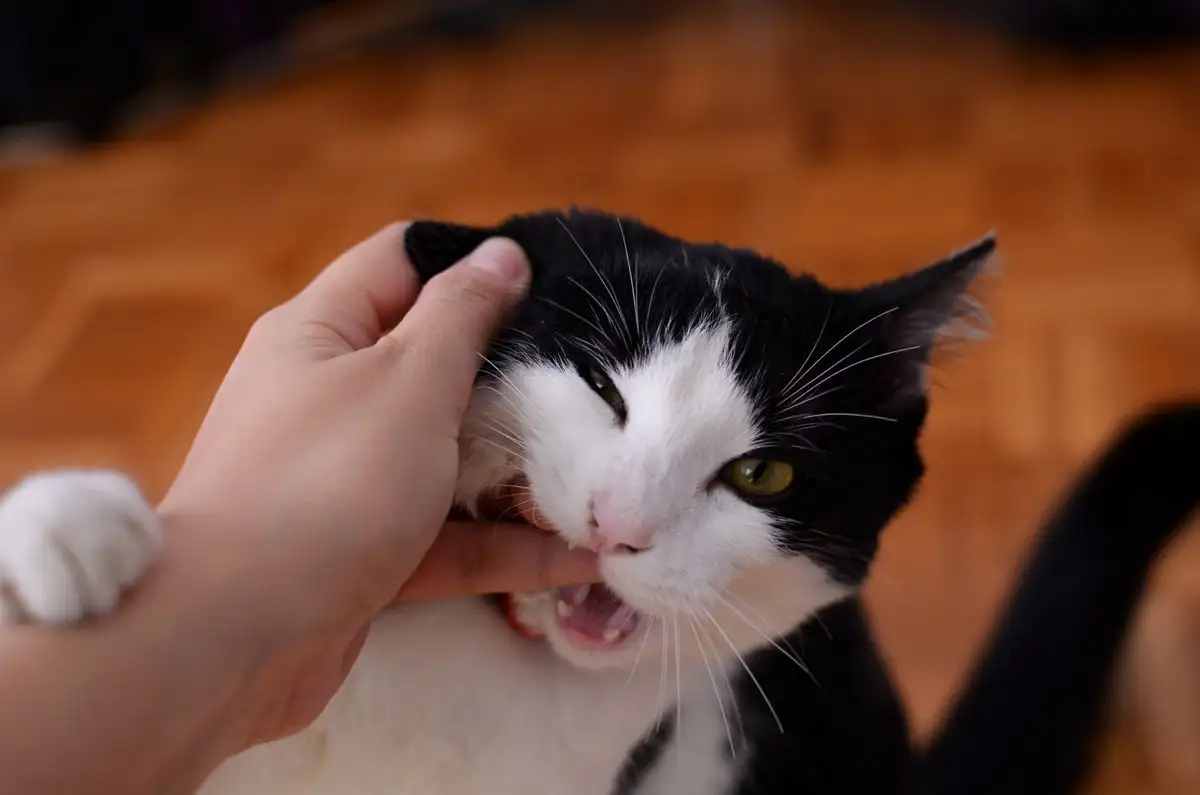
Here is the moment I want you standing in, because it took me three cats to understand it. You're on the floor with your back against the couch. The cat is on your left knee the way he is every night, warm and half asleep, and you slide your hand down his side the way you always do. There's a low sound in his chest a half second before his teeth close on the web of your thumb. Not a swat. Not the quick corrective nip a cat gives when you've petted him past his limit. A real bite, with weight behind it. Then he's off your lap and under the chair, and you're sitting there with four small punctures, certain you did something wrong.
You did do something. You put your hand on a spot. That's the useful part. That's the data.
The map I draw before I pick up the phone
Before I call anyone, I draw a cat on a piece of paper. Badly. A potato with ears and four sticks. Then I mark an X where my hand actually was at the moment of each bite, and I write the date next to it.
Three X's in the same neighborhood is not a personality. It's a location.
What I'm looking for is clustering. Marks bunching up at the mouth or the side of the face. Marks on the belly. Marks along the lower back, or on one hind leg and never the other. One ear that gets a reaction and one that doesn't. If the X's scatter randomly across the whole cat — head one day, tail the next, no pattern — that points somewhere else entirely, and I say so when I call, because it changes the conversation.
The clustered version is the one that stops me. A cat who bites when you touch one specific square inch of him is telling you where, not who. He can't point. The bite is the point.
I also write down what came right before it. A growl. A tail flick. Ears going flat. Most of these bites are not out of nowhere — they're out of a warning I missed because I was watching television.
Why the mouth gets checked before anything else
Every vet I've sat across from has gone for the face first. Lip lifted, one side then the other, a look at the gum line where the tooth meets the tissue.
Cats are excellent at eating through a sore mouth. That's what fools people. The bowl is empty every morning, so the mouth must be fine. But watch how he eats: tilting his head, chewing on one side, dropping hard food and walking away, flinching when you touch the outside of his cheek, drooling a little, breath that's gotten noticeably worse. Grooming sliding downhill is another one — a cat whose coat has gone greasy along the back has usually stopped doing the work.
Dental problems are among the most common and most treatable things found in cats who start biting handlers in middle age and after. That's not a diagnosis of your cat. It's the reason the mouth is the first place hands go.
Eight years old is the line I use
It's a prompt, not a rule. A two-year-old who suddenly bites still deserves a call, but there are more behavior explanations on the table for a young cat — a change in the house, a new animal outside the window, a kid who got grabby. Past eight, the balance tips hard toward the body.
And that's where the worst sentence in cat ownership lives: "He's just gotten mean in his old age."
I've said it. I've heard it from a dozen people in the rescue. It's a story that ends the conversation, and it's the one I trust least, because old cats don't turn mean. Old cats hurt in places that are hard to see. Arthritis in the spine and the joints is common and quiet, and a cat who stops jumping onto the counter doesn't look like a cat in pain — he looks like a cat who decided not to bother. Same with the lower back, the hips, the knees. Handling those areas becomes the thing that gets bitten.
Ears belong in this group too. A cat who pulls away when you touch one side of his head, or shakes it, or holds it a little lower than the other, is giving you a location.
What to write on the card instead of a story
When I call, the receptionist doesn't need the narrative of my evening. She needs the five things the vet will ask anyway. I put these on the card:
- What I touched — right side, mid-back, while he was facing away from me
- When it started, and whether there was a milder version of it weeks before
- How often, and how hard — warning sound or no warning, skin broken or not
- What else changed: grooming, hiding, appetite, jumping, the litter box, where he sleeps, yowling at night
- Anything new in the house, including new people, new furniture, or a new cat on the block
That last item matters as much as the first. And the "what else changed" line is the one people leave out, because it doesn't feel connected. It is connected.
I am not the one who decides whether your cat needs bloodwork or an X-ray. That's the vet's call, and I'd be doing you a disservice to guess at it from a card. The point of the notes isn't to hand over a diagnosis. It's to keep the vet from reconstructing your history from memory under time pressure.
What the first five minutes usually look like
Your vet's sequence will differ from mine, and it should — no two cats cooperate the same way. But the shape of it is consistent in my experience. The cat walks across the floor while the vet watches, because gait tells you things a cat standing still won't. Then hands: the jaw, the face, down the neck, along the spine with fingers on either side, the belly, each leg, each paw, the ears with the scope. Some cats will not tolerate a full mouth exam while awake, and how far to push that in the room is the vet's judgment, not yours and not mine.
The scale is part of the exam. A pound and a half lost since last spring is a finding, and it's one you cannot see at home when you look at the same cat every day.
Sometimes it isn't pain, and I'd rather say so
Not every new bite is a body problem. Cats bite from fear and from overload too. A new baby, a move, a stay at a boarding place, a house full of relatives at the holidays, a neighborhood cat spraying the front door — a cat whose world got smaller can start biting the hands that reach for him. If the X's wander and the timing lines up with an event, that's worth saying out loud at the appointment.
But you still rule out pain first, for a practical reason. Pain is common, it's treatable, and a behavior plan built on top of an untreated sore makes everything worse. The cat learns that hands hurt. You learn to stop reaching for him. The two of you get quieter and further apart, and by the time someone connects the dots, months have gone by.
One more thing, and this one is about you. If a bite breaks your skin, wash it and get your own medical attention. Cat bites on the hand are a well-known way to end up on antibiotics, and the fact that you were bitten by someone you love doesn't change the tissue under your skin.
The cat isn't handing you a verdict
He's handing you a location and a time, and he can't do any better than that. So write both down, on whatever is closest — an index card, the back of an envelope, the notes app on your phone that you never open. Then hand it to someone who can put their hands on him and decide what to look at.
The bite is not the problem. The bite is the message, and it is more specific than most people realize. Your job is to carry it, intact, to the exam room.