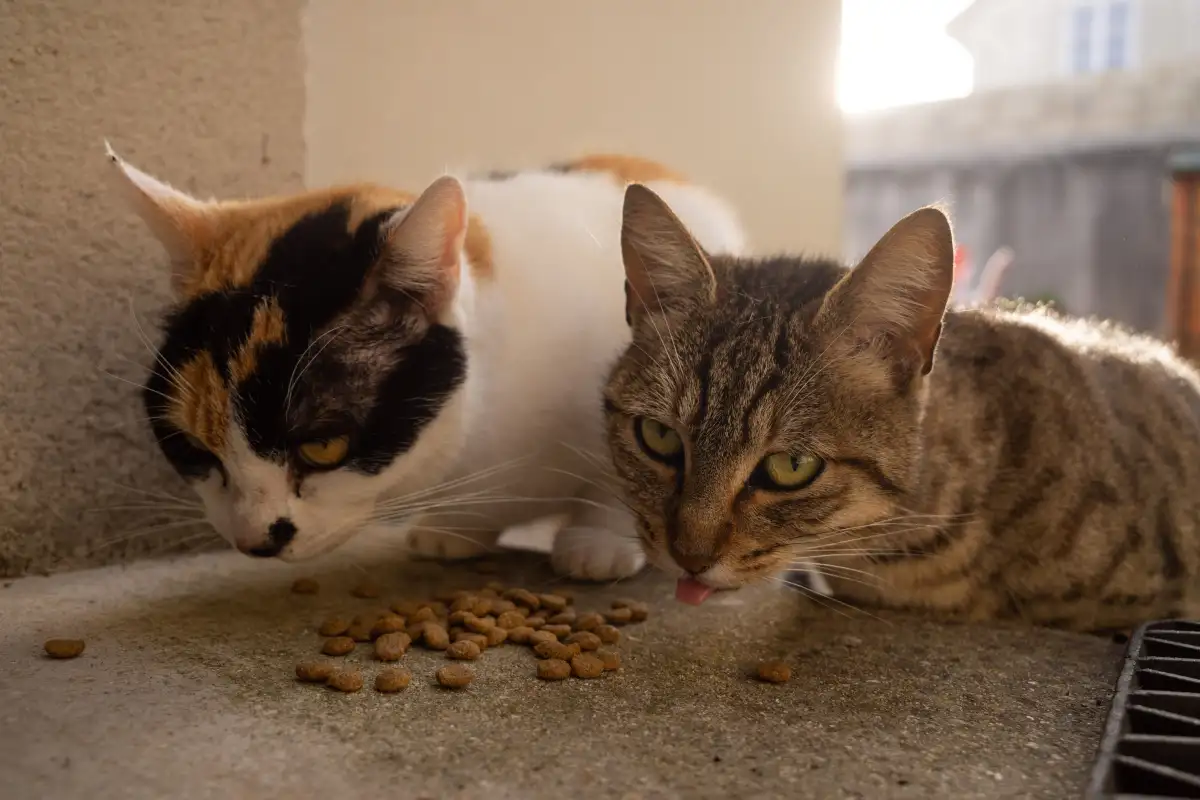
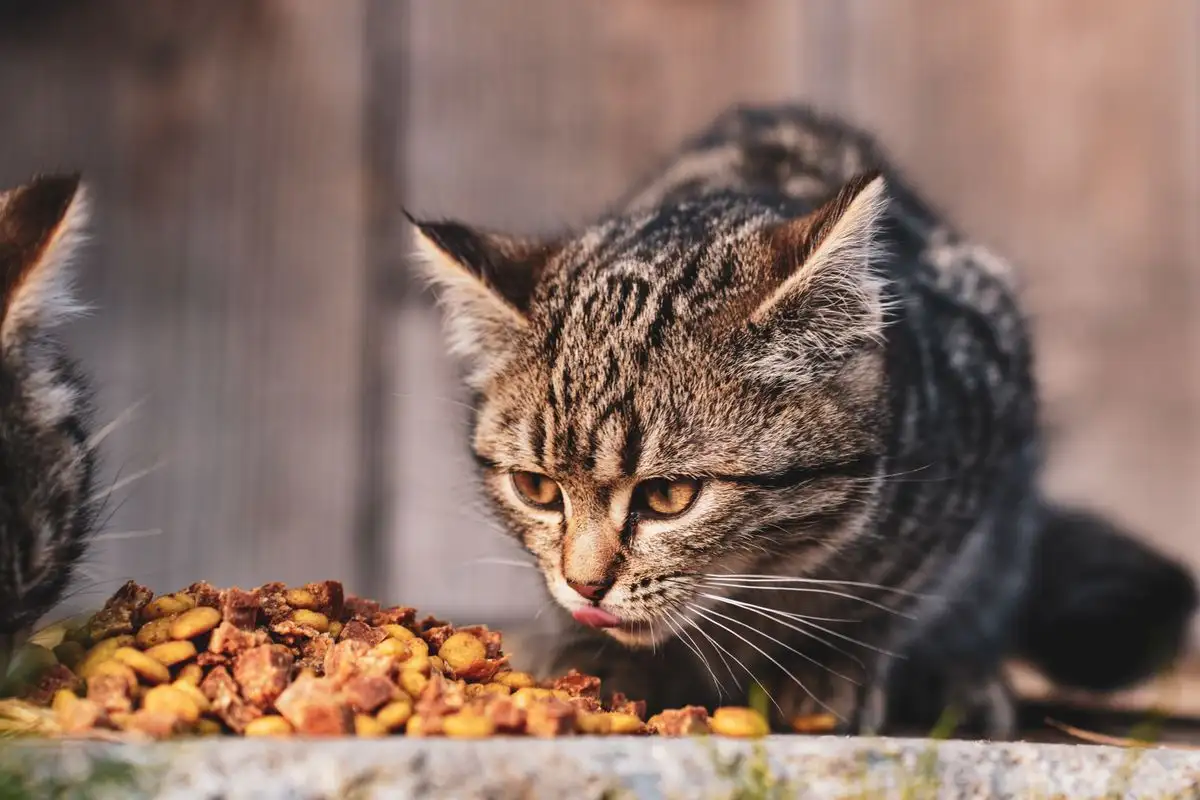
A cat's diet needs to change at two points, and only one of them is tied to a date. The first is the move off growth food, which happens around twelve months for most cats and later for some of the large breeds. The second is the move into a senior pattern, and that one does not happen on a birthday at all — it happens when weight, muscle, and appetite start to drift, usually somewhere between seven and ten years old, sometimes earlier, sometimes much later. Everything in the middle is quiet, and that quiet is the problem, because the cat who shows up at thirteen looking bony was already changing at nine.
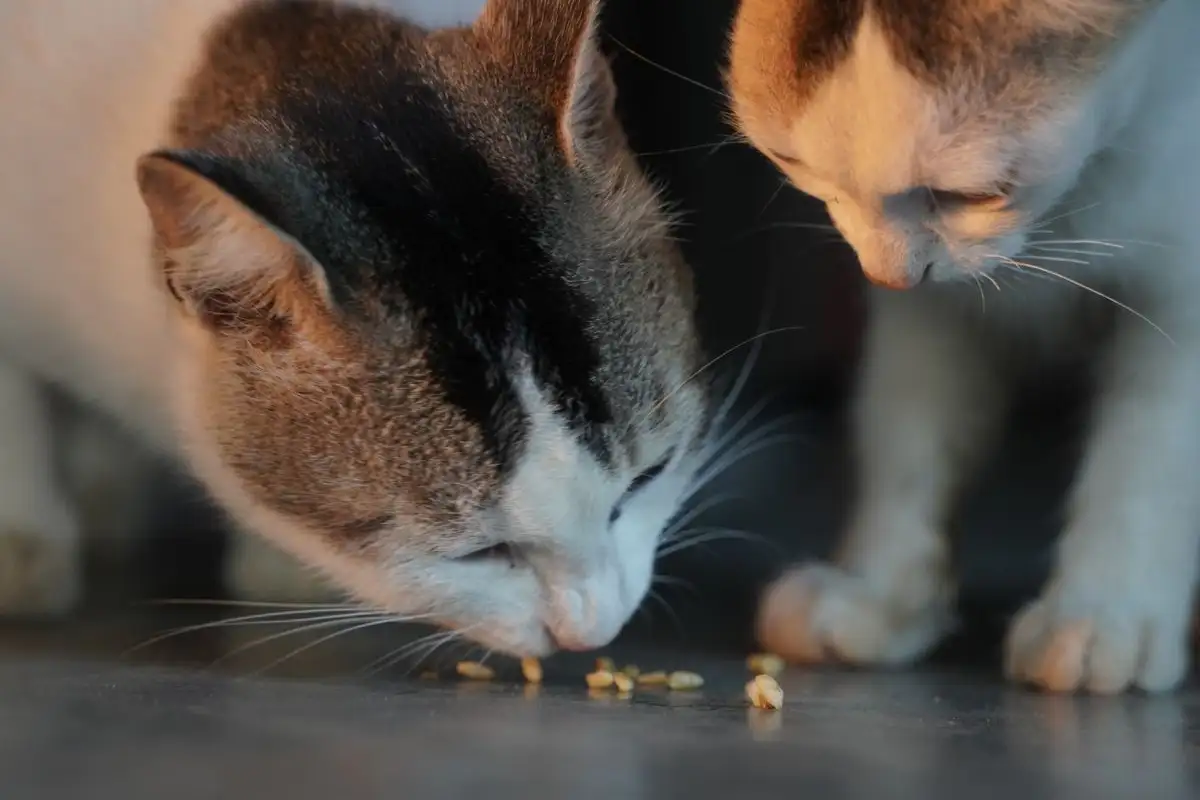
I know the exact bowl. Shallow ceramic, white, chipped on one rim, sitting on the same rubber mat beside the dishwasher for thirteen years. I have filled that bowl four times a day, then three, then twice, and then for a while — without noticing — a little less each time.
Her name is Nell. She was ten weeks old when she came home, a gray tabby with a white chin, riding in a carrier that swallowed her whole.
The first year is not adult food with a bigger scoop
The mistake I nearly made, and the one I watch other people make constantly, is treating kitten feeding as a portion problem. It is not. It is a recipe problem.
A kitten burns roughly two to three times the calories per pound of body weight that an adult cat does. That number gets passed around a lot, and it is true, but it is the less important half of the story. The other half is that a growth diet is not adult food with the volume turned up. It is formulated to a different nutrient profile — denser in protein and fat, built around the calcium-to-phosphorus ratio a skeleton needs while it is still being assembled, dosed for the amino acids a growing body cannot manufacture enough of on its own. Pouring more adult maintenance food into a kitten's dish does not get you there. You end up with a cat who eats until full and still comes up short on the things that never show up on a scale.
So for that first year, Nell ate growth food. Four small meals a day at the start, because a kitten's stomach is roughly the size of a walnut and asking it to hold a whole day of food is asking it to fail. We dropped to three meals somewhere around six months, then to two as she approached a year. She also ate like a creature who had never once been fed — the five-in-the-morning leg-climbing phase lasted longer than I care to admit.
Twelve months is a range, not a deadline
Most cats reach their adult body size around a year. Some of the big breeds keep filling out well past that, which is why the calendar is a rough guide and the cat is the actual authority.
The signal I use is boring: I weigh her. Same scale, same time of day, once a month, written in pencil on the inside of a cabinet door. When the number stops climbing and holds flat for a few weeks, the growth phase is winding down. That is when the food starts to change.
And the change itself is slow — seven to ten days at minimum. I mix rather than replace. About a quarter of the new food into the old, hold that two or three days, then half and half, then three-quarters new. That is not fussiness. A hard swap gets you a cat with an upset stomach, and then you get to spend the next week guessing whether the food is the problem or the switch was, which is a bad week nobody needs.
One thing worth reading on the bag while you are standing in the aisle: the AAFCO nutritional adequacy statement, the little line that says which life stage the food is complete and balanced for. Growth, maintenance, or all life stages. The first year, you want growth on that line. "All life stages" technically covers a kitten, but I have never liked the idea of feeding a growing animal a formula built to sit in the middle of two very different sets of needs.
The middle years are where the drift actually starts
Here is the part almost nobody says out loud: adult maintenance is the longest phase of a cat's life and the least interesting to think about, which is exactly why it is where things go sideways.
Nell was spayed at six months, and that alone dropped her energy needs. She went from a cat who could eat freely and stay lean to a cat who could add a pound without anything visible changing about her day. That is when I stopped free-feeding and moved to two measured meals. Not because free-feeding is wrong — for plenty of cats it works fine — but because I could no longer tell the difference between a cat who was hungry and a cat who was bored, and I needed the bowl to tell me the truth.
Two meals, weighed on a kitchen scale instead of scooped by volume, because a cup of kibble is a volume and kibble does not always fill the same volume twice. That single habit is what made the next ten years readable.
Then the other kind of weighing. Hands on the cat. Ribs should be easy to feel without pressing. From above, there should be a waist tucking in behind the ribcage. Along the spine and over the hips, you should feel muscle, not ridge.
Somewhere around year seven or eight, I started feeling more ridge than I used to. Nothing dramatic. Nell was still eating both meals, still getting up onto the windowsill, still yelling at the birds through the glass. But the shape under my hands had changed, and the bowl had started coming back with a few bites left in the bottom.
That is the quiet part. That is the whole article, really.
Senior is not a food. It is a cat.
Something that took me far too long to understand: there is no single senior diet, because there is no single senior cat. The nutrient standards that govern commercial cat food recognize growth and maintenance. "Senior" is a word on a package, and what is inside can mean almost anything — sometimes more digestible protein, sometimes less fat, sometimes a different fiber level, sometimes the same food in a different bag with a different picture on it.
What older cats actually need splits in two directions, and those directions can point opposite ways at the same time.
Some older cats need more protein, not less — protein that is easy to digest, because their bodies are less efficient at using it and muscle is being broken down faster than it is being rebuilt. Others need fewer calories overall, because they have slowed down and the same amount of food now lands as extra weight. Some need both, which is the genuinely hard case, and the reason a vet who can look at your cat matters more than any article.
And being underweight is a real, common problem in older cats. More common, in my experience, than the obesity everyone talks about. I have fostered cats whose owners were proud of how slim they had stayed, when what had actually happened was that the cat had been quietly losing muscle for two years.
So the senior transition is not "switch to senior food at seven." It is "start watching the same three things more closely, and let the cat tell you which direction you are headed." For Nell it went one way: she needed food that was easier to digest and a little denser, because she was losing shape while still eating. For a foster I had a few years later, it went the opposite way entirely — he got round on the same amount his sister ate, and the answer for him was less, not more.
If there is a single rule in all of this, it is that the cat decides the date. The calendar just tells you when to start paying attention.
The one thing that is not a food question at all
If an older cat stops eating, that is not a signal to try a different flavor.
A cat who walks away from a full bowl, or eats three bites and quits, or suddenly wants to be hand-fed one piece at a time — that is a veterinary question, and it belongs with a vet before it belongs at a pet store. Reduced appetite in an older cat is a symptom, not a preference. It can trace back to dental pain, to kidney function, to thyroid, to any number of things a food change will not fix and will only delay. I have watched people spend two months and a few hundred dollars cycling through flavors before finally making a phone call. The phone call was the answer the whole time.
I will also be honest about the limits of what I can tell you. I am not going to hand you a calorie number for your cat, because I do not know your cat. Body condition, activity level, whether they are intact, whether there is another cat in the house guarding the bowl — all of it moves the number. Your vet can work it out with you. What I can tell you is to weigh the food, weigh the cat, and write both numbers down, because memory is a liar and it will tell you the cat looks the same as always.
How the switch actually looks at the bowl
The mechanics are the same at every stage, which is the one genuinely comforting thing about all of this:
- Mix, do not replace. Start at roughly a quarter new to three-quarters old, and hold that for two or three days.
- Move to half and half, then three-quarters new, holding each step a couple of days. Seven to ten days total.
- Keep the bowl, the mat, and the location the same. Change one variable at a time.
- Do not do it during a move, a new pet, a trip, or a house full of guests. Pick a boring week.
- Watch the litter box, not just the bowl. A stool change is the first sign a switch went too fast.
- If the cat refuses the mix outright, back up a step and hold there longer. A cat who will not eat is a worse problem than a cat eating the previous food for four more days.
Then, ten days later, you are on the new food and nothing dramatic has happened. That is success. The entire point of doing this well is that it looks like nothing at all.
Which brings me back to that chipped white bowl by the dishwasher. Thirteen years, three foods, one cat. The first change had a date on it. The second one did not — I found it by putting my hands on her and noticing that the shape I had been petting for a decade was not quite the same shape anymore. If you take one thing away from all of this, take the habit of noticing. The food does not need to change on a schedule. It needs to change when the cat does.