Watch the ears, but read them as an angle against the skull, not as a shape with a name. Ears turned forward and slightly outward are the resting-alert baseline; ears rotated out to the sides, with the whiskers fanned wide and the cheek pulled flat, mean the cat is already at or past its limit with whatever is happening. That combination is usually the last clear warning before a swat or a bolt, and the shift into it can take a second and a half. Read the ear angle first, then the cheek and whisker pad, then the tail and the weight in the paws — in that order, every time.
I want you on the floor for this. Not standing over the cat — down on the rug with your shoulder against the couch, one hand resting palm-up on your knee, out where the cat can come to it and where you can't follow it. That hand position is doing more work than it looks like. A hand that has to travel to reach the cat is a hand that gets swatted; a hand that stays put lets the cat set the distance, and it leaves you free to watch instead of manage.
There was a gray-and-white foster I kept for six weeks last fall, a stocky thing with a notch out of one ear and a purr you could hear from the hallway. First night, he was on the cushion beside me, rumbling, and I had one hand flat on his shoulder blade where he'd leaned into it. Ears forward, tipped a little outward — the way they sit when a cat is awake, interested, and nothing is wrong. Whiskers out in a loose fan, moving with his breathing. That's the baseline. Every cat has one and no two are identical, which is the first thing you have to unlearn from the charts.
Then I scratched the base of his tail, a spot he'd liked ten minutes earlier, and I counted.
One and a half seconds. The purr didn't stop, which is what fooled me the first few times this happened. What changed was the ears: they rotated out to the sides, not back, so from where I sat they looked wider and lower, like wings tipping. The whiskers actually went first. If I'd been watching the pad instead of the ears, I'd have caught it sooner — the whole fan swinging forward and stiffening, the cheek behind it pulling tight so his face got wider and much flatter. Then the tail lifted off the cushion and started a slow tick. Then the swat, which was a warning swat with the claws in, but I only knew that afterward.
You want to catch the first half of that sequence, not the last.
The ear angle is the fastest channel, so it gets the first glance
Ears move in fractions of a second. They're the only part of the cat that tells you something in the time it takes your hand to travel an inch. The tail is slower, and it's also busy being a tail — balance, counterweight, the little flick that means nothing at all. Posture is slower still. So the ears get the first look every time, but the look isn't a diagnosis. It's a pointer.
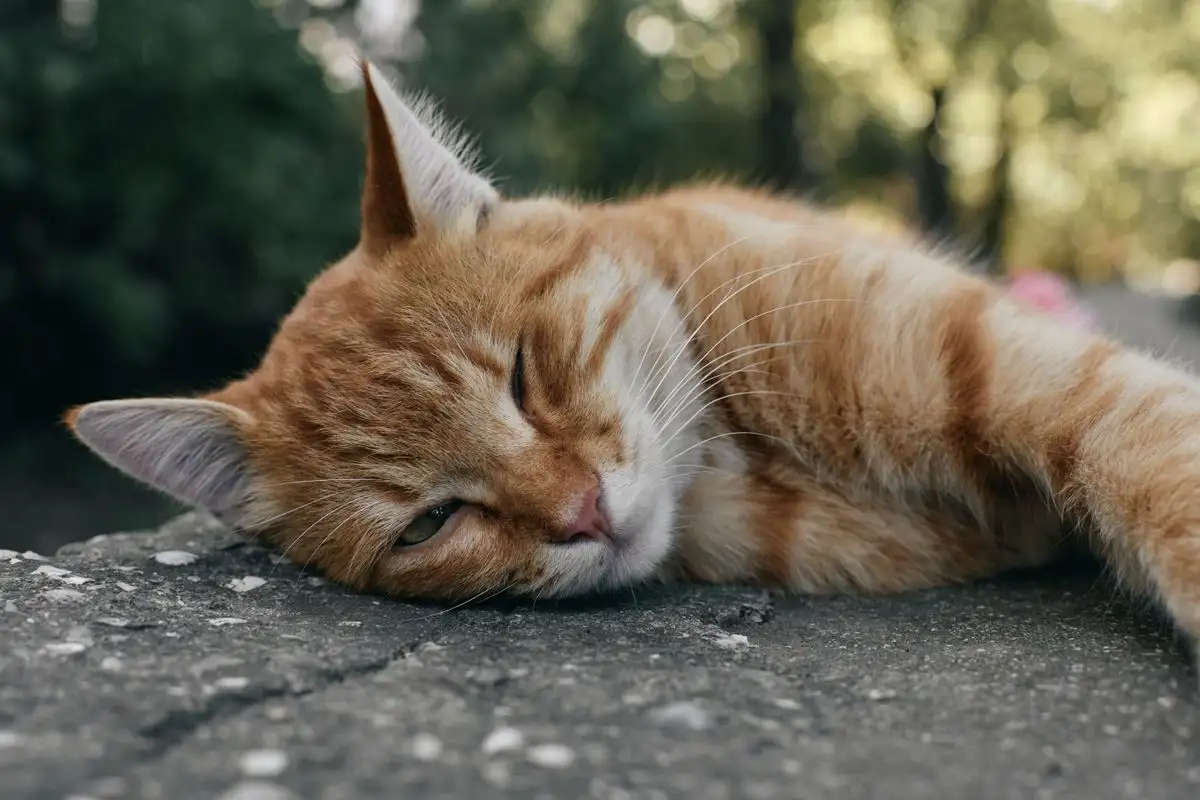
What I'm actually measuring is the angle between the ear and the line of the skull. Forward and slightly out, the ear plane facing ahead and a bit to the side like a cat listening to something just off center, is the resting-alert position. Sideways — ear plane rotating toward horizontal, the opening pointing more outward than forward — is what people call airplane ears, and in my experience it shows up with irritation, with fear, or with a cat that has simply had enough touching. Pinned flat back is a stronger version, and it almost never arrives by itself. When the ears go flat, look at the body: the cat is usually hunched, or its weight has shifted onto the back feet, or it has turned a shoulder toward you. Flat ears on a sprawled, boneless cat is a cat about to fall asleep, not a cat about to bite.
The cheek pad tightens before the ears do
This is the cue that gets left out of most of what I've read, and it's the one I trust most.
Put your attention on the whisker pad — the muscle bed the whiskers come out of, the part that widens when a cat is tracking something and narrows when it isn't. On the gray-and-white, that pad drew back and tightened a full beat before the ears rotated. On a tortie I fostered for a rescue, the tightening was the entire tell; her ears barely moved before she'd had enough, and if I'd been waiting for airplane ears I'd have been bitten twice as often as I was.
The pad going tight is quiet. A small drawing-in, the cheek behind it flattening. When the pad is loose and the whiskers are splayed at rest, breathing through them, you have room. When it tightens, you have maybe a second to change what you're doing.
Whiskers themselves move in two directions worth knowing. Fanned forward and slightly up is interest — the cat leaning its whole face into the world. Pulled back tight against the cheeks, the fan collapsed to a narrow brush, is the other end: fear, or a defensive state, the cat making itself small and getting its face out of the way. Same whiskers, opposite directions. Which is why a chart saying "whiskers forward means happy" will get you hurt. Forward is engagement, and engagement can be a cat launching at a toy or at your ankle.
Then confirm with the tail and the feet
Once the ears and the pad have given me a direction, I check it against two things: the tail, and where the weight sits.
Tail up and loosely curled, or draped and still — fine. Tail low and stiff, or ticking at the tip in a slow metronome — not fine. Weight rocked back onto the hindquarters with the front paws light means the cat is loading for something. Front paws planted and the body leaning in means the cat is going to grab, not flee. Those are different outcomes and they need different responses from you. A cat loading to flee needs you to stop and give it a route out. A cat loading to grab needs you to stop and take your hand away, slowly, without a jerk.
And then there's what I do with my own body, which matters more than anything I say. I stop. Hand goes still, stays where it is, doesn't retreat fast and doesn't push further. I don't talk to the cat in a soothing voice, because the voice doesn't mean anything and the motion of my hand does. If the ears come back forward and the pad loosens within a few seconds, I can usually carry on. If the ears stay out to the sides, I'm done, and the session ends with the cat still on the cushion and me going to get a glass of water.
Not every rotated ear is a message
An ear that's warm and folded over because the cat is asleep is not a signal. An ear that's flattened while the cat works at a hind leg with its tongue is not a signal. A cat that's been lying in a sunbeam has ears that feel hot and sit differently, and none of it says anything about mood. During grooming, during sleep, during the boneless sprawl after a meal, the ears are doing something other than talking to you.
The way I tell the difference is change. A signal is a departure from that cat's own baseline in the last second or two. If the ear has been sideways for twenty minutes while the cat snoozed, that's just where the ear is. If it went sideways while your hand was moving, that's a sentence.
What this looks like in practice
Nobody watches ears, tail, and weight at the same time. I don't. What I do is let the ears pull my attention — they change fastest, so they get the first look, and whatever they do tells me where to look next. Ears out to the side with the pad tight, I check the tail. Ears pinned back, I look at the shoulders and the feet. Ears forward and loose, I go back to what I was doing and check again in a few seconds.
It's a habit, it takes a couple of months to build, and it will be wrong sometimes. There's a cat down the street whose ears sit low and wide at rest no matter what, and her owner reads her by the tail alone. That's the honest limit of all of this: the labels are a starting point, the geometry relative to the head is the thing you're actually reading, and the baseline belongs to the animal in front of you. Learn the shape of that particular cat's nothing-is-wrong, and the small departures from it will do the talking for you.