A slow blink is a deliberate, relaxed closing and reopening of the eyes, and it reads as a non-threatening signal; returning it slowly is low risk. A long, unbroken stare with narrowed pupils sits at the opposite end of the same channel and reads as a challenge, which is why staring back is the one thing to avoid. Both signals only become readable after one unglamorous check: how much light is in the room, because a cat's pupils answer to brightness before they answer to mood.
I do that check on autopilot now. Dusk, kitchen light off, cat up on the back of the couch, and its eyes look like two black coins. Flip the switch and within a couple of seconds those pupils pull down toward slits. Nothing about the cat's mood changed in that half second. Only the light did. If I had walked in, seen the wide eyes, and started narrating fear or excitement, I would have been reading the room's lighting back to myself and calling it the cat.
Light first, mood second
Pupil size is one muscle doing two jobs. It opens and closes for brightness, and it also opens for arousal. Both signals land on the same dial, which is why a wide pupil on its own tells you almost nothing until you fix one variable.
So I take two looks. The first look records the light: overhead on, curtains open, lamp on, dim, whatever it is. The second look, a few seconds later, records whether the pupil matches that light. Bright room plus round, wide pupils is the mismatch worth paying attention to. Dim room plus wide pupils is not information about mood at all, and I move on to the ears and the set of the body instead.
When the pupils are wide in good light, arousal can be fear or play, and it's the same dial either way. What separates them is everything below the eyes. Play has weight forward, ears up or swiveled, a loose moving tail. Fear has weight back, the body low or angled away, ears flattened or held out to the sides. I don't trust anyone who reads pupil size alone, including myself before coffee.
What the slow blink actually looks like in real time
A regular blink takes a fraction of a second. You barely catch it. A slow blink takes a beat, sometimes two: the lid comes down, holds half-closed for a moment, then rises at the same speed it fell. The brow stays smooth. Nothing pulls at the corners of the eye.
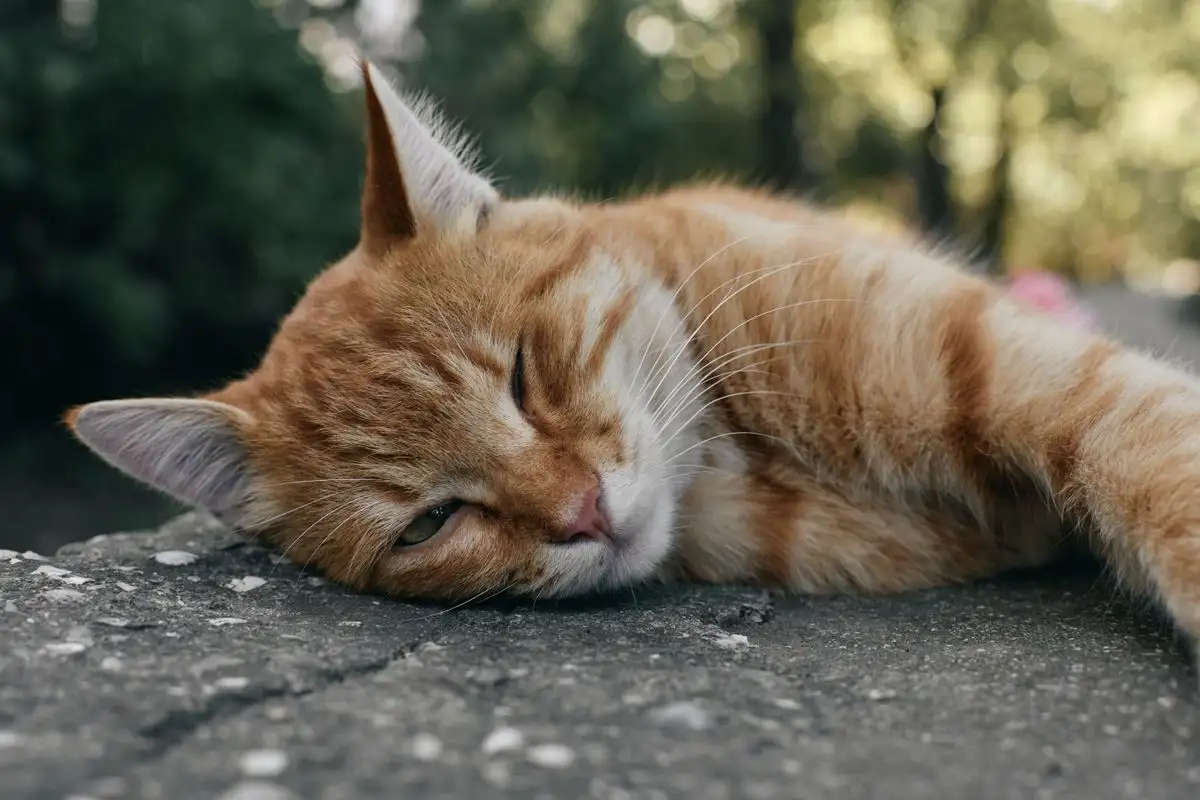
That soft, half-lidded look is contentment, and this is where I part company with people who call it sleepiness. A sleepy cat's lids droop and the head goes with them, the body slacks, the chin drops. A content cat is half-lidded while still upright and still oriented toward you, or the sun, or the food bowl. The eyes are doing the talking, not the sleep.
The part almost everyone gets wrong is how to answer it. You don't lock eyes with the cat and then perform a blink while holding the stare. That's a blink inside a stare, and the stare is the louder message. What works is letting your gaze go soft and drift slightly off the direct line before the lids close, then closing and opening slowly. Break the line with the lid. That's the whole gesture, and once you've seen it done properly you notice how often people do the version with their eyes still fixed and their chin pushed forward.
The other end of the channel
A hard stare is specific. Direct, unbroken, pupils narrowed down, body still, ears doing something I'd rather not lean into. That cat is not asking a question. Two cats staring at each other this way are past the diplomatic stage, and one usually looks away within a few seconds or there's a scuffle. Aimed at a person, it means the same thing.
Do not answer it. Not to prove a point, not to show the cat who runs the house. Looking away isn't losing, because nothing is being won. I break the line, turn my head, get back to folding laundry, and leave the cat a clear route out of the room. Most of the time the cat leaves, the pressure leaves with it, and it's over.
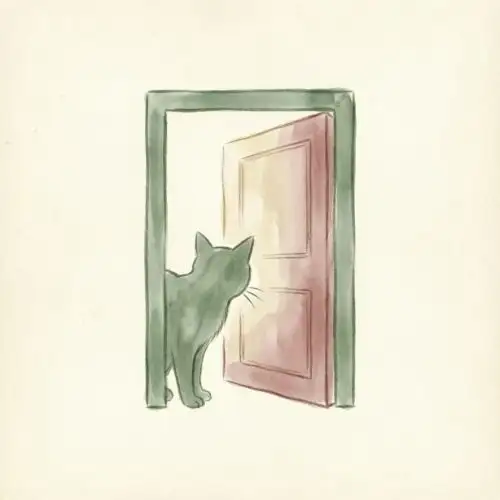
There's a third stare that gets misread as a challenge and isn't. Soft eyes, normal pupils for the light, ears forward, and the cat parked in the doorway at five o'clock looking at me. That isn't a threat. That's a request with a schedule. Same for the cat staring at the cabinet where the treats live. The eyes point at me, but the subject is dinner.
Looking away is doing something
Gaze direction carries as much as gaze intensity. A cat that breaks eye contact, turns its head, or slides its eyes to the side is reducing pressure, not showing contempt. In a house with several cats you see this all day: one cat walks past another, both look away, nothing happens. That's the negotiation, finished in a second and a half, and nobody had to raise a paw. The fights start when one of them doesn't look away.
Blink rate fits the same logic. A relaxed cat blinks normally. A cat trying to keep the peace does more lid work, faster and softer, and a cat that's ramping up stares with the lids pulled back. If you want to know what a cat is doing, look at whether it's adding tension or subtracting it.
The squint that isn't saying anything
Some eye signals aren't communication at all. A cat with a tight brow, a slight squint, a hunched body, and a habit of facing the wall isn't being aloof or subtle. That's a cat that feels bad, and the eyes are just where it shows. A squint that comes bundled with body tension belongs in a health category, not a language one, and I don't try to read a message out of it. I watch appetite, the litter box, and whether the cat wants to be touched, and if the picture stays off for a day or two, that's a vet conversation rather than a body language puzzle. No amount of eyelid work on my part changes a hurting cat.
Where the reading falls apart
Some cats never return a slow blink. The shut-down foster, the semi-feral cat who spent her first year under a porch, the cat who's been in the same room for six hours and hasn't moved. Absence of a returned blink tells you about that cat's history, not about whether you did it right. This isn't a guaranteed technique, and anyone who says it always works hasn't met enough cats.
Context overrides everything else. A slow blink aimed at a cat in a carrier in a clinic waiting room carries less than the same blink at home on the couch, and a hard stare in a strange room is often fear wearing a challenge costume.
The eye alone is never enough. Eyes, then light, then body, in that order.
And you can't speed it up. I've watched people try to teach a cat to blink back in an afternoon, as though it were a trick. It isn't. You're just moving your own face more slowly than usual, and either it lands or it doesn't. The cat decides.
What I'd tell someone starting out: fix the light before you fix the mood, watch how fast the lids move, and notice which way the eyes go. Do those three things and the face stops being a mystery. The eyes are the one part of a cat you can read from across a room, which is exactly why they get misread so often.