A moving cat tail is not a happiness signal, and the fastest way to misread a cat is to import a dog's wag. In cats, tail motion works as an arousal meter: the higher the tail rides, the faster and broader it swings, and the further it travels from a low tip-flick toward a full lash, the more activated the cat is. Read height first, then speed, then what the tip alone is doing, and check the ears and the weight shift before assuming anything friendly is happening.
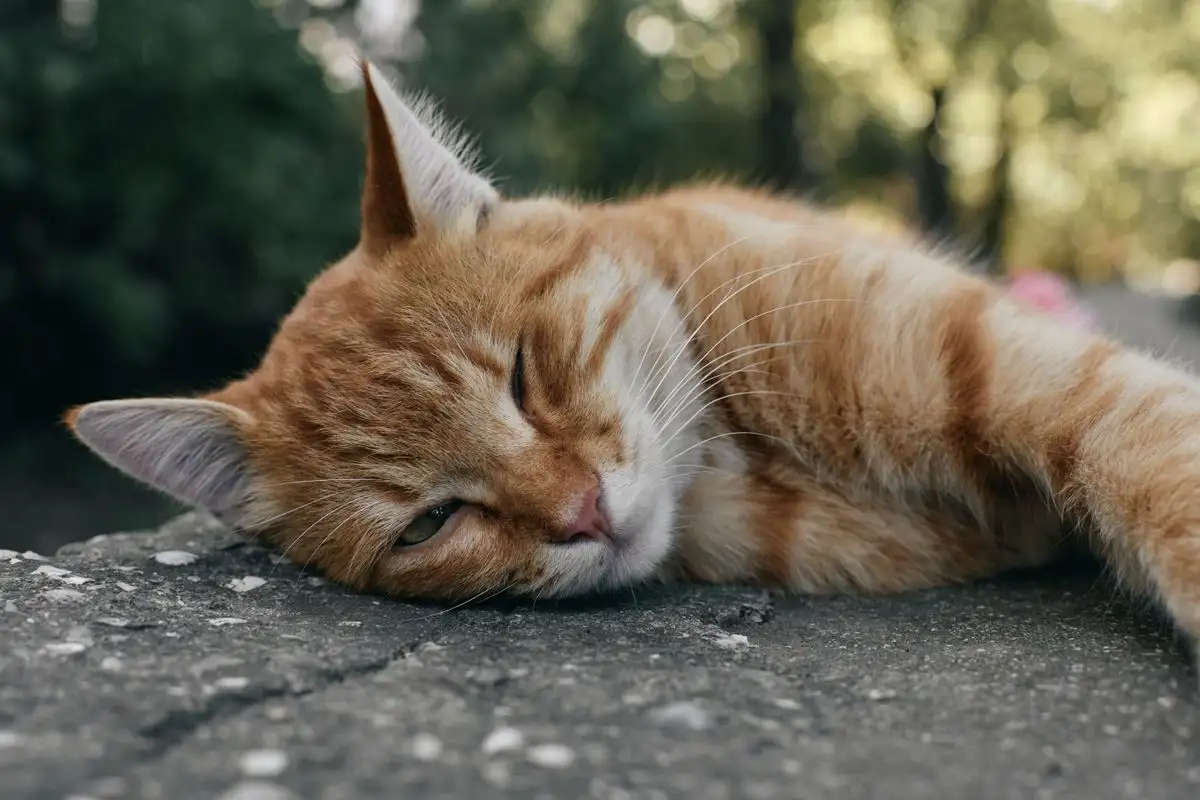
The first time someone said the thing out loud in my living room, I heard the entire misunderstanding in four words. My tabby was flat on the rug in a patch of late sun, eyes half closed, and his tail had started to travel — a lift, a pause, a soft thump against the floorboards, another thump. A friend reached toward him and said, "Look, he's wagging." I put my hand on her wrist. Not because the cat was dangerous. Because he was about three thumps from being finished with the conversation, and she was reading him like a golden retriever.
Stay on the rug with me for a minute. Look at what the tail was doing before the thumps. It had been lying loose and flat, the base slack where it met his spine. Then the base tightened. That's the first thing I notice and the thing most people skip past — not the tip, the base. A tail that firms up at the root is a tail that has been recruited for something. Then the tip started lifting off the boards, maybe two inches, and dropping back. Then the whole tail picked up the motion and began striking the floor hard enough that I could feel it through the floorboards in my knees.
That is not a happy dog. That is a dial being turned up.
Height comes first, and it's the reading people skip
When I walk in the door and my cat comes to meet me, the tail is straight up with a small hook at the tip, like a question mark made of fur, and the rest of him is soft — shoulders loose, ears forward and relaxed, the walk unhurried. That's the greeting. I trust it because every other part of the body agrees with it.
The trouble starts when people read the greeting version and then keep applying it as the tail changes. A tail held high but rigid, with the tip flicking in short, sharp arcs, is not the same message as a tail held high and gently curved. The height told you the cat is engaged. The stiffness and the flick tell you which direction that engagement is heading. I watch the shape of the curve, and I watch how much of the tail is moving versus how much is holding still. A tail where only the last inch is alive is a very different animal from a tail moving end to end.
And height drops matter just as much. A tail that sinks below the line of the back, or curls forward around a hip, or disappears underneath the body, is telling you the cat has pulled in. That can be fear, and it can also be that the floor is cold or the cat is stiff and settling into a position that hurts less. I don't try to sort those apart from the tail alone. I look at the ears — flattened and rotated out is a different story from ears simply relaxed and low — and at whether the cat is making itself small or just comfortable. Wrapped and tucked is a signal to slow down, not a diagnosis.
Then speed, then the tip
Speed is the second thing I check, and it's where the dog habit does the most damage. On a dog, a fast wag usually reads as more enthusiasm. On a cat, fast is not friendlier. Fast is further along.
The slow sweep and the lash are the same dial
Here's the piece I wish someone had handed me years earlier: the lazy tip that sweeps low across the rug and the full-tail lashing that clears a coffee table are not two different emotions. They're the same signal at two settings. Think of it as one scale. At the bottom, a cat is lying still with just the last two inches of tail drifting in a slow, almost sleepy arc — mildly interested, maybe mildly annoyed, still deciding. Move up and the sweeps get wider and quicker, the tip lifts higher off the surface, and the tail starts to involve more of itself. Keep going and you get the hard lash, the thump, the tail striking whatever is beside it. Same channel. Higher volume.
What that means practically is that you should stop asking "is he happy or angry" and start asking "where on the scale is he, and is it still climbing." A cat at the low end is fine to sit near. A cat whose tail has been accelerating for thirty seconds is a cat to give space to, even if nothing about his face has changed yet. The tail gets there before the face does. That's the useful part.
The tail that inflates
When a cat gets startled, the tail can go up and out like a bottle brush, all the fur standing away from the skin. People see that and assume the cat has decided to fight. He hasn't decided anything. That's piloerection, an involuntary reflex, the same category of event as the hair on your arms lifting when you're cold or spooked. The cat's body has been flooded and the tail is showing you the flood. What happens next is a separate question, and a puffed cat is usually a cat looking for an exit, not a cat choosing a target.
The practical takeaway: don't handle a bottle-brush cat, and don't read the puff as aggression. Give the exit. Most of the time the tail deflates in under a minute and the cat goes back to being a cat.
When the tail isn't talking about feelings at all
This is the correction I make most often, and it's the one that took me longest to internalize. The tail is a piece of equipment. It's a counterweight. Watch a cat walk a narrow railing, or turn midair off a couch back, or land from a height — the tail swings out and around to shift mass, and it can whip hard and fast while the cat is perfectly calm. Read that as emotion and you'll think your cat is furious every time he jumps off a bookshelf.
So the order of operations is: is the cat in the middle of a movement task? If yes, the tail is probably doing physics. If the cat is lying still, or standing still, or walking slowly, then the tail is doing communication, and the height-speed-tip reading applies.
Two cats at play is the other place the tail gets misread. When mine chase each other around the hallway, both tails are up and loose, and the whole thing stops every few seconds — one cat breaks off, they stare, somebody shakes, and then it restarts. Those pauses and the upright tails are what tell me it's play. What I watch for is the change: tails dropping and stiffening, one cat consistently backing away without returning, noise that doesn't stop. Play has a rhythm of on and off. Conflict doesn't.
What I actually do now
I narrate out loud, which sounds ridiculous and works better than anything else I've tried. "Base just tightened. Tip's going. Okay, he's done." Saying it forces me to look at the base and the tip separately instead of letting the whole cat blur into one impression.
And I build the scale per cat, not per species. Some cats barely move their tails at all and go from stillness to a single sharp flick with nothing in between. Some carry their tails high and loose by default and thump them while purring. None of the readings above are absolute rules, and anyone who tells you a specific tail position means one specific thing for every cat has probably not lived with many of them. What's reliable is the direction of travel: the tail firming at the base, the sweeps widening, the tip climbing. That part holds up across the cats I've shared a house with.
The habit worth unlearning is narrower than people think. It isn't that you're bad at reading cats. It's that you learned the tail from dogs, and a dog's wag is a social broadcast — an invitation to keep going. A cat's tail is a gauge. Once you're reading a gauge instead of an invitation, the same movement stops looking friendly and starts looking informative, which is far more useful. My friend's hand is still on the rug in my memory, stopped an inch from a tail that was already past the point of being touched. All it took was reading the base before the tip.