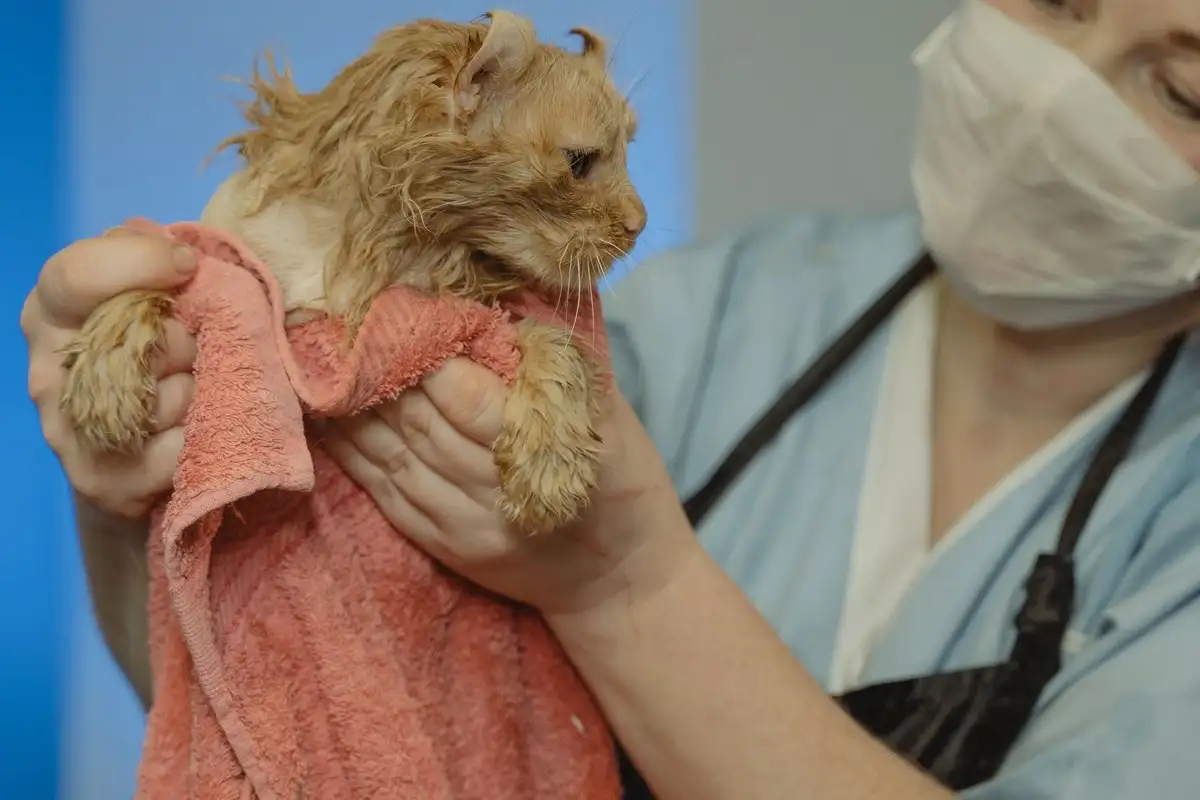
A bath at either end of a cat's life is less about soap than about heat and hands. A kitten that's still nursing shouldn't be immersed at all unless a veterinarian has told you to do it — at that size the body loses heat faster than it can replace it, and a soaking can pull the temperature down in minutes. A senior cat can be bathed, but almost everything about the procedure flips: the room has to be warm before the cat is wet, the floor has to stop sliding feet, and the pace has to stay slow enough that stiff hips are never forced. Same chore, two procedures that barely resemble each other.
Now put yourself in the bathroom with me. The door is shut. The mirror is already fogged because I ran the hot water for five minutes with nobody in the tub, and there's a towel in the dryer that I'll want in about ten minutes. Which cat is on the other side of that door changes everything that happens next.
Warm the room before you warm the cat
This part is the same at both ends of the life span, and it's the part people skip.
A cat runs warmer than a person does, so water that feels pleasantly warm to your wrist reads closer to lukewarm on a cat, and air that feels fine to you in short sleeves feels cool to an animal that's just gotten wet. Run the hot water until the room holds some steam. Shut the door. Put a folded towel on the closed toilet lid so nothing you touch is cold porcelain. Keep the second towel within reach of one hand — not the whole stack, one hand — because whether you're holding a four-week-old kitten or a nineteen-year-old with bad hips, one of your hands needs to stay on the cat the entire time.
For the kitten, that preparation isn't optional. It's most of the job.
A kitten bath is mostly a towel
Very young kittens and their mothers handle this between themselves. The mother's tongue does the cleaning, the drying, the stimulation, and the warming all at once. If you're raising an orphan, you're replacing all four of those things, and a sink full of water is the wrong tool for the work.
Here's the shape of it instead. A bowl of warm water. A folded washcloth wrung out so it's damp and not dripping. A dry towel already warmed. You work one small area at a time — face, then chest, then belly, then the back end where the mess usually lives — and you dry that area right away, short strokes in the direction the fur grows, before you move on to the next. The rest of the kitten stays covered the whole time. If the room isn't warm enough for the kitten to be briefly uncovered, the room isn't ready yet.
Two things decide whether you touch water at all.
The first is the kitten's condition. A soiled kitten that is also not eating, that feels cool along the belly and paws, that cries weakly or just lies there limp, needs a veterinarian before it needs a bath. That combination is a health problem wearing a grooming problem's clothes, and washing it doesn't change what's underneath. The second is fleas. Any flea or medicated product for a kitten is a conversation with a veterinarian, because the animal's age and weight are what determine what's safe — not the wording on the package, and not the fact that it worked on an adult cat.
A healthy kitten that got into something messy is a ten-minute job with a cloth and a warm towel. A kitten that's off in any way is a phone call.
For a senior cat, slow beats thorough
Swap the kitten out for an older cat and everything that made the kitten fragile is gone. What's replaced it is stiffness, a thinner coat, and a body that doesn't bend the way it used to.
Set up before the cat comes in. A rubber bath mat or a yoga mat flat on the tub floor, or just a folded towel so the feet have something to grip. Water ankle deep — enough to wet the paws, not enough to reach the belly. A cup for pouring instead of the showerhead, because the sound of a sprayer is a lot to ask of a cat that's already unsure on its feet. Then both hands free: one under the chest, one supporting the hindquarters. You never lift a senior cat by the scruff, and you don't lift it by the front legs alone.
Past that, slow down further than feels reasonable. Speed is not the goal. Not forcing a joint is the goal. If a hind leg won't extend the way you want it to, you wash around it and let it stay where the cat put it. If the cat would rather sit than stand, you work with a sitting cat. The bath takes longer and goes easier on both of you.
A lot of the time you won't do a full bath at all. A warm damp cloth, a few passes over the parts that need it, a warm towel dry, done. Spot cleaning is often the right call for an older cat, especially when you're only chasing the back end.
Which brings up the thing that matters more than technique. Senior cats often need help staying clean back there, and that's ordinary enough — less flexibility to reach, more coat in the way. What isn't ordinary is a cat who suddenly starts soiling itself, or who can't be kept clean no matter what you do. Persistent messiness is usually a mobility problem or a health problem, not a grooming failure, and it points to a vet visit rather than a longer bath.
The same goes for the coat. If an older cat's fur turns greasy, or dull, or unkempt over a few weeks, that isn't just age arriving. Kidney disease and thyroid disease are common in older cats and both change how a coat looks and feels. A sudden coat change in a senior is a reason to see a veterinarian, not a reason to try a different shampoo.
When the bath needs to wait
Boil it down to one rule that covers both ends of the life span: if the cat is soiled and also unwell, the veterinarian comes first and the bath comes after.
For a kitten, unwell means cold to the touch, limp, not eating, weak crying.
For a senior, unwell means messiness that appeared this week and wasn't there last week, a coat that changed over a few weeks, or a cat stiff enough that washing it looks like it would hurt.
Neither of those animals needs water. Both of them need an exam.
Two ends, two different jobs
Kittens fail at temperature. That's the whole vulnerability, and it's why the answer for a kitten is almost always less water, then less time, then less exposure. You aren't really bathing a kitten. You're cleaning it with the smallest amount of water that gets the job done, then getting it dry and warm as fast as humanly possible.
Seniors fail at stability. Their body temperature still holds, but their joints don't, their coats don't, and their ability to stay clean on their own doesn't. So the answer flips: more warmth in the room, more grip under the feet, more support from your hands — and far less insistence on a full bath when a spot clean would do the work.
Same sink. Same towels. Two sets of rules that don't overlap much at all, and the only way to get either one right is to know which cat you're holding before you turn the water on.