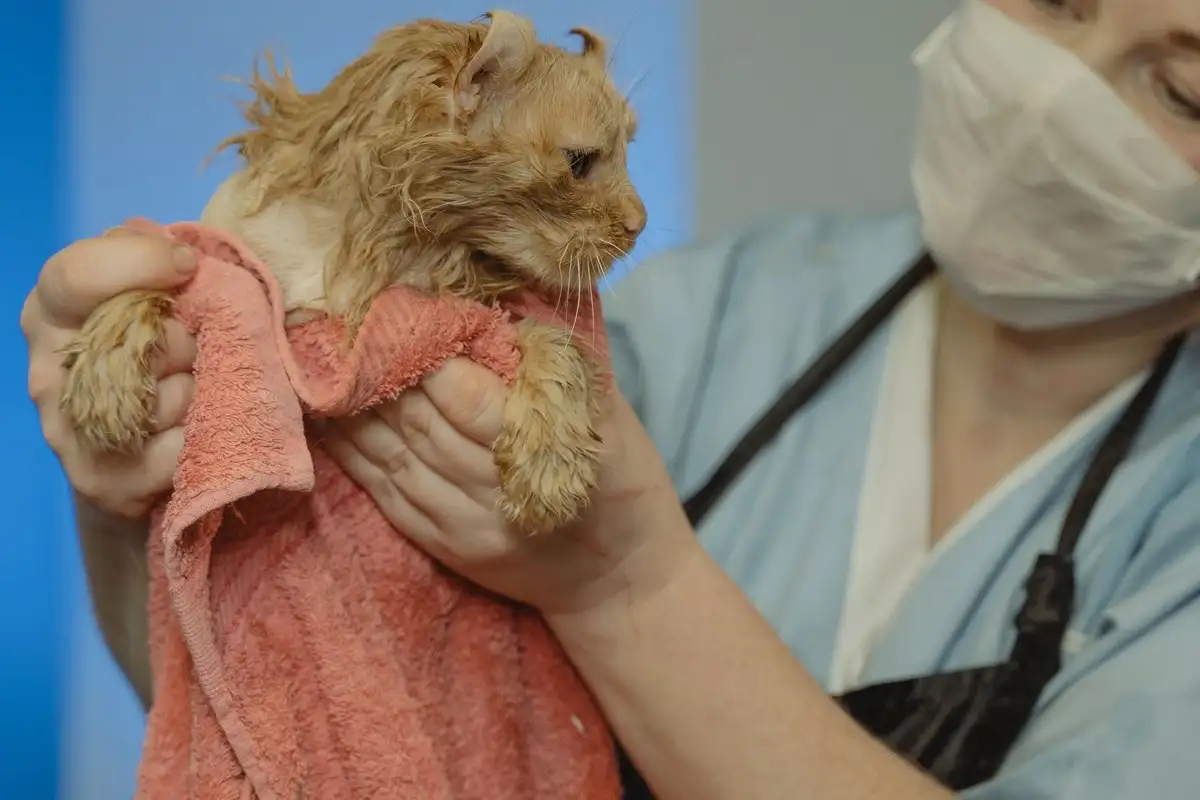
A cat needs a bath when something is on the coat that the cat cannot get off itself: a litter box accident, a sticky or greasy residue, or soiling in a spot its body can no longer reach. A cat does not need a bath for ordinary dust and floor grit, and a coat that stays greasy, matted, or foul-smelling after normal grooming is not a dirty cat. That coat is saying something, and what it is saying calls for a veterinarian, not a bottle of shampoo.
Kneel on the tile floor with me. It is late, the bathroom fan is rattling, and there is a gray tabby on a towel in front of me with a smear down one hind leg that I already know came out of the litter box. She is not hurt. She is insulted. Her ears are turned out at that flat angle, her tail is tapping the towel, and she is watching my hands rather than my face.
Before I touch the tap, I do the same thing every time. I run my thumb against the grain of the coat, from the hip down toward the tail base, and look at what comes off on my skin. Grit, a smear, a bit of something from the kitchen floor: we are in the sink-and-towel part of the evening. But if my thumb comes away greasy, or the fur underneath is clumped into a mat that has survived two weeks of brushing, the tap stays off. That is the dividing line, and most of what people read about cat bathing skips straight past it. I am not asking whether the cat is dirty. I am asking whether the problem is sitting on the coat or coming from underneath it.
What actually earns the water
The list is shorter than most people expect. A litter box accident where urine or soft stool has soaked into the fur. A patch of something sticky or oily the cat picked up on the floor or behind the stove, something that will not come out with a damp cloth and that she will otherwise try to lick out herself. A spot of soiling on a body part she cannot physically reach. Paint, sap, or a household substance, and here you stop and read further down before you turn on the tap.
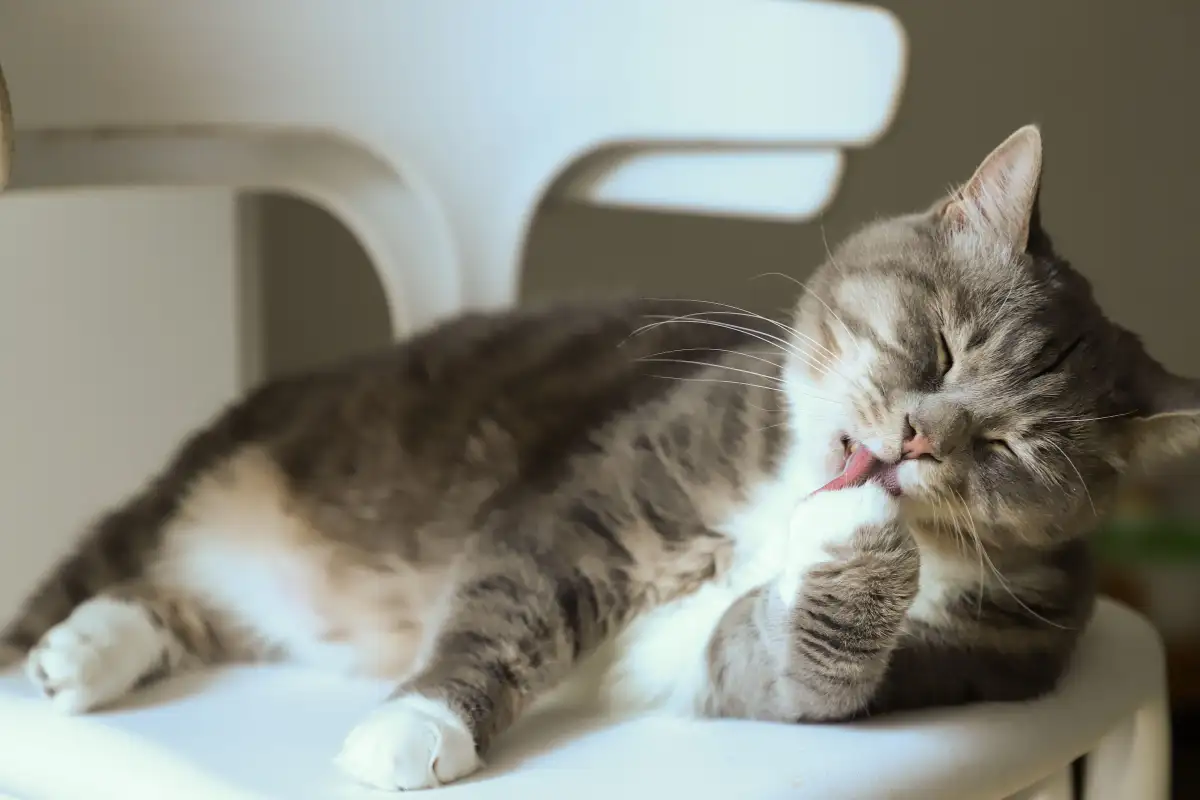
Notice what is not on that list: the everyday film of dust and dander that a healthy cat handles perfectly well on her own. A cat grooms through a good part of her waking day. She has a tongue built for it, a spine built for it, and a saliva-and-fur system that is more effective than most people give it credit for. Bathing a cat who is already clean enough does not make her cleaner. It strips what she has been maintaining and costs her a stressful hour.
That is before the skin itself. Frequent bathing with the wrong thing, or with anything at all, can leave a cat itchy and flaky in a way she was not before. If you like the smell of a clean cat, a warm damp washcloth over the parts she tolerates is usually plenty.
A rear end that is always dirty is a range-of-motion problem
This is the one I wish more people heard earlier. When a cat comes in with soiling concentrated at the tail base, the backs of the hind legs, the lower back — always the same place, again and again — the first thing to suspect is not laziness or a hygiene failure. It is reach.
Watch her groom. A cat with a sore hip or a stiff spine will wash her face and chest thoroughly and then stop, or make a half-hearted pass at one flank and quit. She is not neglecting the job. She cannot get there. Overweight cats hit the same wall for a different reason: the extra mass across the middle limits how far around she can curl, and the rear is the first place that shows it. Senior cats get there through both routes at once, a little arthritis and a little less flexibility each year.
So a bath is the right move for the mess. It is not the fix for the reason. If the same spot is dirty every week, I write down what I am seeing — which areas she is skipping, whether she is slower on the stairs, whether she hesitates before jumping up — and that goes to the vet with her. Sometimes the answer is pain management. Sometimes it is a groomer every few weeks plus a sanitary trim, which is a far kinder arrangement than a fight in the bathtub every seven days.
When the coat is the message, not the mess
Now the other side of the line. These are the things that make me put the shampoo down and pick up the phone.
A coat that stays greasy at the base of the tail or along the back no matter how consistently it is groomed. Mats that come back in the identical spot after being worked out. A dull, scurfy, patchy coat that used to be smooth. A smell that is not litter box and not the ordinary cat smell — a strong, sour, or yeasty odor that persists. Bald patches, especially symmetrical ones, or a cat suddenly grooming one area raw.
And the hard stop signs, the ones where no home bath happens at all: broken or open skin, redness, scabbing, crusting, a wound, or anything moving in the fur. Visible parasites — fleas, flea dirt, the scurf of mites — go to a veterinarian for identification and a plan, because washing a cat does not resolve an infestation and can make a skin that is already inflamed worse.
None of that is a bathing problem, and treating it as one wastes weeks. A greasy coat can sit on top of something hormonal or something dermatologic that I am not qualified to name. My job is to notice the pattern and hand it to someone who can. The bath, in that scenario, is a delay dressed up as action.
The things I will not wash off
If the substance on the coat is unknown, or is anything you would not want on your own skin, the order of operations changes completely. Do not start the water. Call your veterinarian or an animal poison control line and describe exactly what it is, how much, and where on the body.
Here is my reasoning, and it is not about cleanliness. A cat who has something on her fur will groom it off, which means anything on the coat is on a fast track to her mouth. Water can spread an unknown substance over a larger area of skin, or push it deeper, or react with it. And a cat who is already drooling, wobbly, vomiting, or dull is a cat who needs to be in a car, not in a bathtub — a bath first can cost you the window when treatment works best.
Bathing on instruction is a different thing entirely, and I follow that instruction to the letter, including which parts to avoid and whether it should be running water at all.
One more practical snag: if a topical flea or tick product has been applied recently, check the label or call and ask before any bath. Some products are compromised by bathing inside a certain window, and washing one off is not a neutral mistake. That is not a reason to skip a necessary bath — it is a reason to make one phone call first.
A prescribed bath is not a cleaning bath
When a veterinarian has diagnosed something and sent home a medicated shampoo, everything about the bath changes, because it is no longer cleaning. It is treatment, and it only works if it is done the way it was prescribed.
That usually means a contact time — the lather has to sit on the skin for a stated number of minutes while the cat complains about it — and a rinse that takes longer than you think, because residue left in a thick undercoat is both irritating and a reason the treatment fails. It means the prescribed frequency and no more. People tend to over-bathe when something is not clearing, and with a medicated product that can backfire. It also means the whole course, continuing after the skin looks better, for the same reason you finish any prescription.
If a vet-directed bath is not working, the answer is a call, not a second wash.
The mechanics, since you are already kneeling there
Lukewarm water, tested at the wrist. A rubber mat in the tub or sink so she has something to brace against — a slipping cat panics faster than a wet one. A plastic cup for pouring instead of a sprayer, because the sound of a spray head is what tips most cats over the edge. I keep the head and face out of it entirely and use a damp cloth there. Cat-formulated shampoo only, diluted a little, and never human shampoo, which is the wrong pH for her skin and drying over time.
Then the part people rush: drying. A wet cat loses heat fast. Warm room, real towels, and a second towel, and time in a quiet space afterward with no handling. Untangle any mats before water ever touches them — a mat that gets soaked tightens like felt, and scissors dug into a mat lying against skin is how cats end up at the emergency clinic with a slice they did not need. If a mat is that bad, a groomer or vet clips it.
And the honest tradeoff: for some cats the stress of the bath is the biggest risk in the room. A cat who screams, bites, and cannot be scruffed safely, or one with a known heart condition, may be better served by a groomer or a veterinary practice that can do it calmly. I have washed plenty of cats in my own bathtub and I have handed plenty of others to someone better equipped. Knowing which is which is most of the skill.
So the two questions, every time, before the tap goes on. Can she fix this herself? And is this on the coat, or coming from under it? Grit and a smear, answered the first way, get warm water, a towel, and twenty minutes. Grease, mats, odor, broken skin, or something you cannot identify get a phone call, and sometimes that call is the only thing standing between a small problem and a long one.