Low-shedding cats are not hypoallergenic. The allergen behind most cat allergies is Fel d 1, a protein produced in a cat's saliva, sebaceous skin glands, and urine — not in the hair itself. A cat that drops almost no fur still grooms itself constantly, spreads that protein across its skin, and releases microscopic dander into the air and onto every soft surface in the house. Coat type changes how the protein gets delivered, not whether it gets delivered, and no major veterinary or allergy organization recognizes any breed as hypoallergenic.
I keep a stack of white microfiber cloths in the foster room for exactly this. Wipe one across the windowsill in a room where a cat has lived for two weeks, hold it up to the afternoon light, and the cloth goes grey-brown. Run your thumb over that film. It is not fur. Most of it is dander and dried saliva protein, and I have gotten the same smear from a thick-coated Siberian mix and from a Sphynx with nothing but peach fuzz.
That is the whole argument, and it took me years of fostering to stop arguing with it.
A woman who had sneezed around cats her entire life came to meet a big, brown, double-coated foster of mine. She sat on the floor for forty minutes. The cat leaned on her leg, she scratched his chin, everything was fine, and she started talking about the paperwork. Then her eyes went pink and she reached for the tissue box in her bag. She looked at me and said, "But this is one of the hypoallergenic ones, right?"
I used to answer that question with a breed chart. Now I answer it with the cloth.
The hair is just the delivery truck
Here is the part people skip. A cat grooms itself many times a day. Every stroke of the tongue lays saliva against the skin and coat, the saliva dries, and the dried flakes break loose. Those flakes are dander, and they are small enough to hang in the air for hours and to ride the HVAC into rooms the cat has never entered. The Fel d 1 protein sits on those flakes and on the skin oils.
So when someone says a cat is low-shedding, they are describing the size of the truck. They are not describing the cargo.
I think about it as a schedule rather than a dose. A long double coat holds the protein against the body and lets it go in bursts, especially when the seasons turn and the undercoat blows out. A short single coat releases it steadily and quietly, which is why people underestimate short-haired cats. A hairless cat releases it in oil, directly onto whatever it sleeps on.
Which brings up the thing nobody warns you about before you bring home a hairless cat.
Why the naked ones still set off allergies
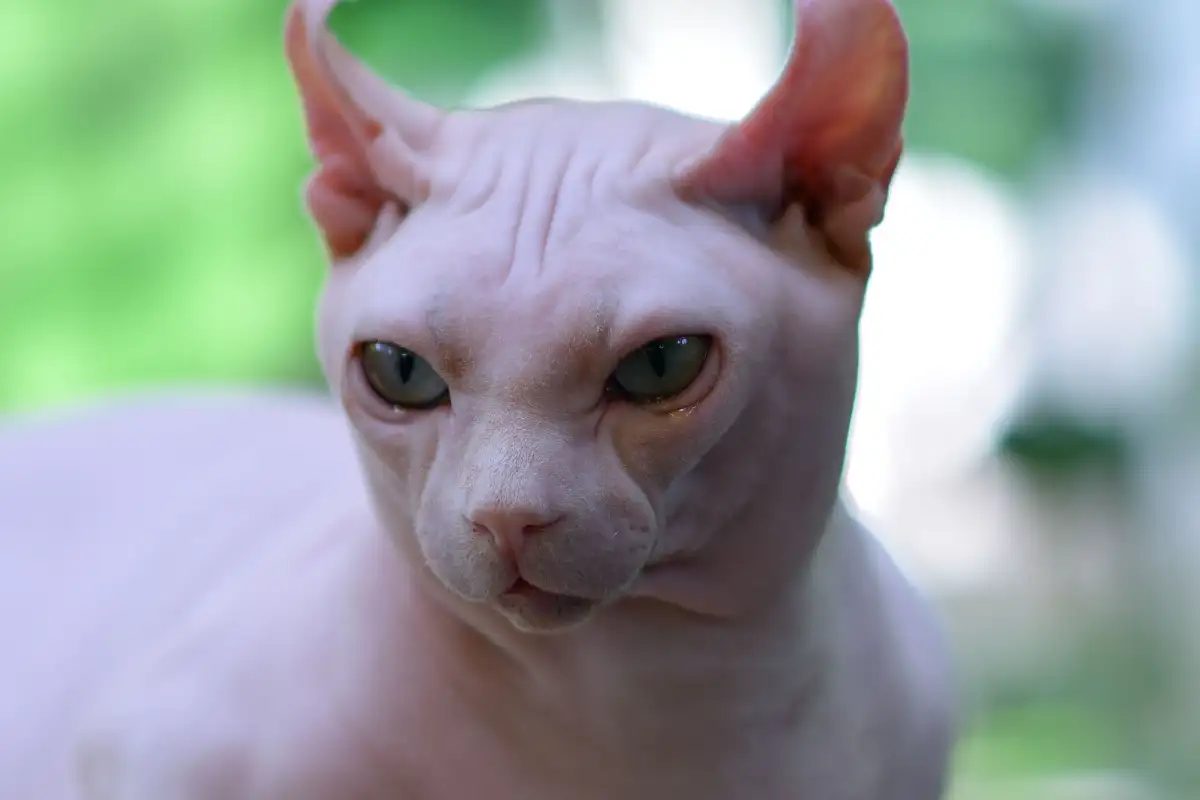
Sphynx and other hairless breeds do not have fur to absorb the oils their skin produces, so the oils accumulate. They need regular bathing, and between baths they leave a faint brownish film on white pillowcases and light-colored couch cushions. I have scrubbed that film off a microfiber throw more than once.
That film is the allergen, sitting where you sit. A hairless cat produces Fel d 1 like any other cat, still grooms with the same saliva, still produces dander from the same skin glands, and simply distributes it through contact instead of through shed hair. If anything, the protein ends up concentrated on the cat's skin and on the surfaces it presses against, rather than drifting loose in the air.
People hear "hairless" and picture an empty allergen account. The account is not empty. It is just being spent differently.
What the breed reports actually mean
Siberians and Balinese are the two breeds that come up most often when someone is shopping for a cat they hope to tolerate. There are genuine reports of individual cats of these breeds producing lower Fel d 1 levels, and I do not dismiss them. I have met Siberians that a cat-allergic friend could sit beside comfortably for an hour.
But the variation inside a breed is wider than the variation between breeds. A high-producing Siberian and a low-producing domestic shorthair are both entirely possible, and you cannot tell which you have by looking at the pedigree. Anyone who tells you a breed is guaranteed is selling you something.
Neuter status matters too. Intact males tend to run higher on Fel d 1 than neutered males, which is one of the reasons a kitten can seem fine and then seem less fine a year later. Kittens also produce less overall. A cat's allergen output is not a fixed number printed on a registration certificate; it changes with age, hormones, and the individual animal.
What actually moves the number in your house
Once I understood that the protein is sticky, light, and everywhere, I stopped optimizing the cat and started optimizing the room. That is where the real gains are.
- Textiles are reservoirs. Curtains, upholstered headboards, throw pillows, area rugs, and mattress pads hold dander and give it back slowly. Hard floors and washable covers are not glamorous, but they are honest.
- The bedroom door is the biggest lever. Every cat owner I know who manages allergies well has made peace with one closed door. Eight hours a night in a cat-free room is a large chunk of your life.
- Air movement cuts both ways. A running HEPA purifier in the main room helps. A cheap vacuum with a leaky bag can throw settled dander back into the air, so I look at the filter before I look at the suction.
- Grooming is a controlled burn. Brushing, and for some cats bathing, removes protein before it lands on your couch. I brush my fosters outside or near an open window, wipe them down with a damp cloth, and wash my hands afterward, not because the cat is dirty but because the protein is transferable.
- Hot water and repetition. Bedding and cat beds get washed regularly in the hottest water the fabric allows. Damp dusting beats dry dusting for the same reason a wet cloth beats a feather duster.
None of this makes a cat allergen-free. It lowers the load in the room, which is the only number you actually live inside.
Test the cat, not the label
If you are going to spend time with a specific cat before committing, do it properly. One visit in a clinic lobby tells you almost nothing, because the cat is not grooming and rolling on its own furniture there.
Go to the cat's actual home. Stay at least half an hour, closer to an hour. Sit on the couch, handle the cat, and then leave without showering immediately. Note how you feel six and twelve hours later, because reactions are often delayed. Go back a second time, ideally on a different day and in a different season. Ask the foster or rescue whether the cat is intact, how old it is, and how much it grooms.
And if a friend with allergies is coming along, that blanket in a plastic bag trick is worth doing — take home a blanket the cat sleeps on, keep it sealed, and open it in your own living room. Your house is the environment that matters, not the foster's.
If you already know you react to cats, talk to a physician about your own situation before you build a household around one. That conversation is not something a breed guide can have for you.
What I tell people now
I tell them that the word hypoallergenic should not be on a cat listing at all. What exists is a range: some cats produce more Fel d 1, some produce less, and every home either concentrates that protein or ventilates it away.
The right question is not "which breed does not shed." It is "which individual cat, in which house, with which habits." The woman on my floor found her answer in a second visit to a different foster, a short-haired cat who happened to be a low producer, in an apartment with no carpet and a bedroom door that stays shut. That cat sleeps on her bed now. She still keeps tissues in her bag. Both things are true, and that is what the breed chart never tells you.