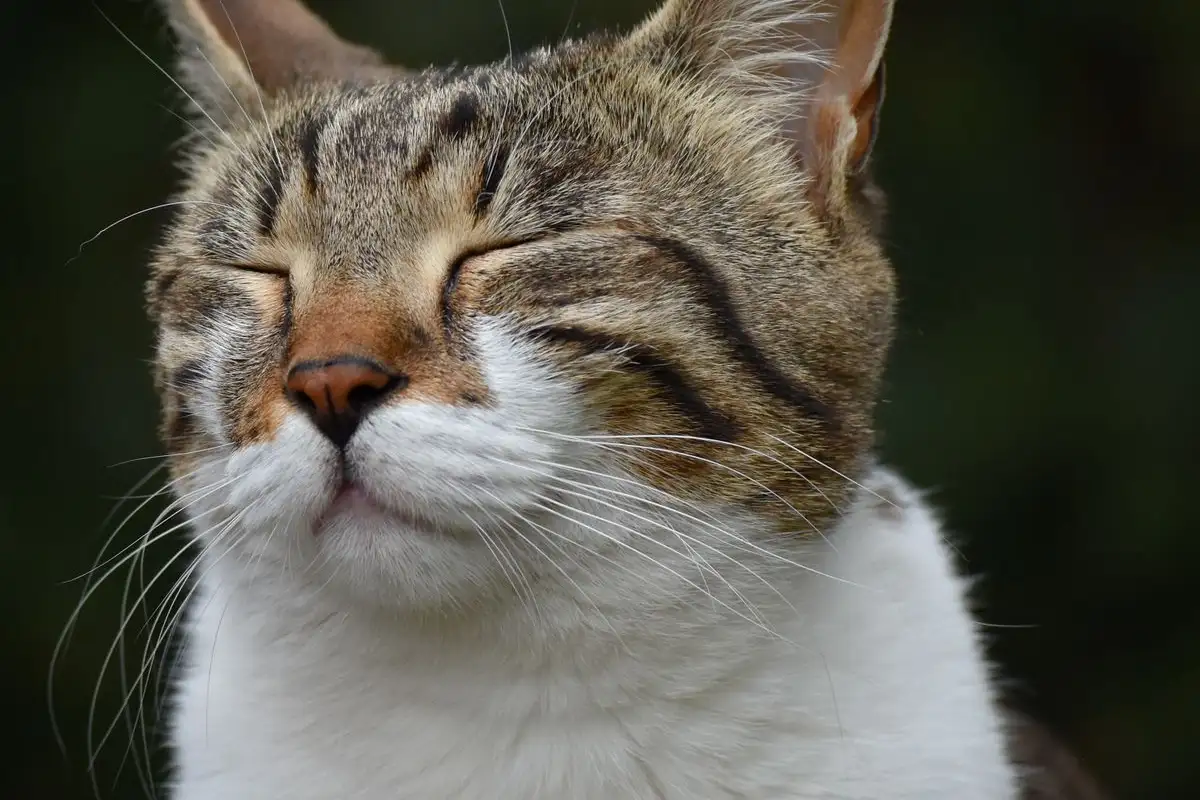
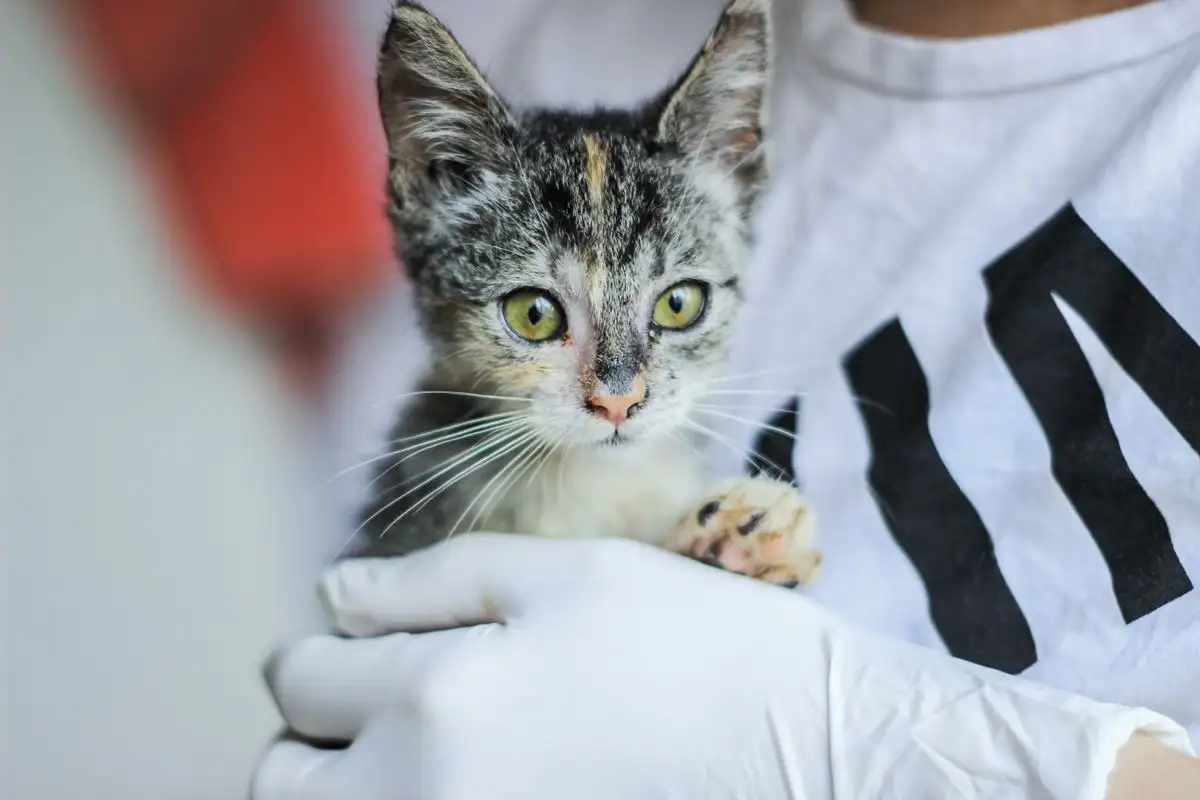
Persistent sneezing that comes out of one nostril — the same nostril, week after week — almost always means something is sitting inside that nasal passage, not that the cat has a body-wide infection. The list of things that behave that way is short: a foreign body, a benign growth like a polyp, or an infected upper tooth root pushing up into the nasal cavity. Every one of them sits where it cannot be seen from the outside, and that is the whole reason a vet takes the sign more seriously than the owner does.
I figured that out on my hands and knees, at 6:20 in the morning, with a mug of coffee going cold on the counter behind me.
The wall told me before the cat did
The cat was under the table by the window, doing the thing he did every morning after breakfast — the head-down, eyes-half-shut, back-end-up stretch. Then he sneezed. Not a big one. A small, wet, unsatisfying sneeze, the kind that ends with him licking his nose and looking mildly annoyed.
What caught me was the cabinet door.
There was a spray pattern on it, low down, at about the height of a cat's head when he's sitting. A fine fan of droplets, fading out toward the edges. And all of it — every bit of it — was on the left side of where he'd been sitting.
I wiped it with a paper towel and thought about it for the rest of the morning.
The next day it happened again. Same cabinet door, same side. By the end of the week I'd started crouching in front of him in the good light from the window with my phone flashlight held flat against his cheek, angling the beam along the side of his muzzle so I could see the rims of both nostrils straight on. The left one was wet and slightly narrowed. The right one was dry and perfectly normal. He was breathing through the right one like nothing was wrong.
That was the moment I stopped calling it allergies.
Both sides or one side is the first real question
Here's the thing about sneezing. Most of what makes cats sneeze is a whole-body or whole-airway situation — a herpesvirus flare, dust, smoke, a fragrance plug-in, the dry air that shows up every January when the heat comes on. Those hit both nostrils. Roughly evenly. They come and go. A cat with a herpes flare will sneeze on Tuesday, be fine Thursday, and start again next month, and both nostrils are wet when it happens.
One-sided sneezing doesn't do that. It's steady. It's the same side every time. And that asymmetry is doing most of the diagnostic work for you, because it means the problem is physically localized to one passage.
One caveat before you build a theory: a cat that always sneezes with his head turned the same direction will throw spray to one side of the room even if both nostrils are involved. So don't judge by the wall alone. Watch him from the front. Get low, get in good light, and look at both nostrils at once.
What actually fits in a nostril
The differential here is short. Short enough that I've stopped being surprised when a vet rattles it off in the first two minutes of the exam.
A foreign body. This is the classic. Foxtail, grass awn, a seed head, a dried blade of grass, a chunk of litter, a bit of pine needle the cat inhaled at the wrong moment while sniffing the ground. Cats sniff everything. They also do that thing where they hold their nose an inch off the floor and inhale hard. When something catches, it lodges in the passage and stays there. The sneezing that follows can be dramatic — fits of it, sometimes with blood in the discharge, sometimes with a smell — or it can be a low-grade thing that shows up for ten seconds after the cat eats. Either way, it doesn't resolve on its own.
A polyp or another benign growth. These turn up more often in young cats, which is part of why owners dismiss them. A six-month-old who sneezes from one side gets told he'll grow out of it. A polyp is a fleshy mass in the passage, and what it does is block airflow. You may hear it — a whistle or a snuffle on that side when the cat breathes, or a louder noise when he's asleep. He may paw at that side of his face or shake his head.
An abscessed upper tooth root. This one is why I always ask about the mouth. One of the big cheek teeth in the upper jaw has a root that sits directly below the floor of the nasal cavity, close enough that an infection at the tip can drain upward into the nose. The result is sneezing and discharge on the same side as the bad tooth — and often the tooth looks completely normal when you open the cat's mouth at home. You can't see a root. That's the trap. A cat with a bad upper tooth root under his nose may also eat carefully, drop kibble, or chew on one side, and those little behaviors are easy to write off as a cat being a cat.
And then a few things nobody wants on the list, which is the other half of why the exam matters. Not every one-sided nasal condition is benign, and the earlier someone looks, the more options there are. I'm not going to pretend I can tell the difference from the outside. Neither can you. That's the point.
Why you can't see it, no matter how good your flashlight is
The nasal cavity is a tunnel. What you see when you look at your cat's face is the front door. The things that cause one-sided sneezing live in the hallway, around a bend, behind structures that don't move.
There's a wrinkle that explains some of the odd signs. The duct that drains tears from the eye empties into that same nasal passage. So a problem on one side of the nose can show up as a weepy eye on that side — a cat with a permanently tear-streaked left eye and a sneezy left nostril is telling you something coherent.
To actually see inside, a vet usually needs more than an exam room and a good light. Sometimes a small scope. Sometimes imaging. Sometimes both. That isn't a dramatic escalation — it's the geometry of the problem. You cannot examine the inside of a tunnel by looking at the outside of it.
The three things that turn this from "wait" into "today"
I've watched and waited on plenty of cat symptoms. I'm not the person who runs to the vet over a hairball. But there are three signs on top of one-sided sneezing that I don't wait on.
Blood. Not a pink tinge once — blood that keeps showing up, or a real streak of it.
Facial swelling. Under one eye, over the bridge of the nose, or any place where the shape of the cat's face is just slightly different than it was last week. Stand behind him and look at the top of his head. Asymmetry there is a serious sign.
A bad odor. One-sided nasal discharge that smells foul, or breath that smells wrong on the side that's sneezing. Cats have stinky breath for a lot of boring reasons, but a one-sided smell paired with one-sided sneezing is not boring.
If it's just sneezing, one side, no blood, no swelling, no smell — it still needs to be looked at. But it's a get-an-appointment thing, not a drive-to-the-emergency-clinic-at-2-a.m. thing.
What I write down, and why
I keep a note on my phone from the moment I notice. Date. Which side. What came out — clear, cloudy, bloody. Whether it was a single sneeze or a fit. Whether I heard anything on that side when he was asleep. Whether he's eating normally. Whether the eye on that side is tearing.
This is not because I'm organized. It's because by the time I'm standing in an exam room with a cat in a carrier and a vet asking when this started, everything I thought I knew turns to fog. Two weeks feels like two months. I mix up the sides. The note is the only thing in the room that's reliable.
Writing it down does something else, too. There's real value in being the person who says, "It's been the left side, steadily, for nineteen days, and here's what I saw." That's not a vague complaint. That's a sign with a shape to it, and a vet can work with it.
The part I got wrong for years
I used to think the wait-and-see approach was the cautious one. Give it time. Don't be the owner who panics over a sneeze.
What I understand now is that the one-sided pattern is itself the finding. It's the most useful piece of information the cat is going to hand anybody, and it has a shelf life. While you're waiting, the passage keeps reacting to whatever is in it. Inflammation spreads. Discharge thickens. The clean, obvious it's-only-the-left-side story turns into a messy bilateral one, and now the vet is sorting through a much longer list.
The reason vets take one-sided sneezing seriously isn't that it's automatically something terrible. It's that the sign points to a short list of causes that all live inside the nose, all need eyes and sometimes imaging to find, and none of them resolve because you ignored them. You're not being dramatic. You're handing over the one clue worth having, before it gets muddled.